Walking is one of the most powerful health tools we have. It improves cardiovascular fitness, boosts mood, sharpens cognition, and can even be a predictor of how well you’ll age. But all those benefits depend on something we rarely think about until it starts hurting: our feet.
For many of us, walking is so automatic that we never consider the mechanics that make it possible. Yet the way we move, the shoes we wear, and the strength of the muscles in our feet can have a profound impact on how comfortably and efficiently we walk. When something goes wrong at our physical foundation, the effects can ripple upward, leading to pain not just in the feet, but in the knees, hips, and back.
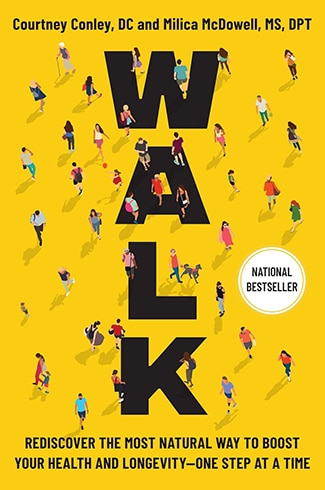
My guest today is Dr. Milica McDowell, a physical therapist and the co-author of the new book Walk. Today on the show, Milica explains why walking speed may be a hidden vital sign, what gives you your signature walking style, and how to spot and address injury-inducing inefficiencies in your gait. We then talk about feet: whether you should worry about pronation, how to rehab plantar fasciitis — and no, it’s not stretching — the best kind of shoes to wear, and much more.
Resources Related to the Podcast
- AoM Article: Solvitur Ambulando — It Is Solved By Walking
- AoM podcast episode with Manoush Zomorodi
- AoM Article: I Started Taking a Walk Every Morning. Here’s What Happened to My Health
- AoM Article: 20 Rules for Walking
- AoM podcast episode with Matt Fitzgerald
- Altra shoes
- Vivobarefoot
- Lems shoes (this is the pair Brett wears)
- Tyr weightlifting shoe
- Injinji toe socks
- Toe spacer
- Study on calf raise standards
Connect With Milica McDowell
Listen to the Podcast! (And don’t forget to leave us a review!)




Listen to the episode on a separate page.
Subscribe to the podcast in the media player of your choice.
Transcript
Brett McKay:
Brett McKay here and welcome to another edition of the AoM podcast. Walking is one of the most powerful health tools we have. It improves cardiovascular fitness, boosts mood, sharpens cognition, and can even be a predictor of how well you’ll age. But all those benefits depend on something we rarely think about until it starts hurting our feet. For many of us, walking is so automatic that we never consider the mechanics that make it possible, yet the way we move, the shoes we wear and the strength of the muscles in our feet can have a profound impact on how comfortably and efficiently we walk.
When something goes wrong at our physical foundation, the effects can ripple upward leading to pain, not just in the feet, but in the knees, hips, and back. My guest today is Dr. Milica McDowell, a physical therapist and the co-author of the new book Walk. Today on the show, Milica explains why walking speed may be a hidden vital sign, what gives you your signature walking style and how to spot and address injury-inducing inefficiencies in your gait. We then talk about feet, whether you should worry about pronation, how to rehab plantar fasciitis, and no, it’s not stretching the best kind of shoes to wear and much more. After the show’s over, check out our show notes at AoM.is/walk. All right, Milica McDowell, welcome to the show.
Dr. Milica McDowell:
Hi Brett, thanks for having me.
Brett McKay:
So you are a physical therapist and you’ve recently co-authored a book all about the benefits of walking. Why is a physical therapist so into walking?
Dr. Milica McDowell:
Well, it’s one of the things that we spend a lot of time in our careers helping people restore. When you’ve had an injury, a surgery, an unexpected accident, walking is one of the things that we push immediately. You have a baby, guess what we do? We take you for a walk right afterwards; you have a total knee replacement, some physical therapist is going to come popping into your hospital room and say, “Hey, let’s get you sorted out. Let’s take you for a walk.” So walking is really one of our fundamental movements that demonstrates balance. It demonstrates coordination, it demonstrates can you follow directions. And so it is really one of those things that is a vital sign for your human existence.
Brett McKay:
It’s something we take for granted until we have those moments in our lives where walking becomes painful and then you become painfully aware that, oh man, I got to think more about this. I can’t take this for granted anymore.
Dr. Milica McDowell:
Absolutely. I mean, you can not get up and make yourself a cup of coffee or use the washroom easily if walking is limited. And for me, that was an experience I had in high school. I had a sports injury that was misdiagnosed. I spent almost a year out of sports, six months not walking, and it was absolutely eye-opening as a 16-year-old who was hoping to play sports in college, that having a foot injury and not being able to walk just completely changed my entire paradigm.
Brett McKay:
So we’re going to talk about some of the things that prevent us from walking effectively, injuries, how to prevent those, how to rehab injuries. But before we do, let’s just talk about the benefits of walking. We had Manoush Zomorodi on the podcast a little while ago who talked about the benefits of walking even in short bouts. But let’s do a little refresher. Why is walking so good for both our bodies and our minds?
Dr. Milica McDowell:
If you don’t walk, it’s kind of similar to sleeping like trash or breathing poorly. So if you aren’t getting enough walking in your daily life, you aren’t accumulating that rhythmic movement. Your health from a physical side and a mental side can just absolutely go down the drain. And so we really want to emphasize and remind everybody that this is just at your fingertips. A little bit goes a long way. So when we think about the physiological health benefits, if you even go for a five minute walk, so we call that a micro walk, usually that’s about 500 steps for most individuals. We’re strengthening your bones, we’re contracting your muscles, we’re reducing your blood pressure. We can help with blood sugar. It helps with mood. And so as we think about our ability to take control of our health, walking is just so readily available. It’s at our fingertips at all times.
And then on the mental health side, when we think about the psychological and cognitive benefits of walking, as soon as you go for a walk, it boosts your cerebral blood flow. So you’re getting all sorts of healthy oxygen and hormones and temperature change to your brain that not only helps reduce your cortisol, it boosts your dopamine and serotonin. So it’s like kicking in those happy hormones that we’re all looking for, and it actually promotes something we call neurogenesis, which is activating neurological growth factor in your brain. So walking strengthens and improves the health of your brain. It improves the function as well.
Brett McKay:
Typically, when we think about walking for health, a lot of people focus on the number of steps we should get in a day. And I think people probably heard it by this time, it’s like it’s not 10,000 steps. That was a marketing thing by some pedometer company. A Japanese company said, oh yeah, you should get 10,000 steps. But it’s like if you get 7,000 to 8,000 steps, you’re probably good. But I thought it was interesting, you guys in this book talk about a walking metric that seems to tell us more about our overall health and robustness more than the number of steps we walk in a day and that’s walking speed. Tell us about this research. I thought that was really interesting.
Dr. Milica McDowell:
Yeah, so walking speed was identified more than 10 years ago as the sixth vital sign. And when we think about vital signs, if you go to the doctor today, they’re going to poke you, and they’re going to take your heart rate, they’re going to take your blood pressure, they’re going to look at your respiration rate, we might take your blood oxygen. So we have a series of vital signs that are predictive. They tell us if you’ve got an elevated heart rate and you’ve got elevated blood pressure as a healthcare provider, I need to dig deeper. And it was almost 15 years ago now actually that walking speed was characterized as another vital sign, meaning it has high predictability for problems down the road. The slower you walk, the higher your risk of dying. And it sounds dramatic, but it is one of those things that then when you start to connect the dots and think, okay, do I have a friend or family member or an elder or someone I know who, gosh, they do walk really slowly, why is that?
Are they afraid of falling? Do they have a balance issue? Are they starting to have a neurocognitive issue where it’s hard for them to coordinate the movement? Do they have musculoskeletal problem? Do they have a systemic disease? What the heck is going on? And so when we think of vital signs, this is one that should be held in high regard. And it is definitely something that when you go to a rehab pro, a PT, a chiropractor, some of the general practice physicians are kind of in on this secret. This is definitely something that we want to pay attention to.
Brett McKay:
Do we know what an optimal walking speed is?
Dr. Milica McDowell:
So we like to say that about a hundred steps a minute is pretty typical, and between 120 and 130 is what we consider to be brisk. So if you and I are in an airport and we are not late for a flight, we’re probably going to be walking around a hundred steps a minute. But if we’re like, oh, I think they’re boarding, let’s go, most people can kick it up to that 120 to 130. And a good way to test that is if you have access to a treadmill is hop on and just do a step count. So you’re counting each strike right, left, right, left, right, left. And you want to just sort of see what feels comfortable to you. Most normal sized adults, so if you’re not like six foot 10 or four foot 10, most of us that are kind of in that normal center of the bell curve are going to be walking at about three and a half to just under four miles per hour if we’re walking at that 120 to 130. So if you’ve ever walked on a treadmill at that pace, you’re kind of cooking a little bit.
Brett McKay:
Gotcha. Alright, so walking speed. I love that. So that’s the sixth vital metric that we should focus on. Correct. This was interesting. You had this whole section. I thought this was really a lot of fun about us having a signature walking style or signature walking pattern. I didn’t think about that, but it’s true. I think everyone has their own unique way of walking. I mean, one of the things that I can do with my family, if we’re at the airport for example, or out in a crowd, I can recognize people or recognize the people in my family by the way they walk. So how do we develop this signature walking style that we have?
Dr. Milica McDowell:
Well, it’s a culmination of our good habits and our bad habits. And so I love a good airport. I travel a ton for work, and I am an absolute creeper. I watch people walk, I judge anyone wearing a stiletto. If you’re wearing a stiletto in an airport, I’ve got my eyes on you and I’m just going to say it here and now. I know this audience is mostly guys, but maybe you can influence your gals in your life. Stilettos are the new smoking. They’re terrible for your health. They are absolutely something that you should not buy the women you love. Stilettos, please, and thank you.
Brett McKay:
Who’s wearing Stilettos at the airport?
Dr. Milica McDowell:
Oh my gosh. The next time you’re there, you just take a look my friend and you will be as appalled as I am. Wow. Because what happens if you need to go 120 to 130 steps a minute because they’re boarding, you’re going to miss your flight girl. But at any rate, I love being in an airport. I love observing other humans as a physical therapist. That’s just a big part of my curiosity as a human. And so yes, people have signature walking patterns and they are a culmination of all the good things and all the bad things and all the old injuries and everything that kind of brings you to waking up this morning, all that accumulation of your life. Think about this. If I’m your boss and you come into my office and I give you a raise and I give you another 20% bonus, how are you going to walk out of my office head held high confident, probably brisk a little bit of a spring in your step.
Not quite Connor McGregor walking into the octagon, but you’re going to have a pep in your step. But if you come into my office and I say, look Brett, this isn’t going well. I’m really disappointed in your performance and you’re missing your KPIs, and I’ve got really significant concerns about your future at this company. When you walk out of my office, things are going to look very different. Your posture will look different, your speed might look different, pace is going to be different. And so walking tells us a lot about what happened to you in the past and it tells us a lot about how you’re doing today. Another part of walking signature is it kind of tells us a little bit about your health history. So if you’ve had a leg fracture, if you’ve sprained your ankles 77 times, if you’ve got a leg that’s shorter or longer than the other, if you’ve got low back pain or a limitation in how your pelvis moves, I mean a physical therapist can certainly tell that’s what we’re trained in. But if you’re a lay person, an average Joe, and you’re in the airport and you see someone walk by and you’re like, huh, that doesn’t quite look right. You’re not necessarily able to diagnose or pinpoint the problem like I could. But what you are seeing is a lack of efficiency. And when you see somebody that maybe swings an arm a little differently or they’re wobbling side to side, or you can hear one foot scuffing differently, oftentimes what that means is there’s something imbalanced and an imbalance typically belies an inefficient gait.
Brett McKay:
I want to talk more about having an efficient versus inefficient gait, but one more thing about walking style. So I was listening to Pandora the other day and the Frankie Vallie and The Four Seasons song came up, “Walk Like a Man” – this is the Art of Manliness podcast. We got to talk about this. Do men and women walk differently?
Dr. Milica McDowell:
Absolutely. Absolutely. Men and women, if I saw a skeleton, I’d be able to tell you if it was a man or a woman. And we have significant anatomical differences. And those differences then influence our movement patterns, our postures. And so absolutely. I think too, especially in the US, men tend to be taller, men tend to be heavier, men tend to have more muscle. And so you’re moving a different machine than a woman is. And so yes, the gait pattern, an efficient gait. So an ideal gait is going to be similar regardless of gender, age, height, weight, you name it. But overarchingly, you could probably de-identify a person for me and most clinicians, and we’d be able to tell you roughly height, weight, and gender just by watching their walking pattern.
Brett McKay:
Yeah. One thing I’ve read is that men tend to move their shoulders more while walking than women do.
Dr. Milica McDowell:
Yeah. So when you think about what’s sort of acceptable posture wise in America, and if you lined up a group of guys and gals, most people are going to lift up their shoulders and kind of get tall and suck in their belly because of some sort of arbitrary beauty standard. And what you’ll tend to notice is women tend to minimize some of that sway. We tend to really suck in that belly to try to look snatched if you will and the guys are like, I’m just trying to get from point A to point B, and I’m trying to do it with some level of style. And so when you see more shoulder movement in a guy or in a gal, what’s happening is they’re creating more rotation. Rotation makes you more efficient. And so a man typically is going to walk a little faster than a gal. A man’s typically going to have a longer stride length and less, he’s significantly shorter than a comparable woman. And so men are generating more force and more momentum partially because of the anatomy, partially because of muscle and partially because of culture as well.
Brett McKay:
Yeah, that’s interesting. Culture, the way we think about sex and gender and a culture can influence even the way we walk, which is interesting.
Dr. Milica McDowell:
Absolutely.
Brett McKay:
I want to talk more about this efficient and inefficient walking. So you mentioned there’s some things you can look at when someone’s walking to figure out whether or not they’re walking efficiently or inefficiently. If you’re seeing arm movement kind of off, maybe they’re not moving one arm, that could be a sign. What are some other signs of inefficient walking?
Dr. Milica McDowell:
The best place to assess this is if you have access to a treadmill. And what’s kind of fun about walking on a treadmill is you can not only hear the walking pattern, you can see the walking pattern and inefficiencies come in about a billion different ways. I had a good friend who I was training for a marathon with and he kept complaining of shoulder pain. And this guy was like an All-American track athlete, total stud. He’s jacked, he’s fit, he’s smart. He’s one of those people that’s like an ideal patient. They do anything you ask him to do. I’ve got this shoulder pain, it’s killing me. It’s killing me. So I was like, all right, you’re this stud athlete. Let’s bring you into the office and see what’s going on. So I put this guy on a treadmill and he’s a marathoner. He is an all American, he’s a total stud when it comes to running.
I get him walking on the treadmill and I’m standing behind him. And if you have a physical therapist in your life, we’re always watching you with love, but we are. And so I put this friend of mine on the treadmill and I’m standing behind him and I whip out my camera. I start videotaping him. All he is doing is walking and I take him up to running speed and then I take him off the treadmill and I’m like, well, how do you feel? Well, my shoulder hurts. I go, all right, well look at this video. Oh, you were taping me? I’m like, yeah, of course. I’m a physical therapist. So I show him the video and I say, what do you see? And he’s like, well, I, I’m not swinging my arm. And this guy was a 400 meter runner in track, right? He’s not a long distance guy.
He is a track runner, runs around in circles, indoor track, 200 meter track, outdoor track, 400 meter track. I was like, bro, you are carrying a purse in your left arm, right arm, super duper, huge arm swing, torso rotation, hip rotation. It’s like unlocking his foot. He’s doing amazing on the right side of his body. And it looked like he was carrying a lady’s handbag on the left. And I was like, whatcha doing? And he’s like, I don’t know. Putting people in an environment where they don’t know they’re being observed, where you can control speed and you can get some video is sort of the ideal place to assess. Efficient walking or running a treadmill is a perfect spot. And if you have somebody that can set up a camera, then you can sort of look at your own pattern. You can sort of be your own detective.
I love that kind of stuff. You don’t have to go to a, like a PT, personal trainer, chiropractor, whomever, to do some assessment. And so the first thing you’re looking for is does anything look off? Do you see a wobble? Are you dipping side to side? Do you see your hip dropping, your shoulder dropping? Does it look like you’re limping? Most of us, even if you don’t have formal training, can identify those sorts of things. And then the other thing I love about putting someone on a treadmill is you can hear the pattern, you can hear if they scuff, you can hear if one foot lands harder than the other, an efficient walking gait should sound like this.
And any efficient walking gait will sound like . . . or you hear like a scuff. And so pattern is huge. And these are the types of things that those of you that are listening to the podcast today, go be your own detective. You can play with this stuff. You’re like, man, I’ve got this nagging Achilles thing and I haven’t been to a pro. Help me. Well go get on a treadmill and have somebody hold a phone and see if you can tell, right? A treadmill is a great place to look for inefficiencies. The other place that you can find inefficiency two today, you don’t even have to go anywhere, is go pick up your walking shoes or your running shoes and flip ’em over. Look at the sole of the shoe. Now if you have brand new shoes, this isn’t as effective. So the dirtier, the older the shoes, the better.
The more mileage you have in the shoes, the better. Because what will happen is the shoes are going to tell you a story of what your pattern looks like. Do you have more wear on the heel? Do you have more wear on the toe? Is the wear different on your right versus your left? If you look at your shoe from the top, does it look twisted? These are the things that clinicians will do if you come into our office. But this is the kind of stuff that anybody can do at home to start thinking about, am I efficient when I’m walking? Or if you’re a runner, when you’re running.
Brett McKay:
Some of the things you recommend to develop a more efficient walking pattern, walk faster. We naturally start walking more efficiently when we have to walk a bit faster instead of just puttering around. Walk taller, have good posture when you walk, that improves your walking efficiency swing your arms. You talked about that. And then you talked about you have this great diagram in the book that shows a foot and how a foot should land on the ground for an efficient walk. What does that look like?
Dr. Milica McDowell:
Yes. So traditional gait mechanics start at lateral heel, so pinky toe side of your foot. And then as you move your body forward, you’re going to load through the middle of the foot, you load the outside of the pinky toe, the ball of the foot, and then your final part of contact is pushing off the big toe. So it essentially goes from the back to the front and from the outside to the inside. And that’s an ideal pattern. There’s all sorts of reasons people have inefficiencies or they can’t achieve that pattern or it’s difficult or what have you. But in a perfect world, if we were trying to get you to an ideal efficient gait pattern, it’s outside of the heel and then you push off with the inside of big toe.
Brett McKay:
And let’s say you have a patient, you’re looking at them like, okay, someone’s off here. We need to focus on improving your foot strike. How do you do that? How do you rehab that? Because someone might’ve been walking inefficiently where they’re maybe walking on the inside of their foot first for their entire life. So how do you train somebody to be like, okay, you’re going to walk, start on the outside of your heel and then kind of rotate on your foot to the big toe,
Dr. Milica McDowell:
Right? Yeah. I listened to when you interviewed Matt Fitzgerald, and I thought it was really interesting in his episode with you how he talked about being a pro runner and having coaches who didn’t try to mess with his gait mechanics, right? So it’s a slippery slope for sure, and it is definitely something where I always have said in my career, 20 plus years as a PT, if you don’t have pain, if you aren’t having problems, I’m not messing with your mechanics. It’s clearly working for you. And if you’re somebody who has some sort of an anatomical difference or you’ve had an injury or surgery, I had an injury in high school, I still have screws in my foot from when I was 16, that changes my loading mechanics for sure. But I’ve done 13 Ironman triathlons, a 50 KI ultra run. I have no mechanical issues, but I’ve got hardware in there.
And there’s a lot of people who do, right? So if you don’t have any problems, don’t mess with it. But if you’re somebody who’s like, I have a chronic plantar fascia problem, I’ve got chronic heel pain, I’ve got a chronic Achilles thing, I’ve got this bite in my hip, I’ve got achiness in my low back, that’s definitely sort of your body trying to tell you, hello, is there something going on down below at your foot? Now, couple that if you are a guy who wears dress shoes, if you have to be kind of fancily dressed for work, if you wear shoes that are perhaps not the right size, over 60% of adults in the US are wearing the wrong sized shoe, wrong length. There’s a lot of factors that can contribute to that. But to answer your question, if somebody has interest in assessing their mechanics and identifying if their pattern is optimal, you can play with it with some very basic drills.
You can play with it with drills. If you’ve got access to a gym that has a mirror, walking toward a mirror, barefoot can tell you a lot. Again, video analysis is priceless. And so even just throwing your iPhone on the ground and videotaping yourself, walking toward and walking away, you can start to get that idea of how do you land if you feel like you aren’t landing lateral and then pushing off big toe medial. You can play with just that strike pattern and standing. So if you go up to standing and almost stand like you’re going to go into a lunge and then you load the lateral foot roll through, push off the big toe and just see how your body feels when you do that, that can sometimes be a good indicator if you don’t have the range of motion to do that or you’ve got a mobility restriction, or like I said, you’ve got old screws in your foot or have had old fracture injury, whatever, it might be a good time to ping a pro, get ahold of your local PT chiropractor foot person and be like, Hey, can you take a look at me?
Because you don’t want to mess with gait mechanics unless you have issues. But if you do have issues, it is a low hanging fruit to try to correct. So
Brett McKay:
We talked about things that can cause issues in your walking gait or gait mechanics. Injuries are a big one, just your life history. What about your anatomy? What if your ankles or your feet naturally cave in or turn in? Can that mess things up for you down the line?
Dr. Milica McDowell:
So this is one of those things we definitely myth bust in the book. You alluded to the 10,000 steps a day. That is definitely a myth. You’re correct. It’s a leftover from a Japanese pedometer company’s marketing campaign in the 1960s. Another thing we myth bust in the foot, people are terrified of pronation. Pronation become this bad word in gait mechanics and shoe advertisements and people who have flat feet often are told, oh, you need an orthotic. Oh, you need this. Oh, you need surgery. And interestingly, there’s a lot of science that says a flat or arch is within normal limits. There’s a lot of data that looks at different populations who have flatter feet compared to those who have higher arches and overarchingly. There isn’t a significant difference in pretty large population studies for stress fracture risk or tendonitis risk and those sorts of things.
And so it is a little bit about dated thinking that pronation is bad or flat feet or bad. Pronation is a normal range of motion. And so if you’ve heard that term before and you don’t know what it means, that’s okay. Most of you listening are probably not clinicians. Pronation is a normal movement. When your load goes from the outside of the foot to the big toe side, your middle of your foot needs to pronate. So it’s just like flexion or extension. It’s a biomechanical term for the movement we’re going through. Pronation is getting the big toe down. And so you have to pronate in order to be able to load the big toe and push off, you’re pushing off your big toes, you’re gas pedaling, gait mechanics. So someone who has a flatter anatomy, it used to be this idea that, oh, you’re going to be really sloppy and you’re not going to be able to generate force and you’re going to end up with itis and fractures and all this other stuff.
And the science has really rebutted that in probably the last almost 20 years. So the good news is as all of us want to learn more and be better stewards of our bodies, pronation isn’t a bad thing. And very small percentage of the population, let’s say I think it’s under 5%, it might be maybe like 3%, actually truly have what we call flatfoot deformity, which is medical condition where you’re super, super, super flat and all your bones are sitting on the ground. I actually took care of a patient a couple years ago who had that problem and ended up having a surgery to reconstruct his arch because he did fit into that tiny little part of the population. But for most individuals, a flat, flat or arch or a more pronated foot isn’t problematic if you back it up with good strength around the area. And so a lot of times people have a flatter arch and then their foot is terribly weak and that can start to cause problems. Alright,
Brett McKay:
Maybe we can talk about ways you can strengthen that. Okay, so we can’t use flat feet to get out of the draft anymore. You’re not going to get that rejection.
Dr. Milica McDowell:
That’s right.
Brett McKay:
Okay. And I think you also highlight they did research they’ve looked at, we’re always looking at hunter gatherers to figure out what does a human body look like without all these industrial trappings around us. A lot of those hunter gatherer people, they have pretty flat feet. They walk around barefoot and their feet. You look at their print like there’s no arch hardly. And they’re fine. They climb trees, they walk miles a day and they’re okay.
Dr. Milica McDowell:
Yeah, a foot that is unobstructed by a shoe gets strong. And there’s this fabulous researcher, her name’s Sarah Ridge, and she is a really smart woman and she researches minimal shoes. So shoes that allow you to behave in a more barefoot manner. So not a shoe with a ton of cushion, not a shoe with a carbon fiber plate, not a shoe with a ton of stack, all that sort of stuff. So a shoe that truly is zero drop, so meaning flat from the heel to the toe, minimal cushion with a wide toe box. And her research has demonstrated that the more time you spend barefoot, the more time you spend in minimal shoes, the larger cross-sectional area you get in the internal muscles in your feet. Now the stronger the muscles in your feet, the bigger the muscles in your feet, guess what happens? Those feet get wider and flatter because just like if my bicep gets bigger, the anatomy is going to change.
And so these itty bitty little muscles that are in between the long bones of your feet, when their cross-sectional area gets bigger, it gives you an appearance of a wider flatter foot. Guess what? Those feet are super duper, duper strong. If you’ve ever seen somebody with a deformed foot, horrible bunion toes are smashed together, hammer toes, it’s all like claw, like it looks terrible. That is a weak, weak, weak foot. That person is going to have absolutely no control of the intrinsic muscles. They’re going to have super weak toe flexors. Those are very problematic for walking and fall risk and balance. When you see somebody with a wide, flat, thick foot, that foot is strong and that foot has a lot of capacity because it has been, as you said, a barefoot hunter gatherer, people who live in beach communities, people that are more often not in a very structured shoe, they have stronger feet.
Brett McKay:
So one thing that can prevent people from walking efficiently or walking comfortably, and I know a lot of maybe runners have experienced this, but this can pop up in anybody. It’s plantar fasciitis. What causes plantar fasciitis?
Dr. Milica McDowell:
It is a bugger. I’ve struggled with it myself. So the plantar fascia is a connective tissue that runs from your heel to the ball of your foot essentially. And its job is just helping to transmit force. It’s an inert tissue. It’s not muscle, it’s not a ligament. It’s similar to tendon from a structural standpoint. It’s kind of in that connective tissue category. So it has a poor blood supply, it has a ton of nerve. It’s one of those structures that when it gets pissed, it’s pissed for a while. So your plantar fascia’s job is supporting the muscular structure of your foot. So guess what? If your foot is weak, who ends up doing more of the work plantar fascia? And there’s a lot of ways to make it angry. You can make it angry by ramping up your volume too quickly. You can make it angry by having weak feet.
You can make it angry by wearing the wrong shoes. You can make it angry by having bad gait mechanics. There’s all sorts of ways to make this thing really cranky. And when it gets upset, it takes a lot of work to calm it down because resolution typically involves some pretty heavy lifting. We have to figure out why is this tissue staying inflamed? Because tissues want to be in homeostasis. Your body’s not happy when something is chronically inflamed. And so when somebody has chronic heal pain or chronic plantar fascia problems, it’s often because another link in that biomechanical chain is not doing its job.
Brett McKay:
So that could be caused by shoes that you’re wearing. It’s just you’re not giving your foot the opportunity to strengthen the muscles to support the foot. And so the plantar facia has to take up the slack.
Dr. Milica McDowell:
Yeah. So we talk about, in the book, we have a thing we call the 24 hour shoe clock. And it’s assessing your day or 24 hours by the type of footwear you’re wearing. So let’s say you’re sleeping and you’re barefoot for eight hours, and then you’re at home for a couple hours. And are you someone who wears slippers? Are you someone who wears inside shoes? Are you someone who pads around the house barefoot? Do you wear socks? And then when you go outside the house, what do you put on your feet? Are you somebody that we interviewed a flight attendant for the book and for men and women, they are required to wear specific uniform shoes. In all the major Delta, United American, they all have a uniform shoe requirement. That uniform shoe does not allow optimal biomechanics of the foot. And that’s a problem.
So if I was a flight attendant and I’m spending eight hours a day sleeping, and then I’m spending two or three hours at home barefoot, but then I’m going into a shift of let’s say 10 or 12 hours in a shoe that has an elevated heel, that has a narrow toe box and is stiff, my foot musculature is being compromised while I’m in that shoe, my biomechanics are compromised, my mobility is compromised. And so when you run into individuals who have chronic inflammatory problems, foot, toe, heel, achilles tendon plantar fascia, we use that 24 hour shoe concept to assess, all right, well how much time of the day are you spending in shoes that are maybe not a healthy choice?
Brett McKay:
Yeah, we’ll get more into shoes here in a minute. And changing your shoe type can help not just plantar fasciitis, but other issues as well. But what else can you do to rehab? Plantar fasciitis? I know there’s a lot of devices out there, training protocols that people use that these involve stretching programs that you can do what actually works for rehabbing plantar fasciitis.
Dr. Milica McDowell:
So similar to a couple of the other myths we busted today, stretching is not typically the solution for plantar fascia problems. Generally speaking, we need to get people strong. And there’s two areas of culprit when you have a plantar fascia problem. A lot of people have weak foot and a lot of people have weak calves. And oftentimes, and this is sort of where the science points us for sure, there’s tons of research right now that’s like in the last probably five years, that’s really trying to drive clinicians away from thinking that plantar fascia problems are a mobility problem and trying to help educate us so we can do a better job taking care of you guys saying it’s not a stretching problem, it’s a strengthening problem. And so if you’re somebody who’s struggling with plantar fascia issues, I would say there’s two things I would immediately tell you to do. The first is assess your shoes because you’re probably wearing the wrong length, and B, something with a narrow toe box. And then the second thing I would suggest you do is assess your foot intrinsic strength and assess your ability to do a single leg calf raise.
Brett McKay:
Okay? And then if your calf raise is not good, maybe add some more calf raises in your strength training program.
Dr. Milica McDowell:
So what’s interesting about single leg calf raise is it is normalized for gender and age, and there are very clear thresholds that you should be able to do. This is something that you can try at home to assess if you have a calf imbalance right side to left, or if you are weaker than your age matched peers. So for guys, if you’re between 30 and 40, you should be able to, and this is real science, we can put in the show notes if we need to. You should be able to do 32 single leg calf raises with just fingertips on the wall. So not holding onto a counter full excursion. And full excursion means going through all the full range of motion. And that’s like with a cadence. That’s not like one, take a rest, two, take a rest three, check your email. It’s 1, 2, 3. So if you’re between 30 and 40, 32, if you’re between 40 and 50, 28, if you’re 50 to 60 23, if you’re 60 to 70, 19, 70 to 80 14, this is demonstrating your single leg propulsion endurance. And so if you aren’t even close to that, or if you have one side where you aren’t close to those metrics, what that’s telling us is you are overloading other tissues. And if plantar fascia is the problem, most likely that’s who because your calf isn’t doing its part of the job.
Brett McKay:
And then another thing I thought was interesting that you can do to rehab is maybe one run a week if you’re a runner or you can do this if you just walk too, make sure you’re doing it barefoot on grass.
Dr. Milica McDowell:
Yeah, the data on that is really fun. And if you don’t have access to safe grass, barefoot on a treadmill is fantastic. But yeah, that’s one that I think a lot of people are very surprised by that because generally when people have plantar fascia pain or they have heel pain, they go, oh, I should get into a huge cushion shoe. All that’s going to do is make things worse. So that’s actually counterproductive. If you have arch pain or heel pain, cushion shoe is not the solution. Less shoe is more a solution. And think about it like this, if I’m in less shoe, am I going to land harder or softer? You’re going to land softer because you don’t want to bang your foot into the surface. If I’m in a super cushioned shoe, it actually makes us strike the ground harder because there’s so much cushion.
We’re not getting that sensory input into the hundreds of thousands of receptors in the bottom of your foot. You have to land harder to get that information to your brain. So it’s counterintuitive, but one of the recommendations you’re exactly right, is barefoot on grass or if you don’t have access to safe grass barefoot on treadmill. And then the other strengthening piece that I would highly recommend if you’re somebody that’s struggling with this type of problem is assessing the intrinsic muscle endurance and muscle performance in your foot. And so in order to do that, and we demonstrate this, this is a drill we call the movement snacks in the book. And this is something we teach in the book. In our book, we have a whole assessment chapter so you can kind of see where you’re at. And my co-author, Courtney Conley of Gait Happens. She’s a chiropractor.
I’m a physical therapist. If you come to see either one of us, the first thing we do is assess you. So in our book we’re saying, Hey, assess yourself here. We’re giving you the tools, do this at home. So if you want to assess the internal strength of your foot after you’ve done that calf assessment, you take off your sock, you put your foot on the floor, and the first thing you do is you try to lift up big toe without lifting up everybody else and without clawing the ground of toes, four or 5, 1, 2, 3, 4, 5, you’re just going to try to lift up big toe. Then you put big toe down and relax it, and you try to lift up toes 2, 3, 4, 5. And this is an assessment of your intrinsic foot strength. Another way you can look at this is called lift, spread and reach. And this is actually one of the exercises we recommend.
Where you are sitting in a chair foot is barefoot, heels on the ground, toes are on the ground. You start by lifting up all your toes and big toe as high as you can get ’em, and your arch, so your ball of your foot is off the ground. So your heels is the only thing contacting. Then you spread out all your toes like little frog. So you have space between every single toe, and then you try to reach ’em out like you’re some sort of a gecko. So you lift the foot up, spread out the toes, reach out like a gecko, and that activates all those little bitty foot muscles, the intrinsic muscles in between your long bones, if that is hard for you, if your foot cramps, if you can’t do that, it’s telling you those guys are weak. And guess what? If they’re weak and your calf is weak, who’s doing all the work? Your planner fascia. So the three of those structures are a team, and if one or two of the team members are not holding up their end of the job, not doing their work, that’s when plantar fascia has to do more work and it gets grumpy.
Brett McKay:
And then I think something to point out, if you’re rehabbing plantar fasciitis, this could take a while. It could take once a long time. It does. That’s the same thing with other foot injuries. I’m sure as a physical therapist, one of the hardest things you have to deal with is managing people’s expectations on recovery. It could take a while, but you just got to keep going on with it and keep doing the protocol, stick with it because the rehab will work eventually. And I think you’d say too, get going on that rehab as soon as possible. If something’s hurting, don’t just ignore it.
Dr. Milica McDowell:
That’s correct. I will speak for the entire community of medical professionals everywhere. It is easier for us to solve your problem more recently to when you were injured then three months, six months, a year down the road. So please, please make it easier on us. And if you tweak something and it doesn’t get better in a week and a half, go grab a professional to help you. It will make us getting you better faster. It will reduce how much compensation you start to create in your life to be gimping and limping around something that’s acute. The longer you wait, the more compensation, the more bad habits, the more that inflammation gets to hang around. And the harder it is for our teams to help support you on that journey, getting back to what you love to do. So yes, don’t let it hang out there because some of these types of problems really do require professional to help you.
And I think that goes back to the shoe conversation. If you’re wearing a shoe that isn’t the correct length or has a narrow toe box or is a pronation control shoe, and you actually don’t need that, it’s helpful to get a professional’s eyeball on there. It’s like, I don’t work for a shoe company. I have no skin in the game to tell you what shoe to go wear, right? But I am a professional who can say, gosh, Brett, that shoe seems like it’s not helping you. Here’s some video analysis. That shoe has a wear pattern. I think it’s a problem. Let’s actually measure your damn foot. 60% of adults are wearing the wrong length of shoe. That’s a big deal. And that contributes to these types of problems.
Brett McKay:
Well, let’s talk about shoes because we’ve been talking about it throughout this conversation because shoes can cause a lot of foot problems that can affect your foot health. I feel like 15 years ago, barefoot running was all the rage. They even had these shoes, the Vibram five fingers. It’s like a thin piece of rubber under your foot and a place for each toe that was big. But then I feel like in the past five years or so, all the running shoes are, they look like these space, age, moon shoes with lots of cushioning. But it sounds like you’re saying those types of shoes might not be good for our feet. So what is the ideal shoe for foot health, not just for running, but for everyday wear, for walking?
Dr. Milica McDowell:
Yes. Unpopular opinion. I was in London recently, and there was a Hoka store, right?
Brett McKay:
Yeah. The Hokas
Dr. Milica McDowell:
Next. It was right next to the Breitling store. And I was like, wow, Hokas got quite a budget for where they’re putting these stores with their real estate, my friends. Yeah, it is interesting. And you’re correct, there was the, Chris McDougall wrote the book, Born to Run. He’s a friend of Courtney and mine and his conversation changed how people looked at footwear. There was this tribe that was able to run at high performance and super long distances, barefoot. And then the five finger shoe came out and everyone said, oh my gosh, let’s all get those and go run long distances. And what happened there was an epidemic of bone stress, injury, stress, fracture, plantar fascia pain, whatever, because people hadn’t earned the right to wear a minimal shoe. So here’s how I like to characterize shoes, and a lot of this is the work from Courtney and her research over the years.
So there’s three categories of shoes, traditional shoe, which is what most of you’re probably wearing. That’s where I would put a Hoka, a Brooks, a Nike, and Adidas, a dress shoe, a high heel shoe, you name it, a wingtip, whatever. Then there’s a functional shoe. And a functional shoe is a shoe that has the following criteria, wide toe box, low heel to toe drop. So that’s the difference between how much foam is under your heel versus ball of the foot and lower cushion. And you’re correct, Brett, in that most shoes nowadays look like a moon shoe. There’s cushion everywhere. The heels are stacked up super high. And that is a big shift in the pendulum of shoe technology. So we’ve got our traditional shoes, which are normal shoes, like your New Balance, that would be a traditional shoe. Then you have a functional shoe, and then you have that five fingers category, minimal shoes, and not all the minimal shoes have the articulating toes like a five Fingers does.
A minimal shoe is going to be classified as a shoe that has a wide toe box, zero heel to toe drop. So that means your heel is not stacked up above ball of foot and then minimal to no cushion. So if I was going to tell you a brand that meets the criteria for functional, a brand I use personally is called Altra running. So they have wide toe box, they do have cushion shoes, but there are a lot of shoes in their spectrum that are in that functional category for us, which is less than six millimeters of heel to toe drop and then lower cushion. So when their company was created, and I think they’re about 2009, maybe 2013, somewhere in there is when they were launched, their first feature was Our shoe is shaped like a foot. And if you look down at your foot, the widest part of your foot should be your toes.
But because most of us wear traditional shoes or we’ve had to wear uniform shoe, we’ve gotten trapped in wearing dress shoes or whatever, a lot of times the ball of the foot is the widest part and the toes are pinched together. But like you mentioned earlier, people that spend more time barefoot, our ancestors, the widest part of the foot was the toes. And so what Ultra did is they said, it’s for us. Our shoes are going to be foot shaped. They’re going to respect the anatomy. Courtney says that all the time. I love when she says that, respect the anatomy with your shoe choices. So if you look at Ultra’s website or kind of check out their shoes, they’ve got things from that more minimal shoe, right? So very low cushion, zero heel to toe drop. And then they have more introductory shoes that do have a little bit of stack height and a little more cushion.
And then a shoe company that does good job in the minimal space is vivo barefoot. And if you’ve ever picked up a vivo barefoot, it’s minimal. There is very little cushion. Your heel and toe are on the exact same plane. It has a wide toe box. But here’s the thing, with minimal shoes, you have to earn the right, if you just go buy a vibrant five fingers, you go buy a vivo barefoot, and you’ve been in a traditional shoe and you haven’t gained the mobility or the strength, it’s like going to the gym and trying to throw a 300 pound snatch above your head. It’s like going to the gym and trying to bench press your body weight. If you haven’t done that, it’s like going to the gym and trying to do a hundred pull-ups. If you’re not conditioned to do it, you haven’t earned the right.
And so the challenge with shoes is this, because there are gigantic marketing budgets and everyone’s got fancy features and they’ve got pro athletes wearing X, Y, Z shoe. As a consumer, it’s super hard to understand where you fit along that spectrum. So here’s my takeaway. Most of you are in traditional shoes. I would encourage you to consider a shoe with functional criteria. And if you want to go even further, you could consider a minimal shoe. But you have to think about that comparison of can you go in and bench press your body weight? Can you go in and snatch 300 pounds? You have to earn the right to get into that minimal shoe, or you can cause problems.
Brett McKay:
For my everyday shoe, which I do all my walks in, I wear Lems.
Dr. Milica McDowell:
Oh yeah, I think that’s a great brand.
Brett McKay:
Yeah, zero drop. But I love them. I wear them out. I mean, I go through two pairs a year. I walk in them all the time. I wear them all the time. And I’ve been a big advocate for looking for more opportunities to make sure I get shoes that respect the anatomy of my foot. I’m a powerlifter weightlifter. A lot of the weightlifting shoes, very narrow toe box. It’s almost like ballerina shoes. They just kind of scrunch your toes together. Whenever I squat, you got 400 pounds on your back and you’re trying to squat and you’re like, man, my feet just feel all scrunched up. But thankfully, there’s a weightlifting shoe brand that came out, Tyr, that has a wide toe box. It’s improved my lifting experience, it’s so much better.
And then Lems does make a wide tow box, zero drop dress shoe. They look kind of goofy though. I’m not ready to go to wearing those when I’m wearing a suit. And you guys talk about this, it’s okay to wear if you’re a guy, wears some Oxford’s for a couple hours, but don’t wear them all the time. And most of the time just stay in that functional shoe.
Let’s talk about the shoe size. I thought it was interesting you said 60% of adults are wearing the wrong size shoe. What’s going on there? Why are people walking around with the wrong size shoe? I imagine it’s because probably the last time they measured their foot was when they were in high school buying new shoes with their mom at JC Penney.
Dr. Milica McDowell:
It’s so true. I mean, how many of us have our high school body weight on our driver’s license? Let’s be honest. So you’re correct. Most people have the misconception that when you stop growing vertically, and I’m almost six feet tall, right? I’ve been six feet tall since I was in high school, so I’m done. I’ve been a size 10 forever. I’m a size 10 in shoes. And another misconception is I wear a 10 in every single brand. So there’s research that came out in 2018, so we’re pushing 10 years that this study has not been refuted. And it was a big scale study looking at adults, and it was, hey Brett, what size shoe are you? So what size shoe do you wear your daily shoe?
Brett McKay:
Size 10.
Dr. Milica McDowell:
Size 10, okay. How long have you been a 10?
Brett McKay:
I’d say since high school.
Dr. Milica McDowell:
Okay, since high school. So when we think about that, and I’m not saying you’re wrong, but I would challenge you to measure that foot, my friend – feet change length for a variety of reasons. Muscle gain, muscle loss, weight gain, weight loss, volume, change, hormones, medications. Most of us have a preconceived idea that when we stopped getting taller, our feet stopped growing. And it’s just simply not the case. So one of the ways to solve that is – do you know the name of that device that they have at every shoe store?
Brett McKay:
I know it’s named after some guy who invented it.
Dr. Milica McDowell:
It is. It’s called a Brannick device. And it is a hundred years old this year. It has never been changed. The features are the exact same. It was innovated in the US. It’s from New York, and that device is still kind of a gold standard of foot measurement. Now, you could go to a clinic and get some fancy foot scan or that sort of thing. And there are some companies, vivo barefoot actually is starting to do a custom flip flop where they scan your foot and they only fit you, which is fascinating, right? It accounts for right versus left differences, those sorts of things. But I would encourage everybody listening, if you take nothing else away, please go measure your foot in a proper shoe store. Because if you thought you were a 10 since high school, you may or may not still be. Your feet are not symmetrical, neither is the rest of you. And so you may have a foot that’s creeping toward a 10 and a half, but if you’re always buying a 10, you’re doing that foot. That’s a little larger a disservice. Another thing to think about is shoe brands are all made on different molds. And so a Nike at Adidas, a Hoka, a new balance, whatever, a 10 is not a 10 is not a 10. And so with that, when you’re switching brands, it’s very important to recognize that you aren’t probably the same size in different brands.
Brett McKay:
So we talked about the ideal shoe is a wide toe box, minimal drop heel to toe drop because you want your foot to just your toes, particularly to splay out as much as possible how they naturally want to be. What do you do if your toes are scrunched together, even when your shoes are off, due to years of wearing constraining shoes? Can you get them splaying out again?
Dr. Milica McDowell:
You can. There is hope. If you take your socks off and you look down and you’ve got a crowded elevator in that anatomy. So there’s a lot of ways to improve your toe splay. One is being barefoot at home and just spending more time barefoot if you have the availability to do that. The second is a device that’s going to cost you 15 bucks. You can get ’em on Amazon, you can get ’em at gait happens. You can get ’em from all sorts of different brands. It’s called a toe Spacer. An important note with these, they are based on your shoe size, so make sure that you are ordering the right size. If you order a toe spacer because if you just order a generic one that’s not small, medium, large, it will not fit your foot and it’s silicone that you wear that goes in between your little toes and it starts to work on restoring space.
Now, to my folks who are high fashion shoe aficionados out there that are wearing suits and wingtips and everything else, you’re not going to be able to put these on and wear them for a long period of time. If your toes were meshed together. Since you’ve been an undergrad at Penn State, this is something you may need to wear for five or 10 minutes and then take off. My husband is a retired professional, big mountain skier, and those in the ski industry know you wear ski boots that are really tight, so you have good awareness and you feel really locked in when you’re doing dangerous things. And he’s got some toe issues from it. And so when we give him toe spacers, he can wear ’em for five to seven minutes. He’s got to take ’em off. But over time, there is hope. You can wear these, wear ’em at home, wear ’em. If you have a wide toe box shoe, you can wear them in your shoes. You can restore anatomical position over time. Now, there are some people who have serious deformities and they’ve got bone spurs and all sorts of issues that may not resolve, but for the majority of us who just have some sins of bad shoes in the past, wearing toe spacers is a phenomenal solution.
Brett McKay:
Gotcha. My wife’s a big fan. The socks she wears when she runs these in ninja socks, they’re like toe socks. She likes them. I don’t have the patience to get my toes in each little holes, but I think it can. Also, putting it on is too much, but I think that it does help your toes splay out. It’s just keeping things separated. And then you also talk about toe flossing. I’ve been doing that. It’s basically you stick your fingers between your toes, creating a toe spacer with your fingers and kind of massaging it and working your foot. That’s something else you can do when you’re watching the Great British Baking Show.
Dr. Milica McDowell:
Yeah, it’s a great way to restore mobility. It’s also a great way to work on creating space. If you can get your fingers in between those toes, kind of like you’re holding hands with your foot. I mean, that just is reminding them what their neutral position was. And if we were able to be barefoot more and we were constrained by shoes less over time, those toes are going to want to go back to that natural state. You made such a good example when you talked about squatting heavy and wearing a narrow toe box lifting shoe. You’re not able to recruit muscles who can help you push into the floor to get out of that hole. If you’re in a narrow toe box shoe, when you go to a wider toe box lifting shoe, you get a performance boost. The science is there. It’s just plain true.
And so that’s not a condemnation of shoes that have a narrow toe box, but if you’ve got the ability to consider something with a wider toe box, you’ve got the budget to try a couple different pairs of shoes. It is definitely something where people see a performance boost and they have better balance. You’re more engaged with the floor. My favorite pet peeve, my husband and I owned a gym for a long time, and one of my favorite pet peeves is having people come in for, we had a CrossFit and we had a functional gym come in for CrossFit and a Hoka or a cushioned running shoe, a Brooks, and I’m just like, this is the wrong tool for a job. You’re bringing a gun to a knife fight or whatever. So you want to select the right tool for the job. And if you’re trying to lift heavy in a super cushioned shoe, you might as well be standing on a pillow.
Brett McKay:
Yeah, you’re going to just waste a lot of energy. Yeah. I noticed when I switched to the Tyr lifting shoe with the wider toe box, I was having some knee pain behind my knee, my right knee when I was squatting, when I switched the Tyr that cleared up. Yeah, I mean, it’s amazing. So the thing the toe play does, it’s going to contribute to that more efficient walking gait, which can help clear up foot pain, knee pain, hip pain, all those downstream effects. That all starts with your foot and having that proper toe display. Let’s talk about one last thing. Something else that might keep people from walking or make walking a comfortable are things like bunions, hammer, toes, calluses. What causes those and what can we do to mitigate those types of injuries?
Dr. Milica McDowell:
So one of the things we offer up in the book when we encourage people to do a little self-assessment is to start with visual inspection. Take off your socks, look at your feet, and do you have deformities? Do you have differences right to left? Are you seeing a big bunion on your left and nothing on your right. Callouses also tell a story, right? Callouses tell us where we’re loading The weightbearing tissue of the foot hammer toes are often from wearing shoes that are too short or from having internal foot weakness where your toes start to claw the ground for purchase. So if you do that visual foot inspection and you’re seeing things that don’t look neutral, again, bunion, hammer, toe, calluses, corns, which are the bumps on the top of the foot, what that’s telling us is that your footwear is affecting the shape of your foot.
Babies don’t have bunions. And there is a hot topic of debate about whether bunions are genetic or not. And I’m happy to myth bust that for those listening, there is a very small genetic component and some people are more predisposed, but years of wearing narrow toe boxes, shoes that are too short or too tight, definitely accelerates the process of that big toe drift. And once you start going down that path without counteracting it, by changing your footwear, by wearing toe spacers, by getting your feet strong, it can be a very slippery slope. So if you’re somebody who just took your shoes and socks off and you’re looking down there and you’re like, I definitely have a bunion, or I have one that’s bigger on one side than the other, it just becomes this opportunity for you to say, all right, well, what’s the, why do I wear a dress shoe to work every day?
Do I wear a narrow? Those Adidas trainers that are back and so popular right now are so narrow, and I see them everywhere. I was just in New York City for a week, and it’s like everywhere I go, people are wearing the samba or they’re wearing the tigers, or they’re wearing that Asics that’s so popular right now. And those are not a foot shaped shoe by any means. And if you’re walking super long distances in those, or spending a lot of hours in them without counteracting it in some way, it can take you down a path of those deformities getting worse.
Brett McKay:
So it all goes back to shoes. Get that functional shoe, and if you’re ready for it, a minimal shoe,
Dr. Milica McDowell:
And get strong and get strong. So it’s functional shoe calf and foot strength. And then if you want to keep going, start working your way into minimal. And the trick with minimal is you kind of dip back and forth. So as I said, just was in New York City recently. I took a pair of minimal shoes. I took a pair of functional shoes, and I can walk around the city in minimal shoes. I can’t do it all day. I can’t go take 12,000 steps or something, but I can do four or 5,000 steps in a pair of minimal shoes, which for me, with a history of foot surgery and some running injuries and those sorts of things is really saying a lot. I’m pretty proud of that, that I’ve gotten enough mobility and gotten enough strength that I can tolerate that.
Brett McKay:
Well, Milica, this has been a great conversation. Where can people go to learn more about the book in your work?
Dr. Milica McDowell:
So our book is called I, and it is available everywhere by books, Amazon, Target, Barnes and Noble, Walmart. We are doing some live events around the US and around London in order to meet the people and get to share our message. My website is milicamcdowell.com. You can find me on Instagram at DrMilicaMcDowelldpt. And yeah, I look forward to meeting people in person. It’s one of those things, if you ever see me in an airport watching people walk, come tap me on the shoulder and say hello.
Brett McKay:
Fantastic. Well, Milica McDowell, thanks for your time. It’s been a pleasure.
Dr. Milica McDowell:
Thanks, Brett.
Brett McKay:
My guest here is Dr. Milica McDowell. She’s the co-author of the book Walk: Rediscover the Most Natural Way to Boost Your Health and Longevity One Step at a Time. It’s available on amazon.com and bookstores everywhere. You can find more information about her work at our website, Milicamcdowell.com. Until next time, this is Brett McKay reminding you to not only listen to the podcast, but to put what you’ve heard into action.