




In my opinion, eggs are one of your best resources in the morning. Full of quality protein, virtually carb-free, and packed with vitamins and minerals, they make the ultimate breakfast food. Don’t be too swayed by the cholesterol scares of the 1980s; eating the whole egg–not just the whites–has actually been shown to have anti-inflammatory properties and to improve good cholesterol levels. Eggs are a fantastic food for men who are looking to get in shape; they help build your muscles, and they keep you satiated for a long time. A study showed that men who ate eggs instead of carb-rich bagels for breakfast consumed less calories over the course of the day.
And besides their great nutritional profile, eggs are easy to prepare, taste great, and are dirt cheap (less than 15 cents per egg!).
Yet, for all of their greatness and simplicity, I know a lot of guys who mess up even a basic scrambled egg. Their eggs are edible, but not incredible. Since we’ve been focusing our efforts on getting back to the basics in the kitchen, I wanted to share my thoughts and techniques on getting the most out of this versatile food.
Here are tips on preparing eggs in four of the basic, traditional ways: scrambled, fried, poached, and hard-boiled. We’ll cover the wondrous omelet in a separate post.
Let’s get cracking.
Scrambled Eggs
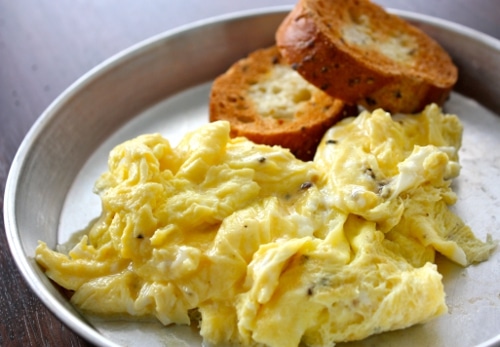
In my opinion, there are two schools of thought when it comes to the perfect scrambled egg. Low and Slow vs. Hot and Fast. Whatever your preference, the two methods typically turn out two very unique types of scrambles. Low and slow yields eggs with small curds that are moist and soft, whereas the hot and fast method turns out eggs with larger, denser curds. Instead of taking sides, I’m laying out both options.
Non-stick cookware truly comes in handy when scrambling eggs. The slick non-stick surface allows for easy cleanup, and preparation containing less fat or oil. Make sure you always use a wooden spoon or rubber spatula on the cookware to prevent damaging the non-stick coating.
One of the more important elements to the perfect scrambled egg, regardless of the method, is air. That’s right, air. The more air you can whisk into the mixture, the more full and fluffy your scrambled eggs will turn out. It’s important to whisk your eggs in a large bowl, using a circular motion that pulls the eggs to the surface, rather than stirring around the perimeter of the bowl. Utilize a tilted wheel motion with either a fork or whisk to get as much air into the eggs as possible. With that said, you do not want to overbeat your eggs. You will know when your eggs are ready when the mixture is evenly colored and frothy.
Many people like to add salt, pepper, cream, and herbs to their eggs prior to scrambling. I prefer to wait to season the eggs until they have finished cooking. Regarding cream or herbs, you can utilize these ingredients to enhance moisture and flavor, but they are not necessary. A properly scrambled egg will not need any additional ingredients to taste excellent.
Scrambled Eggs
1 Tablespoon Unsalted Butter
3 Large Eggs
Kosher Salt
Fresh Cracked Pepper
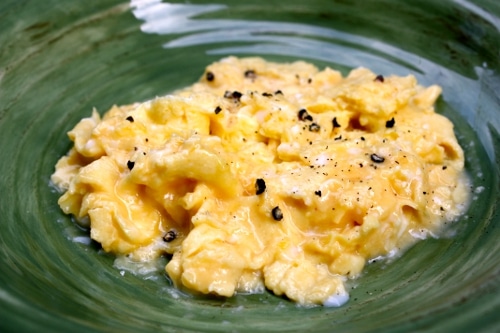
Low and Slow
Low and Slow- Heat an 8 or 10 inch non-stick pan over medium low heat, add butter. Meanwhile, crack eggs into a bowl and vigorously whisk until combined and frothy. When butter is completely melted, add eggs to pan. Wait to stir until eggs have just begun to set. Using a wooden spoon, begin to push the eggs towards the center while tilting the pan. This will create small curds and allow the runny portions to reach the hot surface. Continue in this manner until there is no longer any runny portion remaining. Remove eggs from heat, season with salt and pepper to taste, and serve.
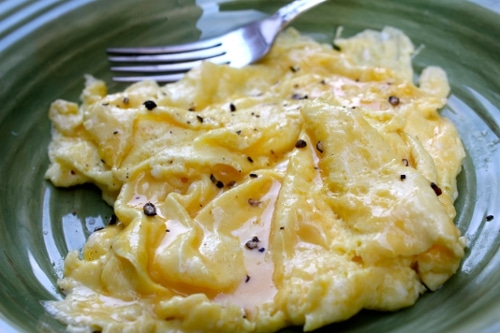
Hot and Fast
Hot and Fast – Heat an 8 or 10 inch non-stick pan over medium high heat, add butter. Meanwhile, crack eggs into a bowl and vigorously whisk until combined and frothy. When butter is completely melted, add eggs to pan. Wait to stir until eggs have set in the pan, the runny portion should remain on top of the cooked portion. Quickly use a wooden spoon to scramble and lift off the cooked portions while allowing the uncooked eggs to reach the heat. Do not over scramble. When there is no longer any runny portion that remains, remove eggs from heat, season with salt and pepper to taste, and serve.
Fried Eggs

Unfortunately, most people typically have a negative connotation with fried eggs. Perhaps it’s the word “fried” in the description. Keep in mind, a fried egg is much different than the caloric disaster of chili cheese fries down at the Starlight Diner. Honestly, fried eggs, when prepared correctly, hold very little of the oil or fat used to prepare them.
On mornings when I’m rushing out the door, my go-to breakfast is a few fried eggs. I can cook the eggs quickly, and I don’t have to pull out, or clean up, several bowls or utensils.
Butter is traditionally used in the preparation of fried eggs; however, I prefer using olive oil instead. The health benefits of olive oil are abundant, but I also like the distinctive flavor it adds. Also, because extra virgin olive oil has a higher smoke point than butter, I find that my pans clean up easier when using oil instead of butter.
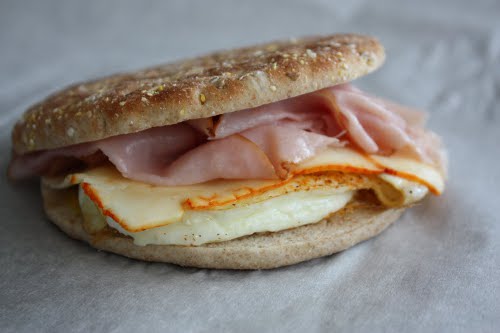
For a delicious on-the-go breakfast sandwich, stick your fried egg between two sandwich thins, and add ham, a slice of cheese, and some mustard.
Fried Eggs
1 Tablespoon Extra Virgin Olive Oil
2 Large Eggs
Kosher Salt
Fresh Cracked Pepper
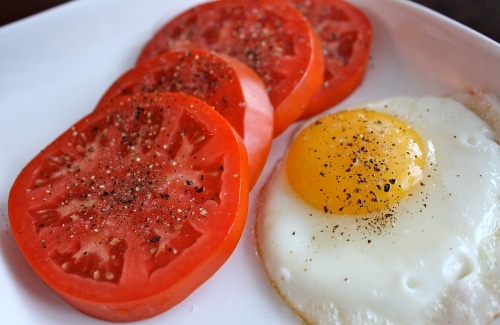
Heat an 8 or 10 inch non-stick pan over medium heat, add oil. Carefully crack eggs into the pan, allowing room for each egg to cook separately. After a minute or so, the egg white will solidify from transparency into a firm white texture.
At this point, you have a few options.
For sunny-side up eggs, continue to cook for another minute until the white portion is firm and just cooked through. Carefully slide eggs onto a plate, season with kosher salt and fresh cracked pepper to taste, and serve.
For a firmer yolk (over easy, over medium, over well), place a lid over the pan and cook (steam) the yolk for another few minutes until the egg is cooked to your desired consistency. You can gently use your finger to press on the yolk to determine doneness. An over-easy yolk will give to slight pressure, whereas an over-medium yolk will be firm to the touch. Remove lid, season eggs with kosher salt and fresh cracked pepper to taste, and serve.
Another option is to remove the pan from the heat, and using a quick tilted back-and-forth motion with the pan, flip the egg onto its other side. Of course, a spatula may also be used to flip the egg. Return the pan to the heat and continue to cook until the yolk is cooked to your desired consistency. Remove from heat, season with kosher salt and fresh cracked pepper, and serve.
Poached Eggs

Novice cooks typically shudder in fear at the idea of poaching an egg. Truth be told, it takes some skill to get this technique down. But, with a little practice and a few tips, you will be able to impress your guests in no time.
Poaching is one of the healthier methods for preparing eggs. Because the eggs are cooked while immersed in water, there is no need to add extra oil or butter. A word of caution: it typically takes a bit more time to prepare poached eggs, which may not make for convenient preparation on a busy weekday.
When poaching, it’s important to find the freshest eggs possible. Ideally, eggs should be no more than a week old. Remember, fresh eggs lack oxygen, are heavy in weight, and the white will gather completely around the yolk, making a rounder, neater shape.
Adding a tablespoon of white wine vinegar to the simmering water will help the egg hold its shape. Simply placing the poached egg in a bowl of water will remove any of the vinegar taste after cooking. I also find that placing the egg on a piece of bread after cooking is a great way to get rid of any excess water.
When entertaining a large crowd, you can poach a batch of eggs in advance, and immerse and hold the eggs in ice water until ready for service. Before serving, return the eggs to simmering water to heat through.
Poached Eggs
1 Tablespoon White Wine Vinegar
2 Large Eggs
Kosher Salt
Fresh Cracked Pepper
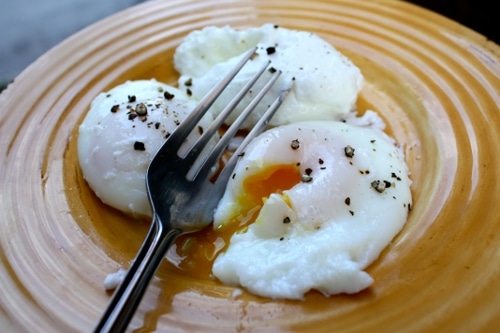
Fill a 12 inch stainless skillet or a large pot with at least three inches of water. Bring water to a boil over high heat. When water comes to a boil, reduce heat to low, add vinegar, and allow water to remain at a very slow simmer. Break eggs into separate small containers. Next, carefully slip eggs into the simmering water. If necessary, using a spoon, gently nudge the egg whites closer to the yolk. Allow eggs to slowly simmer for 3 – 5 minutes, depending on yolk preference. Carefully remove eggs using a slotted spoon or spatula and immerse in water to remove any vinegar, if desired. Season eggs with kosher salt and fresh cracked pepper, serve.
Hard-Boiled Eggs
Hard-boiled eggs are a handy “on the go” breakfast staple. Eating a few hard-boiled eggs in the morning is a convenient way to get your metabolism started without facing a crash later in the day. The best part about this cooking method is that it creates eggs that you can store for several days to use in salads, sandwiches, or simply as a quick snack. A touch of kosher salt and fresh cracked pepper can really enhance the flavor of a simple hard-boiled egg.
Several manufacturers now sell hard-boiled eggs alongside fresh eggs at the store. For a premium, they offer the convenience of precooked and peeled eggs. If you don’t have the time to prepare hard-boiled eggs on your own, this is a great time saver.
However, if you want to save a few bucks, these are really quite simple to prepare at home. My best advice after cooking the eggs is to allow them to come back up to room temperature before peeling. You will encounter trouble if you try to peel the eggs while they are either too hot or cold. Store your hard-boiled eggs in an airtight container and refrigerate, keeping up to 3 – 5 days.
Hard-Boiled Eggs
6 Large Eggs
Place eggs into a large pot or skillet and cover with water by one inch. Over medium high heat, bring water to a slow boil and allow eggs to simmer for 1 minute. Remove from heat, cover, and allow the eggs to sit for 10 – 12 minutes. Carefully transfer eggs into a colander and rinse under cold running water until they are no longer warm to the touch. Allow the eggs to sit at room temperature for 15 – 20 minutes before peeling. Serve immediately or store in an airtight container and keep refrigerated for later use.
What are your favorite ways to make eggs? Got any tips for cooking eggs well? Share your comments with us!


← Previous Comments
I’m trying to perfect a way to make soft boiled eggs that are easy to peel, because eating them whole with the warm yolk running through the mouth is a whole new degree of delicious.
My favourite eggs are slow scrambled! YUM. A chef suggested adding 1 T. water to the eggs and slow cooking them. I also love poached, however I will not eat them unless they have been poached in an egg poacher. My mom has one from the 50′s and it works like a charm.
The worst mistake I have seen men make with scrambled eggs is not scrambling them before putting them in the pan. Lots of guys crack the eggs right into the frying pan and then try to mix them. They get a lot of blobs of white without the yolk, which to me is disgusting (and I think a lot of other women don’t like blobs of cooked white either). Use the extra bowl and do it right, please!!
Oh, yeah… don’t be afraid to eat butter, bacon, coconut and other forms of good fat. However, don’t use vegetable oil to cook with… the stuff breaks down. No olive oil, soybean, oil, canola oil, etc., please! Check out the paleo websites on the internet. Eat your fat!
I soft boil eggs the same way I hard boil them, but for less time. Put the eggs in a pot, barely cover with cold water, bring to a boil, then immediately take off the heat and let ‘em sit for exactly 5 minutes. Then rinse them under cool water, peeling as fast as you can. If you’re fast, the heat from the middle will be enough to keep the whole egg hot. If not, dunk it in hot water for 30 seconds or so.
Your scrambled eggs recipe is missing an ingredient that contributes to the fluff factor, can add to the flavor and can produce a different texture that may be pleasing to some. Milk. I can’t speak to the chemistry behind it all but my thinking is that the addition of milk helps the yolk and the whites gel together better during beating making the eggs more fluffy. As to the texture, the more milk, the more “runny” or “juicy” they become. I think milk also brings out the eggs’ flavor as well. I won’t go into the quantities I use as I usually just “eye” the amounts. In any case, trial and error should produce some tasty examples until you find the amounts that are to your liking.
Nobody’s mentioned broken yoked eggs. Just like a fried egg, but the yoke is broken, so it’s sort of like a hybrid between a scrambled egg and a sunny-side-up egg. + you don’t compact the egg like you would a scrambled egg, so you don’t feel like you’re losing anything
With all the egg scares, I want to remind folks the adage “scramble or gamble.” Scrambled eggs are more done and less likely to have any nasty bacterias still living in them. If you’re taking care of children or a lovely pregnant lady then you’ve got to make sure you cook all the way through. This means flipping the fried egg and cooking the yolk, or scrambling until it’s not leaking on the plate.
Also, remember that boiling water boils at a lower temperature if you’re up in the mountains (high altitude.) If I followed your recipe for a boiled egg I would end up with a slightly cooked, mostly raw, egg! Follow the 10 second rule. Take the egg out with a spoon and if the water on the hot egg dries within 10 seconds then it’s usually done. It takes a good 15-20 minutes with the water boiling for hard boiled eggs to finish cooking where I live.
No, it’s not. That’s just for something much more limited. Traditionally, eggs are not the only thing being fried, and that other thing usually provides the fat, e.g. bacon and eggs (better still, a full English cooked breakfast). You would, of course, add the eggs after starting the bacon.
If you put salt in the boiling water, the hard boiled eggs will have shells that are much easier to peel.
http://articles.mercola.com/sites/articles/archive/2010/10/30/rudi-moerck-on-cooking-oils.aspx
“However, it’s important to realize [olive oil] is NOT good for cooking.”
http://www.westonaprice.org/know-your-fats/skinny-on-fats
I like my eggs raw
I put 3-6 whole raw eggs, depending on whether I am using some hemp protein powder, into a blender with milk, a mango, a banana, and a celery stick. Sometimes I throw a tomato in there and sometimes I use berries.
Very wholesome.
It is IMPERATIVE to serve eggs on a warm plate. It amazes me every time I have people over for breakfast they are shocked when I have the plates in the oven on low or in the microwave for 90 seconds. Either you heat up the plates, or you have 30 seconds to enjoy your eggs!
I’ve read that scrambling eggs is one of the worst ways to cook them (the worst being in a microwave) because it oxidizes the cholesterol in the yolk.
Thanks for the tutorial! Even after cooking consistently for three years, I still need a reminder on eggs once in a while.
Let’s not forget soft-boiled eggs. Bring the water to a boil, add eggs, let ‘em go for 5 minutes. Pull out, peel, enjoy.
AoM hits the mark on this one. When they do a great job, I let them know.
One thing to remember is that if you cook eggs, fried or scrambled, until they are done, they will be overcooked by time you eat them. The continue to cook until they cool, even out of the pan.
Yes, butter makes them better and you really don’t need much. I also like to add a little skim milk to my scrambled eggs, it seems to make them much lighter and fluffier. Yes, wait until the end to add salt and only use fresh ground pepper.
You do NOT add milk to eggs! I’ve known this for years.
Even the Frugal Gourmet knew it. (He might have had other problems, but cooking omelets was not one of them.)
You do NOT add milk–you add a little water.
Here’s a good explanation from someone online called Chef Todd:
“People put milk in beaten eggs for omelets and scrambled eggs mostly because their mothers told them to. They never asked why.
“In my opinion, adding milk to beaten eggs creates more problems than advantages.
“First, milk solids burn at a lower temperature than egg protein or fats. So, adding milk to eggs will assure a brown, rather than a yellow omelet, and slow the coagulation of proteins.
“Secondly, people mistakenly think that the omelet is “fluffier” with milk added. It’s not fluffier, it’s just a diluted egg taste, replaced with dairy. What they are trying to do is better accomplished with a teaspoon of water per egg. Water will evaporate, and egg protein will try to hold it down, leavening the egg. Just like in popovers, eclairs, pate’ choux. Water will not add flavor, will not burn.”
He’s right. Adding a little water works perfectly.
It’s a small amount of skim milk, which is quite different than whole milk, it works. If you are cooking your scrambled eggs to a point where anything would burn, there’s a problem.
I use a properly oiled cast iron skillet and it works perfectly. I prefer olive oil
I finally bought a cast iron fry pan this past winter. Seasoned it in the over every time we cooked a roast… and took it to the cottage. Fried the bacon at med-high… poured off the excess fat. Dropped in a small pat of butter, then the eggs. Turned off the heat… covered the eggs with a lid and pushed down the toast. By the time the toast was done, the eggs were perfectly cooked, and with just a slight nudge around the edges with a spatula, slid out onto the plate.
Don’t prepare food in teflon cookware. Teflon is NOT good for your health!
Soft boiled is a lot of fun. I put them into cold water, bring to the boil (5 minutes) and then boil ‘em for a little over 3 minutes. It works for me.
A note on the scrambled eggs, Gordon Ramsay has a youtube video on how to make the “perfect” scrambled egg . That’s my new favourite way to cook them.
@kmk: I have heard that the protein in eggs doesn’t digest very effectively when they are raw. Just something you may want to look into :)
I usually add a dash of vanilla essence to get rid of the eggy smell.. and oh fresh milk doesn’t make the eggs fluffier but skim milk does.
Maybe someone already covered this, but I saw on a cooking show once that if you stir the water enough to get it moving, the whites will wrap themselves around the yolk better, making poached eggs a little easier. Just food for thought.
Two tips for the poached 1. let the egg boil for about 1/2 a minute and then start splashing water across the top to firm up the outside of the yolk on top . this makes it a lot less fragile. 2. Wait about 2 minutes in to try and slip your spatula under the eggs (just wiggle it under bit by bit) to free it from bottom of the pan. I have about 95% success rate with never breaking the yolk, unless it settled to the bottom too much, or the top wasn’t fortified enough.
Thanks for the tip on the hot plates, I never even thought about that.
For me, scrambled, hot and fast, with a LITTLE browning. Superb.
Best poaching tip I’ve learned:
My Granny-in-law recently taught me to stir the water into a vigorous whirlpool before dropping the eggs in the water, making sure that all the eggs are in the water before the water stops spinning. In addition to preventing the eggs from sticking to the pan if the water is on the shallow side, this technique also helps them maintain a nice shape without using vinegar. TRY IT!
Real men eat eggs raw. My Dad did this in the 50s after football practice. This is the easiest to digest and preserves all the nutrients. It is also the quickest way to eat eggs after exercise or when you are running out the door. Just crack it in a glass and gulp it down whole. It doesn’t taste great, but then again it has almost no taste. Scrambling the yolk changes the molecular structure and thereby reduces the nutrient quality–so fried eggs or whole raw eggs are best! A previous commenter–a woman–said something about bacteria and other nasties in egg yolks. What other nasties? Don’t be so squeemish! If you buy eggs from a local farm, you avoid most bacteria concerns–is is the mass produced eggs that create the most unsanitary situations. Is there still a chance you will get bad bacteria? Sure, a very, very, very, small chance, but it should not be a major concern. My research shows that the salmonella concern is overplayed, and barely applies at all to eggs on a well-run local farm. Look it up online. There is a small chance that you will get bacteria just about anywhere. Local farm raised eggs also have more orange yolks because the chickens are healthier, and this means a much more healthy egg for you. Whole raw eggs are good. Ask Rocky Balboa.
Thanks for the timely article, Brett! I was just thinking about this topic only a few days ago and here it is!
I use an iron skillet and cook my fried eggs in saved bacon fat every morning. I serve it with left-over bacon, orange juice and viola! A hearty breakfast that lasts me all morning. I used to eat cereal and found I was always hungry around mid-morning. Not any more, though!
Again, great article!
i used to mix my eggs before cooking, but when I met my wife she never did and I found myself liking them more. It seems like they are more of a mixed flavor than just scrambled together. We also use salt, pepper, and some red pepper flakes to give it a little kick.
We also use grapeseed oil instead of all the others. It works a lot better and is a lot healthier for you.
Gotta love eggs.
Personally, I prefer a bit of milk in my scrambled eggs. Water works well too. Bottom line…try both see which you like better.
As for cooking with olive oil…Methinks the good doctor should talk to the Italians and French who are rather heart healthy and cook with olive oil. Just saying. (Mercola makes some very valid points, but I disagree with him on some things, such as this.)
Boiled egg suggestion…add some baking soda to the water. Makes them easier to peel (Haven’t tried the salt thing).
For the perfect soft boiled egg there is an equation that includes diameter, initial temperature of the egg, how soft you want the yolk and the altitude (because boil water differs with altitude). Follow the link, it worked perfect for me: http://www.mn.uio.no/kjemi/tjenester/kunnskap/egg/
I prefer mine fried. First, fry up your bacon or sausage in a large skillet, remove cooked meat, leave grease. Then add your eggs. While they’re cooking, add some Tony Chachere’s(http://en.wikipedia.org/wiki/Tony_Chachere's_Original_Creole_Seasoning)
and black pepper.
Hi Matt,
I notice in your posts you consistently refer to Kosher salt. I was just wondering whether you recommend Kosher salt because it has some different properties or a better taste than other non-Kosher salt? Just interested.
Cheers!
It’s amazing how opinionated people are about eggs. And how everyone spouts their opinions as facts. Yes oil! No oil! Yes milk! No Milk! Scrambling’s bad! Runny yolk’s bad!
It’s crazy, really.
I think the best thing is to cook some bacon and then make the eggs in the bacon fat. Also if you make bacon alone save the drippings in a jar and store it in the fridge and you can use it for things like this. You can also cook the bacon up with some sliced jalepenos, to have jalapeno-infused bacon fat to cook with. Don’t add then until the bacon has cooke for a bit, so they don’t burn.
Otherwise I would use Ghee or Coconut Oil, personally.
No one mentioned putting mayonnaise in scrambled eggs. Weird I know but really good. Try about 1 tblsp. per two eggs and scramble away.
Your bit about an over easy egg didn’t mention actually turning it over. An over easy egg is flipped for a short bit. Over medium a bit longer, etc.
Hmmm… i add milk to my scrambled eggs recipe.
I learned to make eggs on the run from a bachelor friend of mine. Crack 2 eggs into a plastic sandwich bag, add some Tony Chechere’s & stir with a fork, microwave on med hi for 1 min 30 secs. Put 2 slices of bread in the toaster & grab the Duke’s mayo out of the fridge. The toast will pop up about the same time as the nuke plant beeps. Set a paper towel under the toast, use the same fork to slather some Duke’s on the toast, and dump the eggs onto the toast. Throw the fork in the sink, plastic bag in the trash, grab your paper towel-wrapped egg sandwich & you’re ready to hit the road. Yeah, it ain’t nowhere near as good as mom’s bacon & eggs, but it’s fast, hot, & fresh with no cleanup.
I feel the need to point out that the whole cooking the egg alters the nutrients of the food is ultimately irrelevant. When you eat any food product you break down the organic materials into something your body can use. Yes cooking the egg alters the structure, but so does digestion. The fact is, unless you are removing nurtients, which is not being done through the cooking process, the body will recieve the same amount of nutrients as it would from raw food materials. In fact cooking has been shown to improve the digestability of certain hard to digest foods. Likelwise the fear of having runny eggs and it not being somehow cooked enough is also equally overblown. The change of getting samonela in the US is very slim. Just make sure you buy quality eggs and wash the shell before you do anything and then forget about.
Okay, I didn’t see anyone else mention this but the reason they’re called ‘over-easy’ or ‘over-medium’ is because, get this, you’re supposed to flip them over. Otherwise, they would just be called easy and medium. Also, runny scrambled eggs aren’t gourmet, they’re just gross (personal preference). Thirdly, butter is king! Good article nonetheless!
Over = flip them over!
Fast Omelette
Dice fillings (vegetables, meat, whatever. I like onions, mushrooms and ham. Buy these pre-diced to save time). Put butter in pan and (once melted) saute fillings. Whip your eggs. Once fillings are lightly browned pour eggs into pan. (Optional: put another pan on top as a lid to cook the top faster) At this point keep an eye on it. Whenever you can lift some of the edge an inch without it breaking off from the rest of the egg, do this and tilt the pan to allow the excess to run underneath. Once most of the liquid is gone put a little bit more butter just inside the edge of the pan and let it run down. Flip the eggs by tossing them (takes 5 minutes of practice to master). Put cheese on top and turn off the flame. once the cheese is slightly melty slide out onto a plate and fold. Done.
My favorite is to pick up a mexican fajita platter the night before. Filling is steak and onions. Put beans inside the fold and salsa, sour cream, and guacamole on top.
Tried out putting fresh cracked pepper in my fried eggs today and it tasted awesome!
Missed the best egg, the pickled egg.
Actually, the culinarily correct way to scramble eggs is to scramble them in the pot.
You crack the eggs into a bowl, then when the pot –non-stick of course– is at high heat, your pour the eggs in, unscrambled. You then scramble them in the pan for a few seconds at high heat, then remove the pan and scramble them on no heat, then back to high, then back to low, etc. until the eggs are scrambled.
This video explains it perfectly: http://www.youtube.com/watch?v=dU_B3QNu_Ks&list=LLClyOM01l4TvNEEiA61t9KQ&index=6&feature=plpp_video
I wouldn’t use extra-virgin for FRYING something. Saute, a very definite maybe. Not only is it easy to burn, it’s cancerous when it does AND I think it’s a waste of money. You can’t taste the “extra virginess” of it. A lower grade would work just as well and works better. Save your good olive oil for bruchetta or salad dressing.
What causes the low smoking point for butter is the solids in it. The money oil (except for great quality bacon grease) is GHEE (clarified butter). Take a whole mess of butter, put it in a pan, heat it up slowly then skim the top. It keeps in the fridge for a long time.
The taste of butter with a higher smoking point. Win-win.
I’d also like to drop another bit of egg controversy.
Ask your mom and dad: THEY ATE RAW EGGS. Drop an egg or two in a protein shake and BANG, it’s frothier. It’s BETTER. For example, what is a classic “EGG CREAM” without a raw egg? Do you think all those people would have drank them if everyone wound up getting severe intestinal distress? Many kinds of mixed drinks too are better (egg whites). Check out a gin flip. Awesome. No one except maybe the very old or pregnant need to worry.
Here’s another one: MOST COUNTRIES IN THE WORLD DON’T REFRIGERATE EGGS. Think about this one. Really think about it, and it makes sense. The only situation where it would be beneficial to refrigerate eggs is if you kept them refrigerated, in storage for a looooooooooong time (which the supermarket can do, and does do. You have really no idea how long it’s been, not really.)
Small farmer’s eggs are better tasting, better for the environment, better for the animals and more nutritious. If you’re worried about contamination, wash the outside of egg carefully immediately before using and if it smells bad, DON’T use it. If you’re really worried, put it in a pot of water and if it floats, it’s off. Eggs are great at letting you know when they’ve gone off.
These USDA egg rules were created to allow supermarkets to keep eggs in cold storage for unnaturally long times to make money. The consumer suffers by having to use an inferior product and the fear of paranoia.
I’d also like to drop another bit of egg controversy.
Ask your mom and dad: THEY ATE RAW EGGS. Drop an egg or two in a protein shake and BANG, it’s frothier. It’s BETTER. For example, what is a classic “EGG CREAM” without a raw egg? Do you think all those people would have drank them if everyone wound up getting severe intestinal distress? Many kinds of mixed drinks too are better (egg whites). Check out a gin flip. Awesome. No one except maybe the very old or pregnant need to worry.
Here’s another one: MOST COUNTRIES IN THE WORLD DON’T REFRIGERATE EGGS. Think about this one. Really think about it, and it makes sense. The only situation where it would be beneficial to refrigerate eggs is if you kept them refrigerated, in storage for a looooooooooong time (which the supermarket can do, and does do. You have really no idea how long it’s been, not really.)
Small farmer’s eggs are better tasting, better for the environment, better for the animals and more nutritious. If you’re worried about contamination, wash the outside of egg carefully immediately before using and if it smells bad, DON’T use it. If you’re really worried, put it in a pot of water and if it floats, it’s off. Eggs are great at letting you know when they’ve gone off.
These USDA egg rules were created to allow supermarkets to keep eggs in cold storage for unnaturally long times to make money. The consumer suffers by having to use an inferior product and food paranoia.
Man your fried eggs are all wrong: You do it with butter on a high heat so that they are frazzled round the outside whilst still runny. You put them in a roll with more butter, grind some pepper on and then you sprinkle cooking salt on top. If you’re feeling bored of eating fried eggs for breakfast/lunch/dinner/supper since last week then you add a bit of Lea & Perrins on top each time until you decide you “just want a simple egg without any of that crazy additive sauce”. You are pretty much set for a happy life this way.
A cast iron pan is the way to go for cooking eggs. if it’s oiled right and the pan is hot the eggs will scalled before they get a chance to burn onto the pan. Also puts some extra iron into your eggs.
So far, the only one I’ve really gotten good at is scrambled eggs, thanks to a friend of mine teaching me how to do them properly when we were on a vacation together. The way she taught me was to crack the eggs into a bowl, mix a little milk in, and whisk it all together with a fork until it’s frothy and bubbly. Before that I just cracked some eggs into an oiled skillet, mixed ‘em all up with a spatula, and called it “scrambled eggs.” Having now tasted real scrambled eggs, I am embarrassed of the poor fare I had made before.
I’ve tried scrambled eggs both with the whole milk and without. It does seem to change the texture slightly; I think they’re a little more fluffy with the added milk, but they’re delicious either way. My friend taught me to wait until the whole mixture starts to set and flip it as one piece, like an omelet; lately I’ve been mixed it up in the skillet to cook it faster. My favorite way to serve scrambled eggs is with bacon, sliced avocado, and salsa, but they’re lovely just by themselves or with anything else. The salt and pepper usually go on the eggs after I’m done cooking them.
I used to cook my eggs using olive or canola oil. Lately I’ve been using butter or bacon grease, because it’s more old fashioned and I am personally convinced that the saturated fat scare of the 80s and 90s was only that, a scare, on roughly the same scale as the McCarthy era was a scare. I use cast iron for similar reasons; it’s old fashioned, it’s not that much harder to clean if you’re quick about it, you get a little extra iron in your diet, and it’s impossible to scratch the thing up and give yourself a daily dose of estrogenics by cutting up the teflon. Besides, a cast iron skillet will last forever. A non-stick pan will wear out within five or six years, in my experience.
I’ve heard that adding baking soda to the water when making hard boiled eggs makes them easier to peel. I’m not sure if it’s really a big advantage, but it doesn’t cost much to add it in there.
What does seem to help a lot is to cool the eggs with lots of ice when the boiling is done (before peeling/shelling). I also use a teaspoon to assist in the peeling, by running it around the inside of the shell. Combining these tips, I can prepare hard boiled eggs better then any other method I’ve tried so far.
Hard boiled eggs are a great snack, and deviled eggs are always popular at parties and potlucks.
My grandmother used to make soft-boiled eggs. I would eat them right out of the shell or dump them in a bowl with salt and pepper.
What areteh rules for soft vs hard boiled eggs? I can never remember if it’s 3 minutes from boiling for a soft boiled egg and 5 for hard? Do the eggs go in the water after boiling starts?
Men,
Fear not cooking devices that simplify the process. I purchased an egg cooker from Cuisinart that prepares hard, soft and poached eggs. The results are nearly perfect and the unit shuts itself off when done.
Although my egg cooking skills and methods differ, there are quite a few good tips within this article for the novice cook. I especially like his tips on the perfect hard boiled egg. Too many people think you have to boil the egg forever, and they end up with an ugly grey ring around the yolk. Cook your eggs just as he suggests in the hard boiled section, and you can’t go wrong!
When it comes to the perfect scrambled egg however, I suggest pulling your eggs off the heat just prior to being fully cooked (still a bit moist), as they will finish cooking from the residual heat after you plate them.
Love this post. Best bit? ‘Let’s get cracking’! It’s an oldie but a goodie.
My favorite way to make eggs is similar to the fast/hot method of scrambling. It’s quick, it’s easy, and it’s really quite tasty!
For my method — we’ll call it ‘the David’ — I start by taking my medium-size skillet and spraying it down with a light coating of canola oil (I prefer the unsaturated fat of plant oils [olive oil can be used as well, but it clashes with the flavor introduced later] rather than using butter, as it is a less healthy saturated fat). I then throw the skillet over the burner, crank it up to high heat and turn the to fridge. From the refrigerator I simply grab 2 eggs and some salsa. I have developed this method using Pace salsa which works great because of both its liquid salsa part which is necessary to thin the final product because I do not use milk/cream (extra fats & a bit of laziness), and its chunky vegetable pieces that add great texture and flavor. So with the skillet still heating up, I crack open both eggs directly into the skillet, open the salsa, and pour the desired amount (my preferred amount usually equals about 1/5 of the pans total contents – just enough for some robust flavors while still leaving the main course of the meal to the eggs) directly on to the eggs. By this time the egg white has begun to take its firm characteristic along the bottom of the pan so it’s time to start turning, mixing, and flipping until the cooked to taste. I prefer the eggs still slightly moist with a hint of runnyness though your tastes may differ. Eating a bit of raw egg doesn’t bother me one bit – in fact, ‘the David’ is actually quite amazing if you prepare it along side some hash browns, cook eggs to be slightly more runny that you would if prepared alone, and when done cooking mix the egg into the hash browns and eat together seasoned with some cracked pepper.
Anyhow, there you have it: delicious, seasoned eggs in about 2 minutes flat with practically zero mess! Rinse/wipe out your pan before sitting down to eat, and you’re good to go for tomorrow morning’s breakfast and the day ahead of you!
Does anyone know about cooking eggs in maple syrup? I’d heard it is a traditional Quebec method, but I’m not sure about the technique. Poaching I think, but obviously w/o vinegar or whisking. I would love to try it. Any thoughts appreciated.
PS – my scramble is low and slow, with milk, but just gently stirred, not whisked. Was always told you stir a scramble, whisk an omelette. Remove from heat early, while just cooked. Serve on toast. No cheese, herbs, etc required.
PPS – Watch the movie Big Night for a scene of omelette cooking. Hey how many other movies demonstrate the art of omelette cooking, eh?
← Previous Comments
Comments on this entry are closed.