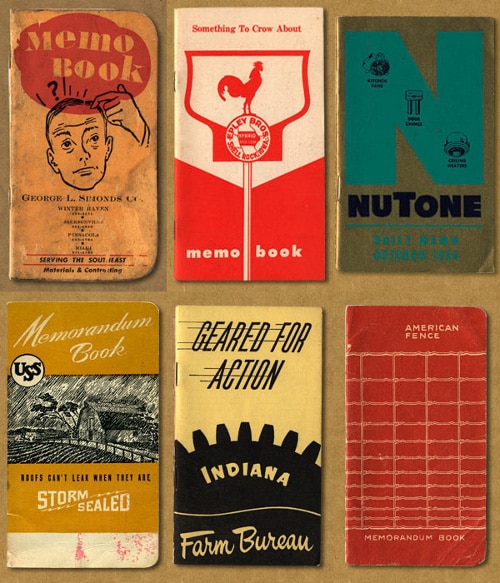





Images from Field Notes
The idea of carrying around a pocket notebook has become quite popular these last few years, revived by the introduction of the current incarnation of the “Moleskine” into the market. It’s become so popular that I’m afraid it has come to be seen as trendy or faddish, and this is putting some men off to starting this important habit themselves. Some find the Cult of the Moleskine and its faux history understandably distasteful. The company shills their pricey Made in China notebooks as the notebook of Hemingway, Van Gogh, and Matisse, when the company that currently makes them only got into the business in 1997.
But don’t let the pocket notebook’s current image dissuade you from carrying one around. The truth is that you don’t need to use a Moleskine (unless you really like them)-even some note cards clipped together will do. And far from being a modern fad, the pocket notebook has a long, important, and manly history. Pocket notebooks were part of the arsenal of a long list of great men from Thomas Jefferson to Thomas Edison (we’re working on an in-depth post of how these men used their notebooks for the future). The repositories of eminent men’s personal effects nearly always includes a pocket notebook full of their ideas and musings.
I spent many hours combing through the google book archives looking for references on the use of pocket notebooks by ordinary men during this past century. The following excerpts I collected show the pocket notebook’s history and demonstrate that far from being the domain of the modern hipster, the pocket notebook has always been used by men from many different walks of life.
The Farmer
“One farmer I know keeps his notebook in his pocket to jot down the tasks which can be performed on a rainy day. This enables him to plan quickly the work for a rainy day. In planning rainy day work, do first the jobs which are in danger of getting in the way of the next dry weather work. The rule is to leave no rainy-day work to be done when it is not raining for in this climate our profits are limited by the amount of outdoor work we get done.” -Circular, Issues 46-105, By Agricultural Experiment Station, College of Agriculture , 1914
The Salesman
“There should be a book in your pocket all the while ready for the name of anyone who might be induced to handle your product. A name overheard, a name suggested by a fellow traveling man, a name secured by visiting with someone from a town you do not make, a name seen in a local newspaper—any such name may be that of your prospect.
One salesman I know buys the local newspaper in every town he enters and reads the personal columns as well as the advertisements in search of men who may be or may become possible customers. He studies openings in towns where there is a possible opportunity, and he puts the right men in touch with them. He visits with representatives of the local commercial organizations and advertising clubs and gathers much information that he tabulates in a pocket notebook. He always has at hand information of value to men in his line of trade, and in time they come to realize it and look forward to his coming, saving him some kind of an order even if they are not much in need, because they want a chance to talk with him.” -The Successful Salesman, By Frank Farrington, 1918
The Minister
“Have upon your study table, always accessible, a good-sized substantially bound blank book. Whenever a germinant thought comes seize your pen and write it down. Such thoughts will come out of your special course of literary reading, out of your cursory scanning of current fiction, even out of the five-minute glance given to the morning paper, out of nowhere and from anywhere. Thought-compelling suggestions entirely foreign to the sermon on which you are just now engaged will frequently send you to your treasure book, and without any damage to present preparation you will scribble down a page of matter that will set you on fire at some future day just when you are in need of inspiration and help. Have also a special vest-pocket notebook and let nothing escape you.” -The Methodist Review, 1907
The Boy Scout
“In one of the pockets there should be a lot of bachelor buttons, the sort that you do not have to sew on to your clothes, but which fasten with a snap, something like glove buttons. There should be a pocket made in your shirt or vest to fit your notebook, and a part of it stitched up to hold a pencil and a toothbrush….
No camper, be he hunter, fisherman, scout, naturalist, explorer, prospector, soldier or lumberman, should go into the woods without a notebook and hard lead pencil. Remember that notes made with a hard pencil will last longer than those made with ink, and be readable as long as the paper lasts.
Every scientist and every surveyor knows this and it is only tenderfeet, who use a soft pencil and fountain pen for making field notes, because an upset canoe will blur all ink marks and the constant rubbing of the pages of the book will smudge all soft pencil marks.
Therefore, have a pocket especially made, so that your notebook, pencil and fountain pen, if you insist upon including it—will fit snugly with no chance of dropping out.” -The American Boys’ Handybook of Camp-lore and Woodcraft, By Daniel Carter Beard, 1920
The Doctor
“When I started in practice, I got in the habit of putting many of my spare moments (had plenty of them!) into studying up some of the rarer diseases that we had to deal with. I would read up all I could find on one subject, then I would take some time in thinking it over, then I would formulate a plan of treatment and write it out in a pocket-notebook. In after years, that old notebook helped me out of a good many difficult situations; and some of the best work I have ever done has come from those notes.” -The American Journal of Clinical Medicine, Volume 25, 1918
The Architect
“The little pocket notebook, I soon discovered, was not a record book in the accounting sense of the term. Nevertheless, it was a very necessary part of the architect’s business paraphernalia. The rules of the American Institute of Architects do not permit members of the profession to advertise, or go after new business in most of the ways that are current among commercial organizations. Therefore, the successful architect is a man with a wide ‘acquaintance among the classes of persons who are likely to become builders. He quickly learns to take note of projected buildings, in order to follow up the prospective owners, and secure for his own office the work of designing the building.
This is the purpose of the architect’s pocket notebook. Whenever he gets wind from any source of a projected building, he makes a note of it. Sometimes he secures his information from news notes in the daily papers; more frequently he gets advance information from the people he associates with, and from regular commercial agency reports. If the prospect has in mind constructing a building of the class the architect is used to handling, he makes a personal call on the owner.
‘Sometimes,’ says the architect, ‘I don’t need to use my little book so strenuously as at other times. A growing reputation and a ‘come-back’ clientele are gradually making it possible for me to devote less time to getting business and more time to handling the work that is under way. I keep the book up from habit; and occasionally it brings me a job of the kind I particularly want, and might miss if I didn’t have my notebook as a daily reminder.’” -The Magazine of Business, Volume 27, By Arch Wilkinson Shaw, 1915
The Naturalist
“I am often asked to recommend the best kind of notebook and diary to use for nature observations; but I have never seen any that is satisfying. The value of notes depends upon their being taken on the spot. If you think that you can carry the records of a country ramble home in your head and write them down at your leisure in the evenings, you are very much mistaken. You must carry them home, already written, in your pocket; and for that purpose you must have a handy pocket notebook. But the notes hurriedly written on the spot are not, of course, intended to be your permanent record. Indeed, your penciled scrawls on a cold day would often become unintelligible within a week. If, however, you use a good system of abbreviations, you will find that you can get a surprising amount of detailed observation into each small page of the pocket notebook; and if the book is “self-opening,” i.e., if the pencil is always fixed to the page on which the next entry will be made, very little time is spent in taking the notes.” -Country-Side: A Wildlife Magazine, Volume 4, By British Empire Naturalist’s Association, 1928
The Student
“But you may say, “I have already begun wrong with a long list of words; my problem now is how to get them right, and how to avoid similar mistakes with new words in the future. It is too late to take spelling over again. What is the short cut to improvement?”
Improvement may be made to begin at once by following a very simple plan. Buy an indexed pocket notebook and enter in it from day to day words that you find yourself habitually misspelling. Study Appendix IV, section by section, and copy from it into your notebook words that seem to resist mastery. Copy only a few at a time.
From this notebook choose a word at a time, and by a deliberate act of attention, look at it as if you had never seen it before; if practicable, spell it aloud—slowly, so that you have time to realize the presence of each letter. Then write it correctly again and again; cover a page with it, writing without a pause; if you can, spell it aloud as you write. Underline, as you write, the part of the word in which your error occurs. Repeat this process for five minutes at a time, if necessary every day for a week, or until you know that you can never misspell this word again…
If you feel that this is hard to do, remember that the alternative is lifelong exposure to the unjust suspicion of illiteracy.” -The Writing of English, By John Matthews Manly, Edith Rickert,
Carrying a Pocket Notebook
Hopefully the excerpts above inspired you to start carrying a pocket notebook yourself. It’s a manly tradition that ought to be continued today. Along with a pocket knife and handkerchief, a notebook should reside in the pocket of every man.
No matter what profession you find yourself in, the most essential function of the pocket notebook is to provide a place to capture the ideas that spring to mind throughout the day. You may get a business idea, an insight into something you or a loved one has been struggling with, or hear a quote you wish to record. Even though you feel sure in the moment that you’ll be able to remember these thoughts when you get home, every one of us has experienced the agony of realizing later that an idea is utterly gone from our minds and that no amount of mental gymnastics can bring it back.
But the pocket notebook has many more uses. I use mine for brainstorming sessions and as a place to write down and review my personal goals and keep track of things I need to get done. I use it for mundane things like grocery lists and people’s phone numbers. And I love to make calculations, keeping track of income and figuring out when I can pay off my debt. And of course I use it doodle and play hangman with Kate when I get bored at church.
What do you use your pocket notebook for? Share your ideas in the comments!
Related Posts


{ 142 comments }
← Previous Comments
I’m a college student, and I use a notebook to keep track of my favorite places to eat and shop, their addresses and hours. I also keep a short list of things to do. That way, if I am ever at a loss for what to do or where to go at any time, I need only reach into my pocket.
(I used to use it to keep notes of ideas also, but I’ve found that for that purpose text messaging my e-mail account from my phone works very well.)
Do not forget the police officer or paramedic….we use them all the time
Every good Non Commissioned Officer in the US Army has at least 3by 5 cards clipped together and a pen in their pocket. This is ingrained in them as part of being squared away. A pocket notebook dosen’t have to be recharged…. Nuff said.
I actually started carrying a pocket book earlier this year. At first it started as just a notebook to jot down thoughts, lists, and whatnot. But I soon realised that I should put it to better use. I always used to have ideas about a business I want to start, but always forgot them within a few hours. I began writing these thoughts down in the book so I could one day come back to them when needed. I’ve filled quite a bit of the little book with many thoughts ranging from what my business will be, to how I will run it, start it, what to build, and basically anything that comes to mind that will benefit me when the time comes to take the leap. A thought can come at any time and any place, and having a little notebook to jot it down lets you remember it forever (and not go insane later that day wondering what that perfect business plan you thought up was).
Where is the best place to buy a pocket book and what is a good brand.
@Joey-
I use Field Notes. I like the way they look and feel, they’re not too expensive, and they’re Made in the USA.
http://fieldnotesbrand.com/
Could we have an article on how to use a notebook please?
Every one has different styles but it sometimes difficult in trying to find and organized way of note information and ideas down.
Growing up my neighbor always had a stack of index cards rubberbanded together in his shirt pocket. He was one of the smartest men I knew and if you were talking with him he would often pull out the cards sort through them and then read some awesome quote he had read in one of the tens of thousands of books he had read. He was an engineer and a true manly man all through the years when they were hard to find. I use my blackberry for taking notes but definitely not as manly as a notebook.
As a woman I always carry a notebook and pen in my purse…it is chock-full of notes I’ve taken on various things throughout the years, and is also fun to look back through later on. It has first impressions of the house we eventually bought, lots of price comparisons for different items from home improvement stores, sketches of and info for baby furniture so I can look up reviews online when I get home…in fact, I don’t know what I’d do without it! I find a physical notebook keeps me more accountable than an electronic device too; it’s easy for little random notes to get lost in cyberspace but when they’re in the notebook they’re there permanently and can be found just by flicking through the pages.
I usually have a couple notebooks on me at any given moment, usually a small Moleskine in my jacket or shirt pocket and a larger notebook in my briefcase/messenger bag, Sometimes, depending on the task, I may have several of the small notebooks with little black-and-white labels on them to keep the different subjects separate.
Before I got laid off and stuck in the and of Temp Jobs, I was a newspaper reporter by trade, so a notebook was a must, and the habit stuck. The digital notepad on my smartphone is nice and all, but I’ve never gotten it to feel as quick or intuitive as a paper and pen.
One bonus use of a pocket notebook: you can use it as a template in folding a pocket square. Fold your silk around the notebook in whatever pattern you prefer, and you’ll have fairly crisp, straight edges. Then slide the whole thing in your sport coat or suit jacket pocket, make sure it’s in place, and ease the notebook out.
As several (military) guys have already said: I really believe Rite in the Rain is the standard. Rite in the Rain has NSN’s (number to allow military bulk purchase) for all it’s products and there’s a good reason why. After coming back from a long patrol, my RitR pad will be wet with sweat and still takes my notes. Ask any private what something he better always have on him over here is and he’ll tell you: his weapon and something to write on and with.
Levenger (levenger.com) makes really nice pocket note books that are refillable with index cards. I have the International Pocket Briefcase, which also holds a passport. Thank you to whom ever made the Jetpens recommendation!
I always have a pocket notebook with me for various things. I’ve used everything from index cards to Moleskines…I like making my own now just as a way to relax on a rainy day if I’m not working. I always keep one close by with a good pencil.
Brett,
Check out Commonplace Books in your research on the use of notebooks. Particularly those compiled by Thomas Jefferson.
-AT
Brett,
Check out Commonplace Books in your research into journals and notebooks. Particularly those by Thomas Jefferson.
If you want a quick and easy printable notepad try this PocketMod site. It formats a single sheet of paper into a 6 page notebook that you print out and fold into a small customizable notebook. Has some great template pages to select from as well.
http://www.pocketmod.com/
I have been carrying and using a pocket notebook since starting as an onsite system support tech about 20 years ago. I have had PDA’s but always was wary of the possibilty data loss. I liked the old notebook and pen as there was no chance of losing the data and I could easily access whatever I had written. I now carry a pocket notebook with me at all times. It really comes in handy when fishing or camping when an itinerant thought or idea strikes.
Even though I work in the computer industry I am somewhat old school in that I think not everything needs to be electronic. Sometimes you need to actually hold something in your hand.
Hi! My name is Jenny, I’m 28 and I’m from Canada. It must seem like a weird thing for a girl to be on this site, but I saw this post mentioned on http://www.moleskinerie.com/ and I just had to tell you guys a story.
I remember my grandfather used to always have a little notepad in one of the chest pockets of his typical plaids shirt, along with a pencil, some chewing gum (juicy fruit) and cigarettes. He would take out that notepad to make notes and write down measurements whenever he was working on some project. He was a carpenter and a handyman and he used to make the most beautiful bird houses, and had this addiction that is quite peculiar; whenever he repainted one room, he ended up painting the entire house, and invariably every wooden surface in the house would be painted the same coat of whatever color paint he happened to have. The window sill trim, the floors, the stair rail, and even all the wooden furniture, would get painted in the same color. Choice colors I remember from my childhood; lavender, orange, yellow, blue, red and the last color he ever painted the house before he died; steel gray. These are the things I remember about him, and I think the habit of carrying a notepad around for his wood working was something that made me think of him as a ‘man, grandfather, carpenter, artist’ as opposed to just another working class joe.
In the tradition of family members who carried notebooks, my mom used to keep notebooks in her purse for writing down everything, shopping lists, prayers, thoughts, feelings, answers to problems she’d figured out, all of it. Mom passed away in February, and recently I pulled up one of the old notebooks she gave me, and nearly broke down in tears.
Even though I’m mostly digital now, I now plan keep at least one lined notepad with me everywhere in memory of them both. I think little notebooks are something that has a very cultural and memorable importance. When I’m gone, I want to leave behind something tangible for my nieces and nephew to remember me by, not just some files on a hard drive.
Thanks for this great post, it really brought back some great memories!
A pocket notebook is a must for an teacher or a researcher. While a moleskin has a nice appearance I perfer the much cheaper mini compostition notebook. They look exactly like the classic speckle cove of the compostition notebook but measures 4.5 by 3.25 inches fitting into a breat or pants pocket. With 80 sheets I go through one ever 3 weeks or so but they are ecomonical and pair perfect wth a pilot g2 mini pen in a color matching the cover.
Jenny, that’s a wonderful story. And you have great reasons for notebook carrying. All the best /m
I have been carrying a small notebook with since I was in high school. I’ve used a ton of different types of notebooks throughout the years. I still maintain a homemade index card notebook that I made with some cut up plastic binder pieces, a pilot’s checklist ring, and a hairtie, but I found that it is really bigger than what I want to keep in my pocket. I carry it in my bag most of the time, but I found that I wanted something that I could keep right in my pocket, so I don’t have to bother with opening up the bag and digging through it when I wanted to write something down, or for when I don’t want to carry a bag. Right now, my constant pocket companion is my Rhodia #11 pad. I use it to jot down pretty much anything that comes into my head. It’s my main info dump and idea inbox. Then I process the information whenever I get the chance (end of the day usually) and transfer anything I still need into a more permanent place. Some info goes into other, larger notebooks I maintain (like my writer’s notebook or my lesson plan book for school) and some I type into the web based “notepad” that syncs with my Droid. Then I rip out the page and recycle it.
Lately though, I’ve been looking through some of my old “catch all” Moleskines that were part journal, part checklist, part sketchbook, part info dump, and I find that I miss the permanence of keeping a notebook intact. I guess I’m torn between the romance/nostalgia factor of those old books, and the sheer practicality of my Rhodia pocket notebook.
Anyway, I could talk about notebooks for days (which might be the tiniest bit sad) so I’ll go ahead and just stop here.
Yes I have numerous Moleskine notebooks, but recently I’ve been buying Border’s Piccadilly brand of notebooks, identical to Moleskine’s but about $10 cheaper.
Great comment, Jenny. It sounds like your grandfather was a very interesting fellow!
I have been keeping journals and notebooks for several decades. I have a large collection of filled journals. Lately I have been using Moleskines and Rite in the Rain notebooks which related to my job I can buy at a little over wholcsale prices. I have an iPhone but prefer my notebooks most of the time.
I have a couple of old pocket notebooks that belonged to my Dad from the 1920s. His very short notes gave me a glimpse into his life at that time. It prompted me to be a life long notetaker.
I,m 9 years old boy.and I like having a notebook.I will ask my dad to buy me a notebook.
When I was in Navy I used the green “Memoranda” notebooks they gave to us. I don’t know if they still do it not? I found it very helpful in keeping up with my duties. Now however I am looking for less things to carry around. I usually carry keys, knive, handkerchief (a art of manliness suggustion), wallet and cell phone. I don’t use my back pants pockets as I hear it is bad for you back. That said I only have my two front pockets and adding a notebook to the mix is just too much. While I prefer using pen and paper my iphone helps me to minimize. Terry
After losing too many ideas to the “I’ll write it down later” theory I started carrying a notebook about a year ago. It’s a small Moleskine (yes, I fell for the propoganda – and pay dearly for it) that I put any and every idea or thought or book recommendation, etc. into. Then as I have the chance I move the idea to a designated larger notebook. This keeps all content organized and, if something were to happen to the pocket notebook, the loss would be minimal.
I’m extremely happy that I started doing it because I rarely have to do the “mental gymnastics” anymore. Also, like Bob (#125) said, I hope one day my son gets something from my thoughts – even if it’s just a laugh.
It’s funny that you wrote on this topic, I was thinking of putting together a post about my notebook system on my blog.
P.S. Thanks for the research on how it can benefit the different professions. It was interesting.
I always have my mini-pocket DayTimer calendar with me. I keep all my appointments in it along with when bills are do. I thought about a moleskine but it seems a little big for my pocket.
Nice thread, thanks.
I always have a notebook in my pocket – you can write while you’re actually on the phone…
Years ago when I was working on feature films as a runner and Third AD, I always had a notebook in my back pocket. A new one for each film. In the front page was a list of how the principles liked their coffee -Director, DP, Leads Actors etc – so they only got asked what they wanted on Day 1. After that, I’d just look and raise an eyebrow, and get a nod.
And all those little tasks you get given when you’re a gofer – call times, pick-up instructions, notes to phone back to the Production Office, everything got scribbled in the notebook.
And when someone asked you whether you’d done that thing or not, and you couldn’t remember of course because the fifteen hour days were pretty busy, there it was in the notebook, with a line through it to show you that yes, you’d done it. And who you told, and what they’d said, and when call time was tomorrow…
Best job in the world, Third AD.
I started keeping a notebook in 2003, mainly as a ‘pocket counselor’ for bemoaning the state of my life at that point…… needless to say, I got very fed up with that, and soon started using it for more enjoyable things: cuttings, thoughts, ideas, quotes, pics and finally started sketching, something I’d always wanted to do!! Now I’m on No 32, and feel lost without my Moleskine to hand.
Wow, over 130 comments! This post obviously struck a chord.
I’ve carried notebooks and journals for years. Usually a 5×8 journal, but now I’m a convert to Field Notes (lots of links already, but here’s another: http://fieldnotesbrand.com/ )
It’s got to the point that I now wear a shirt with a breast pocket 95% of the time when I leave home, because I want to carry my notebook. I take my blackberry along, but it’s the notebook that gets all the work.
One Fieldnotes notebook seems to last me a month or so. I’m starting my a new one tomorrow to kick off September. It’s their County Fair notebook for Tennessee, where I’ve never been (I’m Canadian), but at least now I know their state bird, insect, mineral and population! :-)
As soon as I read this post I went out to Barnes & Noble and bought a pocket moleskin. In the past week I’ve used the book almost everyday for all sorts of things. Journaling, ToDos, Quotes, lists, notes, and important information. I’ve had an iPhone for the past two years and have mainly used that, but I feel much more in tune and motivated to write things down with a dedicated notebook.
The upside of having a notebook as apposed to an electronic device is that the device has many other entertaining functions to distract you and discourage you from writing, while a small pocketbook is dedicated soley to this function. Before I bought the notebook I would never think to write down my thoughts and life experiences, but now that I have one, it literally screams at me to write it down.
Thanks for the awesome post!
One thing should be added to this delectable compilation of notebook-worthy thoughts about notebooks. Flimsy products with half-finished paper discredit the far away country from whence they are often imported, and utterly defeat the objective! We must demand strong, smooth paper and well-attached covers. How can anyone demean perfectly decent thoughts by consigning them to trashy papers?
I’m so glad to come across this article. I have been using pocket notebooks for the past year now and always felt a little strange for doing so. That is because the use of cell phones and other electronic devices makes me feel that i look a little odd with old paper and pen. However now I see I’m not alone in my notebook ways and it makes me feel pretty good and made me laugh. :)
I have carried a note book for 40 years, from college to retirement and always found it invaluable. Although I am just starting to use it, my Android phone has excellent voice to text and I can dictate into a “notebook” on it, However, I still carry a conventional notebook because sometimes you just want to write a note without speaking. Now, if that phone could only read thoughts!
I have a bunch of notebooks and even got a Moleskine to see what the hype was about, but they’re too linear to be of any use to me. They invariably end up with a bunch of short, disjointed memos jotted in, and quickly forgotten because it’s all unindexed pages.
I grew up with the first home PCs, and I’m used to taking notes nonlinearly, building onto each section as more info arises, and moving whole sections over with others as their context becomes more apparent. So my real notes are on whatever PDA I have on me in a given few years. I’m trying to make the Moleskine something a bit more since I’m practicing calligraphy in it and hope to make it something interesting to check out later, but to me the only useful note is one where things can be inserted and removed freely anywhere within it.
Levenger used to sell (perhaps they still do, but I didn’t see it on their site) a little leather wallet that held Post-It’s. It has a plastic liner on one side, so one takes a pile off a pad and presses them in place.
I found one in my father’s effects after he passed, and it goes in my pocket every day. I like having the capability to rearrange pages, to hand a page over with information if I don’t have a business card with me, to write a note and then place it prominently (e.g., on my steering wheel when I need to gas up first thing in the morning), to toss a page when a checklist is complete. Pads of Post-It’s are cheap for refills. I use the stickiest ones, which withstand rearrangement and alfresco posting best.
Wonderful article! I thought I was the only person who used notebooks like this; I even kinda felt geeky about it, like it was a weird little secret. I use a separate one for rollcalls, out on patrol, for personal notes, SWAT ops, as well for a journal. Thank you for the great ideas and also for the other article detailing the notebooks of 20 famous men.
Great to read all the uses people have for notebooks and all the variants they make and use.
I carry around a plain paper A6 size notebook nearly all the time for the last fifteen years or so – a little too big for a pocket, other than a jacket pocket, but the tradeoff is that they’re big enough for small sketches or small bits of ephemera to be stuck into; a wine label from somewhere, a tram ticket from someplace while travelling, etc. I tried for a while to go all digital and use a PDA, but found too often that the medium got in the way of the message, for me the act of using them is more intrusive than just grabbing a pen and jotting down a sentence or two, and as I like to point out to people, I can drop my notebook down three flights of stairs and keep using it, and the batteries never go flat.
Shopping lists, thoughts, ideas, travel journal, observations on wildlife or my 2yr old little boy, rough notes from meetings at work, it all goes in there. Each day I start a new page, the date goes on the top of every page, I use my own blend of some of the ideas from http://patrickrhone.com/2006/05/12/org-fu-uberpost-productivity-whitepaper/. The downside of the paper notebook is always the searchability and reusability, I try and offset this by transcribing most of my reusable notes into plain text files on the computer, nice and simple, a text file for each day – eg 2010.09.17.txt, no chance of suddenly finding that the XYZ program’s datafile suddenly becomes unreadable or the vendor goes out of business. Sure the transcription is double handling, but it is quick enough not to be too much of an annoyance.
10, 20, 50, 100 years from now, will the digital notes be readable, will the paper ones? Will it matter to anyone other than my family?
Love this. Great blog. Happy to have found you.
Hype is hype, but Moleskine is the only brand I have discovered that makes pocket books with manuscript paper. As a student of composition, that is invaluable.
Love the site.
← Previous Comments
Comments on this entry are closed.