







So You Want My Job: Professional Photographer
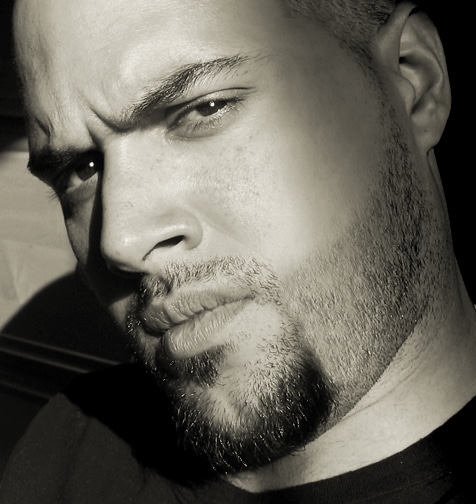
Once again we return to our So You Want My Job series, in which we interview men who are employed in desirable jobs and ask them about the reality of their work and for advice on how men can live their dream.
Becoming a professional photographer is the dream of many a shutterbug. But going from snapping pictures of the birds in your backyard to shooting the cover of a magazine takes a lot of luck and a lot of hard work. Michael Le Brecht II knows this very well. Michael got his big break when he landed his first Sports Illustrated cover with the young high school basketball player deemed the “chosen one,” LeBron James. Since then Micheal has shot over 30 Sports Illustrated covers including another LeBron James cover, Chad “Ochocinco” Johnson, Eli Manning, Oscar De La Hoya and more. Michael is a talented portrait photographer and took a break from his busy schedule to give us a little insight into his job.
1. Tell us a little about yourself (Where are you from? How old are you? Where did you go to school? Describe your job and how long you’ve been at it, ect).
I’m originally from Brooklyn, NY and now reside in NJ. I am 33 years old, married to Yesenia, and have two children, Samantha and Mikey the III. I went to SCCC in Loch Sheldrake, NY, and F.I.T. in NYC. I have been a professional photographer since 2000. I primarily work for Sports Illustrated as a freelance photographer shooting portraits.
2. Why did you want to become a photographer? When did you know it was what you wanted to do?
I always enjoyed going to pro sports games and taking pictures when I was a kid. In high school, I took a photography course and since then I knew this would be my profession, so much that my photography teacher wrote in my yearbook: “When you become famous and shoot for Sports Illustrated, give me a call.” So I did.
Advertisement
3. If a man wishes to become a photographer, how should he best prepare? Do you recommend majoring in photography in college or taking some other route?
Shoot, Shoot and Shoot. Majoring in photography is not necessary. Taking courses only helps. Assisting and shooting is the most important thing an aspiring photographer can do.
4. How does being a freelance photographer work? Do you only get paid if a publication accepts and publishes your pictures?
As a freelance photographer, you are at the mercy of a phone call. The good thing is that you can turn down any assignment without literally getting fired; the bad thing is that you really can’t turn down any assignments. As a freelancer, it is important to be available when called upon. Payment is per assignment, and in some cases you can get paid more for usage of images (Space over rate, whichever is greater). Ex. $1000 day rate, $2000 usage fee for a cover shot = $2000.00
5. How competitive is it to land a job as a sports photographer?
Very. As much as I want to say it is initially talent, it’s not. It’s “who you know.” Talent keeps you in the game, but “who you know” gets you in the game.
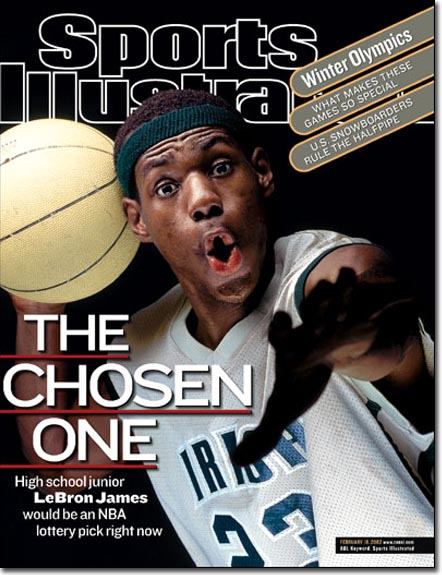 Famous SI LeBron James cover
6. How does a guy work his way from shooting high school football games to taking the cover of Sports Illustrated? How did you work your way up and what tips do you have for others?
Practice and timing are very important, but being in the right place at the right time is everything. Luck is a big factor in sports. You can prep and anticipate every play, but what makes sports so great is the unknown. I think it’s possible for anyone thinking of being a pro photographer right now; with the latest technology, if you have the money for the expensive equipment, shoot a lot of high school and college games, and put together a nice portfolio, you can work your way up. But it does take luck. I started out working as an intern at ABC television in NY. There I met James Drake, an editor for ABC at the time, who used to be a Sports Illustrated staff photographer. He introduced me to Manny Millan, one of the greatest basketball photographers of all time. Manny was a SI photographer who later took me on as an assistant. I worked with Manny for five years. He was a mentor to me, a man for whom I will always be grateful. In 2000, I started shooting more and more, and SI took notice and hired me for my first job, The Little League World Series. It turned out that the team from NY had a ringer named Danny Almonte, so it turned into a national story and my portraits of him ran in the magazine. Early the next year, I shot my first cover (currently over 30 covers) for SI, and it was LeBron James, “The Chosen One.”
Advertisement
7. What is the best part of your job?
Having the opportunity to capture history, by freezing time in a creative way.
8. What is the worst part of your job?
Traveling delays and being away from the family.
9. What’s the work/family/life balance like?
This is the hardest part, balance. But as I am figuring out, you have to schedule everything in order to not let one entity of your life suffer your absence. Managing all this is not easy but is doable.
 Personal holiday card taken for Grant Hill and family
10. What is the biggest misconception people have about your job?
That you have it easy, that when you’re not shooting you’re doing nothing. Shooting is the easy part; its everything else that’s hard. I believe when you are a professional photographer who freelances you have a 24/7 job. I constantly have to promote myself, and I spend countless hours archiving and retouching images. It is very misunderstood.
11. In this changing media landscape, what are your thoughts on the future of the photography profession?
The future of photography is video. It is only a matter of time where most jobs will be shot in video, and grabs will be made to create stills. So there will always be need of a photographer, but the photographer must continuously evolve.
12. Any other advice, tips, or anecdotes you’d like to share?
Professional photography is definitely not suitable to all photographers, as the uncertainties of your next job is stressful enough to cause hair loss (happened to me), heart attacks (not yet), and very high rates of divorce (hopefully not me). But despite those associated fears, I wouldn’t trade it for a 9 to 5, I guess I was made for 24/7. One’s life can be enjoyed to the fullest every and any minute of each and every day.