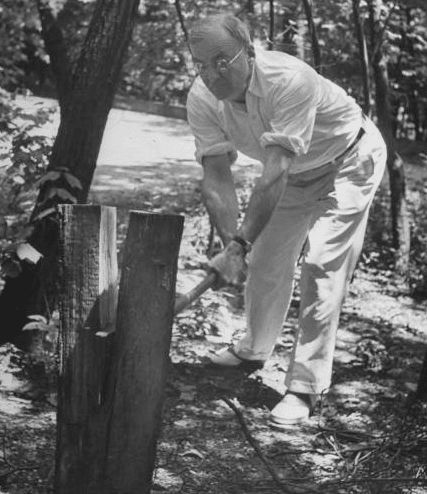







Editor’s note: This is a guest post from Will which originally appeared in the Art of Manliness Community.
I’ll admit it: for me, splitting wood has nothing do with lowering the heating bill. I like that satisfying thunk! and the feeling of power, seeing that big obstinate piece of wood doing what I want. The look of the fire in the evening is nice, too, especially when you didn’t have to buy the wood at the supermarket.
Here’s how to harness your inner-lumberjack and hew some firewood with your own manly hands.
What You Need
A maul or ax. A maul is heaver and has a wider head than an ax which makes it advantageous to splitting wood. But an ax can work just as well for smaller wood splitting jobs. Also, remember that the key isn’t sharpness; you’re not cutting wood or even chopping it (a common misnomer); you’re splitting wood.
Wood. Seasoned wood splits better, but I usually split the wood green, so I don’t have to stack it again.
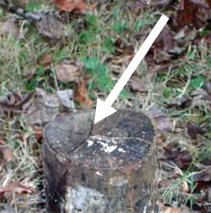
If the wood has nails in it, forget it. It’s not worth the risk of damaging your ax, or for that matter your eye when that nail goes flying. And if it’s curvy, don’t bother. I’m no safety expert, but trying to deal with unusual situations is often how accidents happen.
If it’s got a knot in it, skip it, especially if it’s green. You’ll spend all day trying to get through it. The exception is if you can find a line through the center that doesn’t get close to any knot. Then the knots won’t interfere. (“Center” is defined by the grain or splits in the wood, as shown on the right.)
Split It Along the Lines
Put the piece on its end, on a chopping block if possible. If not, just put it on the ground, propping it as needed to keep it standing. Driving the ax into the ground dulls it, supposedly, but I’ve chopped into dirt countless times and the ax still cuts.
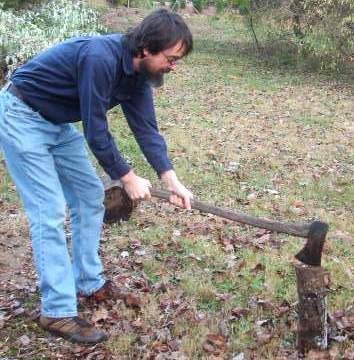
Now place yourself such that when you swing with straight arms, the blade will hit the wood, right in the center (picture on left). Err on the side closer to you. Here’s why: if you miss on the side close to you, the blade goes into the ground. But if you miss on the far side, the ax handle hits the wood. Too much of that and you’ll be buying a new handle. (It hurts your arms too.)
Making sure there’s no one and nothing you don’t want damaged anywhere nearby, to be hit by flying wood, a flying ax, or anything else . . . stand with your legs apart a little, pull the ax straight back over your head, and swing it straight forward. Build up speed and let the momentum and weight of the ax do the work– not your brute strength.
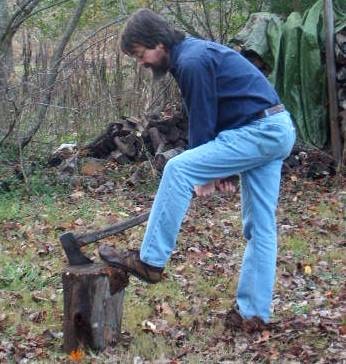
I try to hit the same place every time. I never do. It doesn’t matter. Wood with a slightly ragged edge is not a problem. You will get the ax stuck in the wood and have to wrestle it out (right); that’s also not a problem.
Eventually it will split with a nice crack! Then do a few gentle hits into the crack to separate remaining strands of wood connecting the pieces of wood together.
If the piece is bigger, you can still go for the center, but it might be easier to chop pieces off the sides, until you have something manageable.
What You Get
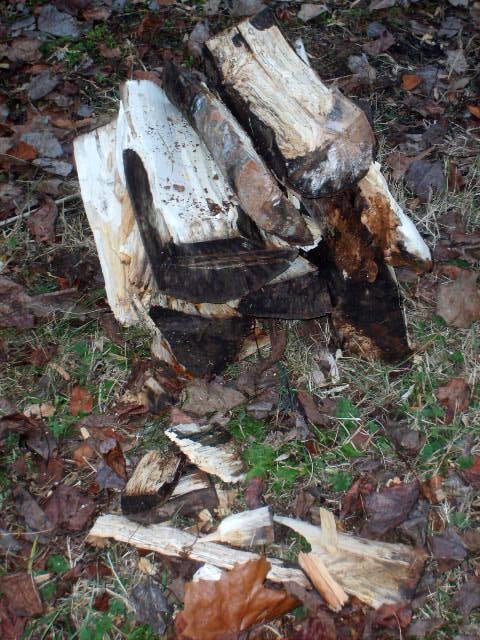
Those pieces that you made too small . . . are your best accomplishment, because they’ll help you start the fire. Split wood burns more easily, especially the small pieces.
And now that you have a woodpile full of fuel . . . it’s time to make a fire.
Bonus Tip:
If you’re cutting a big ol’ piece of wood, here’s a tip to save you time and energy:
(Hat tip to Paul for this find)
What are your tips on splitting wood? Got any recommendations for axes and mauls? Share your advice with us in the comments!
Related manly posts:


Facebook


{ 47 comments }
Ax not a Maul? A maul is so much easier. Axes are sharper and narrower, made for chopping. A maul is heavier and wider, made for splitting. The cost is negligible. Anybody that splits wood will tell you that you should use a maul for splitting and an ax for chopping down trees.
You missed the most important part. Stacking it. But maybe that is a post on its own. Stacking it so that it does not fall over is a big step. Just a thought.
Sincerely,
Kirk
I’ve grown to really enjoy splitting wood. So much so that I’m ahead of schedual this year. All the winter wood has been cut and stacked in a small barn and the remaining wood is heaped up in a large pile next to it. All that extra firewood is like adding money to your savings account. Nice to have in case of an emergency.
In the past I’ve borrowed two hydraulic woodsplitters and I managed to outlast them both. I felt a sense of triumph. Like John Henry going against the steam powered technology of the day.
Not only that, but splitting wood:
1. Provides heat in the winter months
2. Relives stress & gives me time to relax my mind.
3. Gives me a sense of accomplishment at the end of it all. (wipe brow and get a drink).
What kind of pathetic wood are you guys splitting? If it’s anything like that video, it’s not worth burning in your fireplace. If that big block was Australian Ironbark, it would have taken 5 minutes of hard work with a block splitter (or maul, as you Yanks seem to call it) before you got the 1st crack. Thats why the big bits are split with a chainsaw and hydraulic ram. You then attack the smaller pieces by hand. The best firewood I’ve ever come across is from old fence posts, preferably Ironbark, but any hardwood does the job.
Here is how you splitwood:
http://www.youtube.com/watch?v=YeanPDO-D6M
I agree with the above posters — you need a maul. With that, it’s mostly about the form of spinning the maul around, not strength (although that doesn’t hurt). Once you have the form down, you can hit the log in the same spot two or three times and the wood is split!
Ditto — you definitely need a maul. But if you don’t use a maul, you can get by with an ax, provided: 1) it has a sufficiently heavy head (my father said a double-headed ax was always his favorite, even more so than a maul), and 2) has a wooden handle. A fiberglass handle, while supposedly more durable, is too light. It will also develop hairline cracks that will shed splinters that hurt like the dickens and are nearly impossible to remove.
Also, the instructions completely fail to mention what you’re aiming for: a wedge-shaped piece of wood that has at least two sides of bare wood, with only the short curved side still covered in bark. The whole reason for the exercise is because bark is fire resistant, so you need as much of the heartwood exposed as possible. This usually means splitting each log into four pieces (three splits).
Personally, when I split wood I prefer using a wedge and sledgehammer. Once you’ve started the wedge into a crack, every blow of the hammer strikes the same spot, so you’re not wasting effort hitting here and there before you get a splitting blow. That said, I split wood for material for my woodworking.
As far as tough woods to split- the worst I’ve run into is elm. Woods like maple and oakrive easily once you get them started. For elm I had to pound the wedge to the bottom, and the wood still refused to come apart completely.
Here are some beautiful examples of how to stack the wood:
http://www.acontinuouslean.com/2009/11/03/firewood/
1. Use the whole handle, as you swing your top hand should slide down the handle and finish touching the other hand. Slide your hand up the handle to retrieve the maul over your head. (I use an 8 lbs maul). This keeps you from bending over so far (protects you back) and gives far better speed with the maul.
2. every block has some natural cracks. with knotty and large wood, aim for those.
3. put the knots on the bottom.
4. with large un-splittable blocks, chip chunks off the side, it lowers the cohesion of the rest of the block and eventually you can split anything.
the fiskars axe is way too short.
If you have a large round, start hitting it with the log splitter on the far side away from you then work your way towards you, just take a half step back after each swing then if you still haven’t opened a cleft flip it over and do the other side right above the one you just did and it should open up pretty good. Once you have a semicircle shaped block of wood just use a sharp axe to hack triangle shaped pieces about 150mm across off the sides and each bit you take off will leave another option for another triangle, this also makes it easier to stack. I do this with the huge wind blown macrocarpas from old shelter belts on my mates farm.
we cut 5-6 cords of wood (each is a stack 4′ x 4′ x8′) AND a thousand gallons of heating oil each year (big old farm house)
>my boys are indispensible to this process… a great source of manly training. here is a way to make it fun for them …. wood-splitting golf. the parties involved agree beforehand how many strokes a piece will take to be split, then have at it… if you do it in 1 fewer strokes than agreed to, you shnot a birdy
… if you need an extra one, its a bogey, etc. then it’s the other guys turn. it’s kinda fun.
>yes, dont waste time on gnarly pieces you come across…. we save them for a bon fire at thanks=giving or new years.
>if you have one with a prominent fork in it, do NOT try to chop between the branch and the main trunck.. the tree is MADE to resist that sorta action. instead, turn the thing upside down and aim your stroke so that your blade is in the middle and inline wiht the branch and trunk.
>we had a wood splitter… prefere the quiet and companionship of hand splitting. the range of motion is better for the back too.
>if the piece is fairly big across, you will need successive hits that form a line across the center… remember.. the bark acts as a girdle holdign the thing together. so giv e it a hit onj one edge and work your way across.
>as we live in maine and its fairly cold, we only do hardwood, which has more heat value. GENERALLY softwood is easier to split, but good for quick fires.
>we cut the trees, split it and stack it in the woods to dry. leaves all the mess out there, and makes it more pleasant an atmosphere. then in the fall we go out as a family with the tractor and trailer, and some cider to fetch it. this also breaks up the work over time. was a groaner for the kids when young, but part of them love it now.
>though we have all the modern conveniences, my wife has a wood cookstove too. there is nothing like cookies made in it
b
@Ryan Duff and Mike Hostetler: I’ll take your word for it that a maul would work better—I’ve never split wood at all, much less with a maul. But I do own an axe! And I think there are lots of men in my situation. Given that this is a “how to” post, I think the verbiage of “A maul is heaver and has a wider head than an ax which makes it advantageous to splitting wood. But an ax can work just as well for smaller wood splitting jobs.” is more than fair and helpful.
I find that starting with my right hand (I’m right handed) on the top of the ax handle and sliding it down as I swing gives me a better split. You need to be careful while doing this because you can lose accuracy if you’re not careful.
14 years we’ve heated our home, dried our clothes and heated our water with wood from 39 acres of mostly Oak/Popple, using 8-11 chords/year depending on weather. “making wood” as it’s called in our rural area, is considered by nearly all the men almost a spiritual thing, as comments above hint at, there is a mental health benefit, difficult to describe, that makes a men & boys feel manly to drop-block-spilt-cure-burn wood to meet our needs, it just feels great. Besides Michael’s tips(#10 above) and others, I’d like to add these: A key to splitting is reading the wood, like you would read the water on a stream to avoid the underwater obstacles. A chopping block about knee high can save your back-the completed stroke ends up with the maul handle level. For tough wood, cut blocks ~12″ long for easier splitting; short pieces “stack” well with this quick method: Toss the wood into a “wind row” pile on a line of pallets. Tarp or use some scrap steel siding or scrap plywood just for the top 30% so air flow is maximized for good drying (needs 2 summers minimum in a very open area for green oak.) If you don’t dry it well, you can have lots of creosote build up (potentially very dangerous) and much less heat as your fire must boil the moisture out before it really burns.) For smaller pieces of wood, ones that won’t stand up for you, lay it down on your block-hit it on the side. Frozen wood splits easier. A rip chain (works great-fast!)for your saw is worth it if you your wood source includes a lot of big old trees or has species of very tough wood like elm, cottonwood, box elder, etc. Lastly, allow me to bust one of the common myths: all species of wood generate very closely the same BTU’s of heat per pound of dry wood. It’s the volume that varies; I know to cut 14 chords of Popple to equal the heat of 9-10 chords of oak. If you don’t burn wood, offer to help someone who does, pack a great lunch, maybe bring a grill, and you’ll enjoy the day better than most other things you could have done.
Wood splits much easier when temps have been in the 30s for a while. Also, for large pieces, a wedge and sledge hammer work very well.
Interesting posts, but so far no one has actually given the best tip for splitting wood. Wood splits best when it is green, and the weather is very cold. My father, brother, and I kept warm in a turn of the century farmhouse. We cut wood on the weekend, and burned a minimum of 4 face cords a week. So, here is the tip. However you present the blade of the ax to the wood, at the moment of impact turn the top of the ax, and your wrists to the left quickly, all in one motion. The pushing of the blade to the right will blast the wood apart. Its a neat trick, and I have had much fun with my city friends after they were unsuccessful, popping the wood apart……
I just want to reiterate sean’s comment – I think pulling your maul/axe out of the wood is a waste of energy. A couple of blows with a sledgehammer will usually finish the crack made with your initial blow.
About 35 years ago, an old timer my dad hunted with told me this: Wood warms you up 4 times. 1) When you cut it; 2) when you split it; 3) when you stack it; and 4) when you burn it.
I started splitting wood when I was nine years old with a hatchet and a small sledgehammer. I’ve never really stopped.
These are Midwestern backwoods terms for the various tools used:
Bit: Term for blade. A double-bit axe looks like Gimli’s in Lord of the Rings.
Hatchet: a single-bit axe designed to be small and light for one-hand use. Not much good in splitting unless you are trimming branches off a log prior to splitting.
Chopping axe: Light weight axe (can be single or double-bit) designed for chopping against the grain, generally very sharp. Should NOT be used for splitting without an underlying piece because if you do sink it into the ground and hit a rock, that thin edge will notch badly.
Maul: Heavy, single-bit tool with a round, tempered back end that can be hit with a sledgehammer without damaging the tool.
Lickety Splitter: A massive maul with a soft steel head that is easily sharpened if you accidentally hit a rock. It cannot be struck with a sledgehammer without damaging the tool. Generally 10-15 lbs. head…not a tool for beginners. It takes a few days of use for an experienced splitter to acclimate to its size.
Sledgehammer: Large hammer (8-12 lbs. head) designed to drive wedges and mauls through logs.
Splitting axe: NOT a maul. A splitting axe is lighter, generally has special wedge-shaped parts on the sides of the main wedge of the head, and may NOT be struck with a hammer. You’ll hurt the tool.
Wedge: Literally an iron or steel wedge. You drive it through logs to split them. Respectfully, I disagree with the article in that you CAN successfully drive through most knots with a wedge and sledge combo.
Wood Grenade: A four-sided wedge that splits well-formed logs into four pieces.
I personally use a Fiskars chopping axe to cut down trees, and their splitting axe for most of my splitting. For heavy splits I use a 12 lbs. Lickety Splitter or wedges and a 10 lbs. head Stanley sledgehammer. I’ve never had any difficulty with fiberglass splinters after 5-6 years of using their tools, and they are so well designed I can generally split 2-3 pieces to someone else’s 1. Unless they are using a much larger tool like a Lickety Splitter…and in that case, I outlast them by an hour or two with a much lighter Fiskars splitting axe.
Just my two cents.
Safety is being missed here. An old scoutmaster’s rule: Before you swing the ax/maul the first time, hold it out at arm’s length and mentally double this distance. Turn 360 degrees to measure a circle around you. Mark this perimeter with a rope. Never, ever allow anyone to enter this circle. No running is allowed anywhere in the general vicinity. Small children should be inside or holding the hand of an adult while they watch you from well outside the rope.
Also, hold the ax straight up above your head, stretch as high as you can on your tip-toes, to ensure that the ax won’t snag anything overhead.
My grandfather grew up splitting wood and when younger, used a cross cut saw take trees down. He usually used what he called a pole axe to split wood. Which is just a regular axe used for splitting. He also used a technique, which me or my father cannot match, for wood splitting. He would twist his wrists at the moment of impact, which would almost bust apart most pieces of wood. When I try this, it usually results in the axe bouncing sideways off the wood. My grandfather did have unusally strong hands and the heating of his family’s home and stove depended on plently of wood, so he had plenty of practice.
The maul is also referred to as a “go-devil”. Typically the most difficult wood to split is a green water birch, which is just a knot of stringy grains. It makes it very difficult to start a good split in the wood, you are typically just cutting the pieces apart and if using a hydrolic splitter, it just “mashes” up. Probably the best burning wood is good, dry black locust. It burns hot and long. It also makes great fence posts, being that it is very hard and rot resistant.
Note: if you are splitting wood with someone else and have two splitting mauls or if you are by yourself and have two mauls, just use the hammer edge of the other maul if you need to force the stuck maul through.
I have to agree with the guys who posted about the sledgehammer. I chopped a fair bit of wood in my day, and by far the best time I’ve had of it was with a wedge and a sledgehammer. If you can, find something called a “star wedge.” It’s got a star shaped pattern that goes down into a point, and there’s nothing it can’t split!
A lot of great discussion here! I do want to add something about safety: I think that old scoutmaster’s rule needs a wider range. It’s not just the ax that can hit things. Those pieces of wood often go flying, and although they’re not as bad as an ax, they can hurt!
And there’s so much more to talk about. I would like to see a good post about stacking the wood. And there’s the issue of avoiding creosote in the chimney.
Oops — just noticed Rick Scoutmaster’s comments on creosote.
wow, thanks for this, ALL of this. I guess my Dad was a manly man, and a pretty handy one at that who could do just about ANYTHING. Unfortunately i never had the best relationship with my father, so he never passed any of these skills down. thanks for filling the gap.
Will, the old scoutmasters rule is: before you swing the ax/maul the first time, hold it out at arm’s length and mentally double this distance
Yes. Wood can fly further than that.
A good read and many fine comments. I feel proud that I have something to add.
When purchasing an axe, have a mind to its head. While an axe head is a simple tool, there are still better and worse designs out there.
Look at the head from top down, where the handle sits flush at the top. Now look down towards the cutting edge. If the head is a straight wedge, you have a very basic design and though it may be made of a superior steel, the straight sided axe will stick in wood much worse than the next design.
If you look at the profile of the axe and see that from the edge it grows wider then narrow again before widening to cover the handle, you have a top notch axe. Such a blade will rarely stick in wood whether chopping or splitting.
Another point on handles.
The best material for handles that I have used is hickory wood. It has a light and balanced swing, dampens the shock of impact nicely and is very strong if used properly. If you should break a handle it can be replaced in an afternoon, if you have the knowledge to do it properly. Break a fiberglass handle and you will have no such luck. Even if the hickory is to be replaced once a year (and this due to improper use, I would think) and the fiberglass not at all – the hickory has a better swing and is handsomer in appearance.
I hope this is of some help.
Many good comments so far. Working wood for fuel by hand is a lost art like so many things, and so enjoyable. Here’s a few pieces of info that I’ve found useful:
1. A maul is tool that’s best for splitting. An axe is designed to cut. Keep your tools sharp and free of corrosion. Old school axes and mauls had hardened edges like a chisel, most modern tools are not hardened. You could seriously heat damage an old school axe with a grinder, but nowadays you can use grinders and whatnot to reset the edge on very dull tools.
2. Wood that has dried some will split best. If you want to impress, split very dry wood with a straight grain and use a heavy maul (~8 lbs. or so). Give it a full swing with your dominate hand providing the force and your other hand on the bottom of the handle. With good aim you will split perfectly on the first blow.
3. Remember that the point is preparing lots of wood. Efficiency is everything. If you’re spending lots of time on one piece something is wrong. Either you have the wrong tool, a bad swing, or wood that’s too green or knotty. Assess the problem and re-attack. Splitting wood should be fast and effective.
4. If you want to learn more about traditional woodcraft I’d recommend the book “The Woodwright’s Shop” by Roy Underhill, published 1981.
A maul. A sledge. Two wedges. No axes if you are splitting wood. Use the axes to delimb a felled tree. I prefer A Snow & Nealley hudson bay axe for that job. Enough said.
Excellent comments! One idea that I didn’t see…If the Maul gets stuck on the first swing you can also pick up the maul, wood and everything and swing it upside down so the maul hits the block first. Almost every time the wood will split all the way through. It is heavy, but that weight provides a lot of momentum.
Gentlemen,
Just a tip for someone getting their splits by swinging either an axe or maul:
Think of it like hitting a baseball or golfball… don’t take your eye off of it! If you keep looking at the spot you want to hit, you have a much better chance of actually doing it. I run an 18thC historic site. Hand-forged axeheads with round eyes and no poll, and most of what we split goes for cooking & baking. This means splitting each piece down to smaller and smaller bits (that’s where the hatchet comes in) and try (I emphasize try) to teach new teenagers every year how. Scary. Its in the swing and letting the bit do the work.
I prefer a 3 1/2 lb AX for resplitting wood. I have a wood cookstove, our only stove and our primary heat in an off-grid cabin.
I buy our wood, and it comes “split”. But 95%+ won’t fit into the small firebox, so I resplit almost all of it. Sometimes I split it down into six or more pieces!
I like an ax for this, its much easier to swing well and accurately and I think it splits more easily with its narrow head. I’ve used a maul plenty of times too, but sometimes its not the best tool. Just to note the wood is Pinon which is a pine that is almost a hardwood. I’d not normally try to do an initial split with my ax on a large and unsplit piece, a maul works better for that.
Also, I hate axes and mauls with handles that are too short. If I miss I want to be absolutely certain its hitting the earth and not my feet.
well, i gotta tell ya, for the hard wood i use a maul. the soft wood, like birch, splits a lot easier with an axe. its good to have both.
Green wood or seasoned wood, what is easiest to split?
It is much easier to split green oak, but Maple splits easier when seasoned.
I used to use a “wedge” that looked like a barbed cone, and a sledgehammer. It split the toughest logs neatly in half.
I can’t believe Michael is the only one to mention this, but I was taught by my father early on that you can save a lot of your strength by sliding your hand from the top of the handle to the bottom as you swing. This will allow you to control it as it’s coming down and it also makes it lighter work. Of course, you get more blisters on your hands, so you need leather gloves. Anyone who’s split wood knows that you need them. The kind I like the most are hard tan leather gloves.
Lots of conflicting information here, but agreat debate none the less. I do enjoy splitting wood, which is good, because I get to do about 5-7 cords each fall. Green, dry, knotty, pine, fir, larch (the Montana gold standard,) even some aspen and cottonwood when they blow over. We take what we can get, because we usually put it off until September, and then beggars can’t be choosers! What follows are my humble opinions on the humble topic of splitting wood:
Watch out for beetle killed trees. They are tempting, standing there all dead and dry. But the tree filled all their bore holes with sap, and that resin becomes creasote and tar in the stove. Plus, if you don’t burn it all before the beetles emerge, they might eat the trees in your yard, and that’s not too cool. I guess that mostly applies to softwoods.
Hickory or ash handles are vastly superior to fiberglass. Fiberglass is too flexible. I can feel energy being wasted as the maul head contacts the wood, and the handle bends. With a maul, its all about shocking the wood apart at the moment of impact, and any energy that is absorbed or even delayed by the handle softens the blow. They may be indestructable, but you will pay for that in extra labor.
As was mentioned by others, I too start with my hands apart, and bring them together near mid-swing. I also start with the maul head in front of me, held sort of like you might a rake or broom at rest, and bring it completely around, none of this over the head business. I also take a step forward, and finish up bent forward at the waist. This is a total-body workout, and generates a considerable amount of force, if I do say so myself.
I also never use a block. A lot of power becomes available from the core muscles when you bend at the waist, but if the wood is up high, you can’t bend, so you can’t use those strongest of muscles. I like my firewood “downhill” for splitting.
As another gentleman commented above, half the battle in wood splitting is “reading” the log. Take advantage of natural checks in the log. Be aware that branches do not grow opposite each other, but in a spiraling pattern of mathematical beauty, so that one branch does not shade the ones below it on the living tree. Therefore, if you have knots, don’t split at right angles to them, put your split lines just a little to one side of a knot, and you can be sure in most cases that the wood below is clear, and should split well. And if it still gives you trouble, don’t wear yourself out beating on it, get out your wedge.
Obviously, that first split (in half) is the hardest. If you’re faced with a big round, the best way in my experience to get it apart is to put one lick on the far side of the round, as close to the edge as you dare, then one on the near side, again close to the edge, and in line with the first. Repeat, drawing the line towards the middle from both sides, until it pops. With experience, you’ll know when it’s ready for the coupe de grace, and space your blows accordingly. I have split tamarack rounds the size of card tables this way. Admittedly a easy-splitting softwood, and boy was it fun to watch those monsters jump!
I’m looking forward to trying the “wrist flick” this fall. I have a similar trick. I usually line up several rounds to split in sequence. To keep them from splitting apart wildly and knocking their neighbors over before I get a chance to, I pull toward me at the moment of impact. This somehow calms the action of the split pieces, and they fall rather gently to the side, and slightly forward, towards me. Split on.
All this talk about this wood or that is best is pure snobbery. Are we lesser men because my great northwestern conifer forests are devoid of black locust or your eastern hardwood forests lack ironwood!?! Use what you got and be thankful you live in a place where there are TREES!
Wow, what time is it? I gotta go to bed.
My grandfather use to punish my dad with splitting wood, but he always kept it secret that he actually loved doing it.
I feel very fortunate to have grown up on a farm with a wood stove. My brothers and I would often fight over who got to split.
Yet another advice, this one is from a 72-yr-old Russian. Always use a bottom piece, and put the log to be split on top of it. If you split the log standing directly on the ground, you are wasting your energy by compacting soft ground soil. Use the bottom piece which is wide, heavy and knotty. The heavier the bottom piece, the easier the splitting.
I carry a small hatchet into the woods and have been splitting logs this way for some time:
http://www.youtube.com/watch?v=FmXURKP3RMY
This technique plus a good sharp knife (and a little bit of knowledge) goes a LONG way…
You can easily fell a large tree (or make sections from fallen trees) and make a shelter or whatever with this..
Things to keep in mind while using a axe are:
safety, read the wood, efficiency (work smarter, not harder!)
Stay safe and have fun
P.S. love the site!
Good tips all, but here’s one I haven’t seen posted yet:
When dealing with a tough piece that won’t split upon first impact with the axe (if you’re using an axe), don’t waste energy trying to wrench the axehead out of the wood for another blow; simply raise the axe with the log stuck on it, rotate everything 180 degrees, and bring the back of the axehead down on a firm surface. The log will split itself on the axe by its own inertia. I know, it doesn’t seem like it would work that well, especially as it’s difficult to swing with much force with a log on one’s axe, but you’ll be amazed. Physics, baby.
This particular article describes the technique fro splitting wood minimally. There is more to it than just swinging a sharp peice of steel.
1. begin by standing with feet slightly wider than shoulders, toes pointed ahead. guage your distance to the log by resting the axe head on the wood. hold the axe with left hand on the base of the axe handle and right hand above it, similar to a baseball bat.
2. step back with the right foot only. about 20 inches. the distance between heels should be the width of your shoulders. your shoulders will be turned and your knees slightly bent. keep your left hand at the base of the axe, but allow the right hand to slide up the handle almost to the head. while holding the axe, put your right thumb to your right shoulder so that the axe head is behind you, blade facing the sky, your left hand holding the axe is in front of you, and the axe handle is aimed at the wood.
3. to strike, push the axe head straight up with your right hand and the handle with your left. simultaneously, begin to step forward with your right foot. the effect is that the whole body raises while you push the axe up into the air. once your left hand is at the same level as the top of your head, stop it and allow your right hand to slide down the axe handle, camming the upward movement of the axe handle into a circular swing.
4. impact. just before the axe head strikes the wood, your right foot should plant shoulder width from your left and your right hand should find its place just above your left, and grip the axe firmly. both hands will be between knee and waist height from the ground, depending on the height of the wood being split. At the moment of impact, the handle should be paralell to the horizon or on a very slight angle with the head end lower.
The result is that you use your entire body to strike a powerful blow against either a peice of firewood or capital criminal. It matters not, both bring comfort to all present when split and burned.
Comments on this entry are closed.