





It’s every man’s worst fear. You’re at someone’s house, you finish doing your business and flush the toilet, but instead of going down, the water comes up along with whatever you just deposited in the bowl. Would you be paralyzed with panic in that moment? Or do you know what to do?
For some reason, the lot has fallen to men to deal with clogged toilets. I guess in a time when we’re no longer needed to ride out in defense of the tribe, our toughness is marshaled to do battle in the bathroom. But many men charge in brandishing their plunger but lacking a game plan on how to attack the clog. To help us learn how to effectively unclog a toilet, I called up Rod from Roto-Rooter and got the scoop. Here’s his advice.
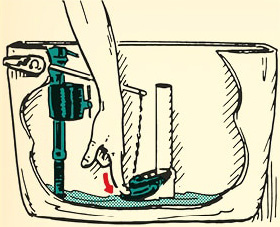
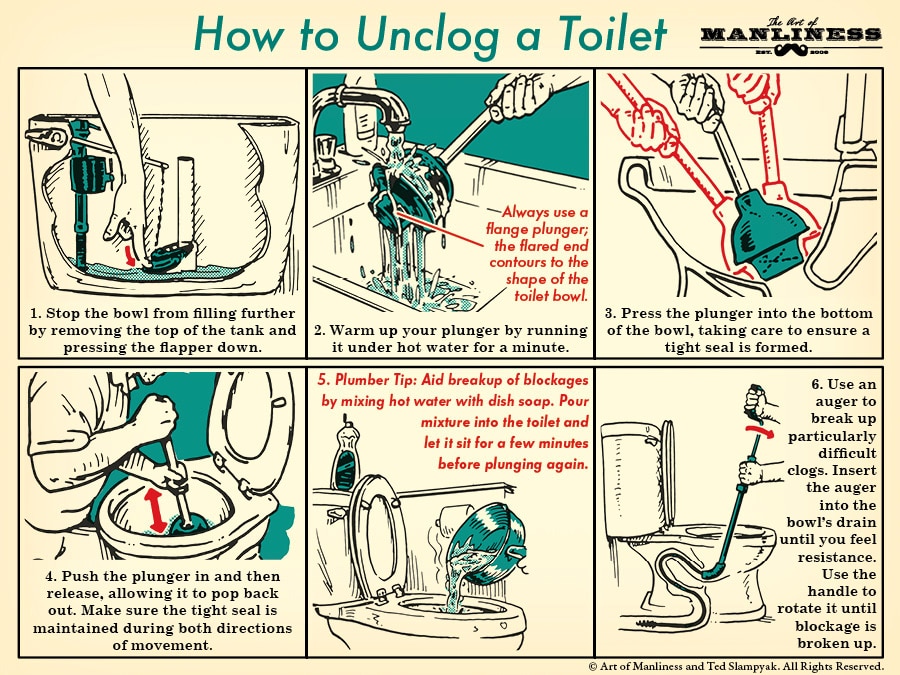
Stop the toilet bowl from filling up. If it looks like the water might overflow out of the toilet, Rod suggests taking the lid off the tank as quickly as possible and closing the toilet flapper. The flapper releases water from the tank and into the bowl. It looks like, well, a flapper. If you’re worried that your flush has a good chance of turning into a flood, take off the top before you pull the trigger. Then you can keep one hand close to the flapper while the other hands pushes the flusher. The minute it appears the water is rising, you’re ready to stop the deluge.
Toilet flapper (Image source: The Jay)
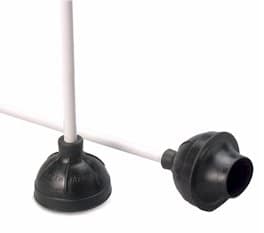
Get the right plunger. Once disaster has been averted, it’s time to unsheathe your plunger. To effectively use a plunger, you need a good seal between it and the toilet bowl. Funnel-cup plungers are the best plungers for this. They’re the plungers with a flange, or added piece, extending off the bottom of the rubber cup.
Funnel-cup plunger
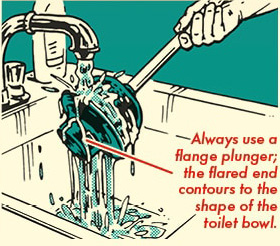
Warm up your plunger. Stiff, hard plungers don’t work as well as soft and pliant ones. Run your plunger under some hot water before you use it. This will soften up the rubber, which will help you get a better seal on the toilet bowl.
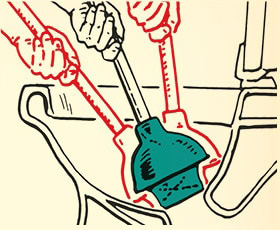
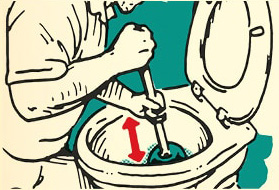
Plunge correctly. Stick the plunger in the bowl and use it to form a solid seal over the exit hole. Rod said that most people only focus on the downward push when plunging. But the pullback is just as important. Give a few good up and down strokes with the plunger and flush the toilet. If the water clears from the toilet, then you’ve successfully unclogged it. If the toilet starts overflowing again, just close the flapper to stop water from entering the bowl. Repeat the plunge and flush sequence until your clog is gone.
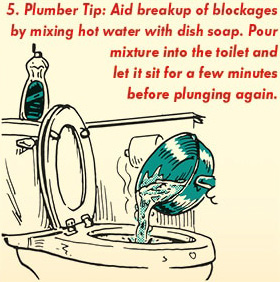
Secret Plumber Trick: Add Hot Water and dishwasher detergent. Add a few cups of hot water to the toilet bowl before you start plunging. After you pour the hot water in, let it sit for a few minutes. To put it mildly, the heat helps break the, um, stuff up. This will make unclogging the toilet with the plunger much, much easier. The heat from the hot water can sometimes break up the clog without plunging, so this could be a good tactic to use if you a clog a toilet at a friends house and you don’t want to face the embarrassment of asking for a plunger.
Also, try adding some dishwasher detergent to the mix. The soap can help break the clog up, as well.
(Hat tip Ryan and Jim in the comments).
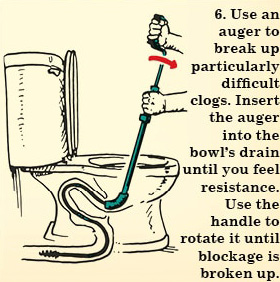
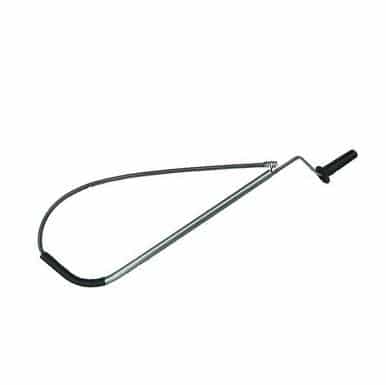
For harder clogs, use an auger. If the plunger doesn’t work, Rod says it’s time to bust out the auger. An auger is a cable like device that you snake through the toilet hole to help loosen up a clog. You can find augers at most hardware stores.
To use an auger, you simply snake the cable down the hole. Start turning the crank on the end you’re holding until it stops. This means you’ve reached your clog. The auger will either break up the clog or hook on to it. If it feels like you’ve hooked the clog, pull it out. Discard any waste on the end of the auger. Give the toilet a few good plunges to clear up any left over blockage. Flush. Shazam! Cleared toilet.
When to call the plumber. There are times when your own efforts just aren’t enough. How do you know when it’s time to call in the professionals to battle your clog? Rod says that if you see water backing up in the sinks or showers whenever you flush, it’s time to bring in a plumber. Water backing up in odd locations when you flush means you have a clogged main line. A plunger and auger won’t get the job done.
Avoiding clogged toilets. Rod’s parting advice was to avoid clogs in the first place. First, teach children that the toilet is not a Jacuzzi or water ride for their GI Joes. Rod says that the majority of his work with clogged toilets involves toys and other items that kids have flushed down the toilet.
Rod also says it’s important to ensure the jets around the toilet bowl’s edge are nice and clean. Stopped up jets will prevent the toilet from flushing at full power which in turn prevents you from clearing out the toilet and its contents. Weekly toilet cleaning with a brush will prevent build-up. If you haven’t cleaned the toilet in a while, you’ll probably have mega buildup. Rod suggests using an Allen wrench or screwdriver to clear out the junk.
Finally, take it easy on the paper. You don’t need an entire roll to wipe your bum.
Any more tips on how to unclog a toilet? Share them with us in the comments!


Facebook


<
{ 10 trackbacks }
{ 38 comments… read them below or add one }
Very nice piece. I too am the blunging hero in my household. I cam credited as being the quickest blunger in the SouthEast that is not a real plumber. What can I say, I learned from the best… thanks dad.
I share your the role of sole-plunger in our home. I don’t know what would happen if there were a plug and I wasn’t around; maybe we should have a class.
That being said, when I do have to “do the deed”, I’m always wary of the “the pullback” as I’d hate to get dirtied toilet water splashed back into my face. I’ve never had a problem in the past withOUT “the pullback”, though, so I’ll continue being an amateur, I suppose. : )
As always, good stuff men should know, AoM!
As a night-time janitor, I feel as though I am qualified to add one more technique to this already brilliant cache of advice: hot water. It seems counter-intuitive, adding more water to an already clogged toilet, but it works. Just add a few cups of hot water to the disaster, let it sit, flush, and plunge (only if needed).
Hope it helps; it sure has helped me.
For all but the worst clogs, I usually have very good luck leveraging gravity. Done properly, no tools are required. With a steady hand, press the handle down only slightly to let water slowly trickle into the bowl. Don’t let a full flush happen – you’re likely doomed to an overflow disaster. Let it fill the bowl almost to the top. A couple gallons of extra water at 8 pounds per gallon usually creates enough pressure to wash down the stubborn deed. Sometimes a little patience is needed, but within a minute or so, all is well. Again, I like this technique because no tools are required – it can be finished very discreetly when it happens away from home. Note: This will NOT work if GI Joe is hiding down here.
One thing about the funnel-cup plunger that’s important: Don’t go straight down into the water trapping air in the plunger when instead you should tilt the plunger to fill it with as much water as possible before submerging it. Pushing water instead of air provides more force into the exit hole, helps with the suction of the pullback and there’s far less bubbles exploding to the surface causing the dreaded “poo-water splash”.
How timely was this article? The only toilet in the house stopped-up at 7AM Tuesday morning. Sometimes potsful of hot water from the stove work but not this time, as it was coming up into the tub, as the expert warned. Last April we had the septic tank pumped and that wasn’t it. Rented an augur- it worked, although the business end was kind of puny. This time I reluctantly called Roto-Rooter and had a professional go back into the main line with his super-auger and it was tree roots. Again. The original owner planted a tree next to the septic tank, which was dumb, but it shades the deck so I don’t want to cut it down. If I have to go through this again, I will.
This is just one of those manly skills that not all men are born with. Thanks for sharing this as this will be truly useful for me and my husband. Keep up the good work. By the way, these best gifts that you could give your better-half might interest you too. Thanks and have a nice and fulfilling day.
I had a serious case of Toilet blockage the other day, try as I might the plunger wouldn’t work, and the u-bend was at such an angle that the auger wouldn’t get round. After trying the hot water trick which has worked in the past and sticking a long piece of rubber hose as far down as possible and blowing to try and create extra pressure (Please note to BLOW not SUCK!!!)
and having no success, I read about the Coke method. After pouring 6 litres of coca cola down the pan, what ever it was that was blocking it gave up the ghost and the blockage cleared. Only problem is now I’m a little worried about what the Coke’s been doing to my insides!!
Of course, if this happens “at someone’s house” and you’re hoping not to be embarrassed, you’re probably not going to have your choice of plungers — let alone an auger.
I will second the hot water trick. Hot water melts the fats and makes it all more flushable.
“Rod says that if you see water backing up in the sinks or showers whenever you flush, it’s time to bring in a plumber. Water backing up in odd locations when you flush means you have a clogged main line. A plunger and auger won’t get the job done.”
Wrong. This just means that it’s time to bring in a good, long pipe snake.
A few weeks ago, I ran into this problem when I discovered that my 2-year-old had been flushing baby wipes down the toilet. Sewage water was backing up in the laundry room drain and basement shower (*shudder*), so it fell to me, the man, to fix the problem. Plumbers have a dirty job to do, so they deserve their pay; however, a real man should be willing to take on his own home’s dirty job before forking over so much dough.
After many, MANY hours of running a pipe snake in and out of my main line clean-out, the pipe was cleared and the sewage drained mercifully back into the sewer.
@James, I too was hoping for the secret No Plunger trick to unclogging the toilet at someone else’s house. Guess I’ll just have to bring along my auger. Or hold it.
@James/Jamie-
Alas, there is no secret plunger-less method to unclogging the toilet. Rather, the take away tip is to close the flapper if the toilet is about the overflow. Most people then have a plunger nearby to care of the clog. If not, while it’s still embarrassing to ask for a plunger, it’s a lot less embarrassing then to tell someone, “My crap is on your bathroom floor!”
Nice article, I learned all these techniques.
The real question is how to handle the clog when you are not in your home. You don’t want to be the guest who clogged the toilet and needed help.
That is what we really need a lesson on.
I may be stating the obvious, but it helps to know the location of the cleanout. In my home, a previous owned had sheetrocked over it!! I’ve never needed to use it, but thanks to a thoughtful plumber marking the wall, I know where it is.
I once had a clog that was unplungerable (if that is a word). My daughter flushed the toilet after doing her business and simultaneously knocked a tube of toothpaste into the bowl with her elbow. I tried everything to fish it out to no avail. Finally I had to disassemble the toilet and take the stool out into the yard and used a garden hose and a bent up coat hanger to get the tube out of the waste trap. This was not easy… Once the contraband was recovered (fully washed by this time) I took it into the house and showed the family the prize. The look of horror was priceless on my daughter’s face when I informed them that we do not waste anything in this house and that they would have to use the remainder of the toothpaste. Hehe… I was not serious and of course threw the tube of toothpaste away, but we have not had this happen since.
@Brett: I usually just reach for the water shutoff valve rather then open the tank and grab the flapper; this method may be faster, though, come to think of it.
Augers are powerful tools, but worth a bit of caution when you have to resort to using one.
Toilets are usually pretty safe as all the plumbing that’s likely to get clogged is heavy-duty porcelain, but sinks are a danger zone. I’ve seen augurs blow right through older pipes in kitchens and bathrooms and make a worse problem than you had to start with. Before auguring, take a good look under the sink at the condition of the P-trap pipes. Any rust? Corrosion? Leaks already in progress? If so, put down the auger and prepare yourself for the possibility of some under-sink surgery.
Also, when you’re plunging a bathroom sink (if you have a wife or daughter with long hair, this is not so much an “if” as a “when”), stuff a wet washcloth in the over-flow drain hole otherwise most of your plunging power will be wasted moving the water in the overflow path up and down instead of moving the water in the P-trap.
Liquid dishwashing detergent has been really helpful around my house to clear the really difficult clogs. Just squirt two or three seconds worth down the toilet, wait a little while, and flush; be ready to grab the flapper, though, in the event it was unsuccessful. It sometimes takes two or three iterations to clear a really substantial load.
In our house, toilets are plugged on a daily basis. We’ve spent many years unable to discover whether this is a plumbing issue or a biological one, but it has led to a surfeit of plunging experience for my father and I. In my experience, with a 100% human waste blockage, your biggest issue is how big the obstruction is. If it’s blocking nearly the whole pipe, flushing will cause the bowl to fill nearly to the top and lower extremely slowly. Luckily, clogs like this are usually the easiest to clear, as plunging puts more pressure on the entirety of the block. It’s the small blockages, that only obstruct a portion of the pipe, that take time and effort. Many times the majority of the water will flow right around the block, making it hard to get the pressure you need. Luckily for me, time and effort has always proved successful in vanquishing these modern beasts of the household.
Also, you didn’t mention them, but our household uses a plastic plunger with a flange and accordion section instead of the typical suction cup. I’ve found it to be extremely effective at clearing blocks, and as a bonus never causes “splashback”.
Flapper valve or intake shutoff valve? I’d say the flapper valve unless your hostess has a burning candle or something inhibiting a speedy removal of the tank lid. In older houses especially, the shutoff valve may have seized long ago and might even come off in your hand!
Don’t forget the final step — once all is clear, rinse the plunger thoroughly with clean water in the toilet bowl.
I can’t believe the best clogged toilet tip *ever* hasn’t been posted yet. Two words: liquid soap. A few pumps of hand soap, or even better, dish soap, let it sit, then flush. Works a treat. Google it.
We have 3 young children in the house, and seems like we were getting a couple of clogs a month, usually pretty messy. The problem was always too much paper. To avoid the clogs, we told the kids to flush after their ‘movement’ but before putting paper in the toilet. Then they can flush again when they’ve cleaned their bums. This method uses more water, but it was a trade off we were willing to make!
(1) If the water’s too high and plunging makes a mess, try just letting it sit for a while, even a long while. Often enough, it’ll drain slowly, enough to make the amount of water easier to work with.
(2) I’ve never tried the heat-the-plunger-with-hot-water trick, but remember that that means you’re putting the plunger into the sink or the tub. Even on the assumption that the previous user rinsed the plunger, this is still pretty gross and in fact it could transmit some nasty infection to someone. I would say DON’T do this in the sink, and if you do it in the tub, clean the tub really well with some kind of disinfectant after.
Hey guys,
I am a master plumber and believe it or not….poop is the least likely cause of clogged water closets. WC’s are engineered to flush objects 2-3″ in circumference..can anyone out there match that??
In my experience, #1 is too much toilet paper or worse paper towels, followed by flushing tampons down, kids/little toys and occasionally a dog dropping a tennis ball into the bowl while getting a drink.
I would be cautious about putting very hot water into a vitreous china fixture, particular if that fixture always has cool/cold water in it and suddenly shocking it
w/ hot water could cause it to crack… $$$$
Plumbers protect the health of the nation!
Gravity rules. Try and hold back Niagara Falls. Many clogs are not true clogs but incomplete clearing of matter through the toilet trap. Our newer toilet is a water-saver model. It regularly clogs for my wife; never (yet) for me. The difference is how we flush. She flushes by pushing the handle down once, often followed by the complaint that the toilet is clogged. This requires plunging and several flushes.
I use a pre-emptive strike following my activity. On my flush, I push and hold the handle down, increasing the amount of water applied to the potential obstruction. The toilet flushes with 1.6 liters which moves the contents along, but holding down the handle lets another 1.5 liters–already in the tank–through and seems to be enough to fully push the contents through the trap. I have never located any instructions for the model of toilet, but it definitely operates as a two-stage flusher despite not having a dual-mode labeled handle.
Try holding the handle down for the flush if the toilet is a water-saver; it might be the solution.
So You Want My Job: Plumber?
I know you’re unlikely to find one at a friends house, but we (I actually, as its always me that causes it I’m afraid) have one of those compressed air plungers that always clears it with one or two blasts. Make sure you get the extension handle though… Pretty good at clearing sink pipes and plugs as well actually. Might try the detergent trick next time though.
Sometimes if you turn on the sink, or other water sources in another room you create a vacuum that sucks it out as well.
I lived in the USA for a while — my family found that every where you go, the toilets would block, it is so common a problem that most people we visited would tell us to put soiled toilet tissue in a waste basket, not in the toilet — imagine the hygiene and vermin problems!
the size of domestic sewer pipes used in the US varies from as little 3″ (70mm) up to 6″ (140mm) for multi-unit developments, with 8-10″ used in public pipes.
in Australia and most of Europe 4-6″ pipes are the norm in homes.
the restricted size of American sewers is compounded by the large volume of water — dual-flush / low-flow cisterns are still pretty uncommon; added to that is high water level in the bowl (it seems almost a half-bidet for the uninitiated) — so there is a lot of water that has to be moved along with your crap down a narrow pipe, tiny pieces of paper are evidently too much for them.
as for unblocking — I’ve tried filling the bowl with Coca-Cola, but found that a few litres of it does nothing except help stain the porcelain — you’d probably need a lot to do anything more than what water pressure and gravity does by itself.
the detergent sounds like a winner — the enzymes in detergent are what targets specific components of waste matter (fats/starches/etc), although bear in mind not all detergents are made equal — a really cheap one probably won’t do much for your toilet except give it that lemon scented bubble freshening.
it begs the question — why there isn’t something specifically engineered for this purpose, that you could add every so often to your cistern, to remove calcium deposits and sewer ‘plaque’ from the pipes!
Thank you GUYS. How ’bout teaching the ladies of the house “how to” instead of yelling at us for “letting the child/dog/kid/ whatever” get near the toilet. Nothing is more frustrating and/or mortifying than to be treated rudely in a moment of distress. An upstairs toilet has overflowed so many times that the ceilings of the rooms below need to be removed and replaced.
Why hasn’t someone come up with a “drainage pan” situated under the floor below the toilet and along the edge of the bathtub to catch this overflow and direct it to a secondary drain pipe which would eventually connect with the sink drain. The water would not contain any fecal matter and though “contaminated” could be directed toward a secondary drain.
Who has the answer?
Who keeps dishwashing liquid in the palace? Besides, shampoo works much better, especially if you have a little time to let it work its magic. Grab it from the shower, jet it in the toilet, and let it sit for as long as possible. It will often loosen and clear clogs all on it’s own (if they’re not insanely packed in). I find that shampoos that are denser than water (they sink to the bottom quickly) work best. This hack also works best with a bowl that’s full of water — probably because the pressure of the water on the clog pushes the shampoo into the clogging matter. An added benefit — when you’re done and the bowl’s unclogged, your bathrooom smells shampoo-ey fresh.
in my case ,i had a blockage in my toilet and fixed the problem by banging the pipes with a hammer ,havent had any problems since
How to Unclog a Toilet Like a Plumber
Thanks for sharing
thanks – I tried the hot water and detergent with a stubborn blockage a few minutes later I heard a hiss and air pop from the drain. cool idea, it’s like alka zeltzer.
I think it’s hilarious that we’re on a website about being manly, and so many men are dancing around the word ‘feces’ like we’re all going to be permanently damaged by the mere mention of it.
from the article:
“To put it mildly, the heat helps break the, um, stuff up.”
I just read another article on this site that suggested leaving out disposable words such as “um”. A true manly man uses scientific and technical words in situations like these and saves the slang words for the locker room/mens’s club.
This is a great site and article. “The “hot bucket” theory has saved from countless embarrassing situations.
I’m not sure if this has been mentioned before but I thought I’d offer a quick tip: If you find yourself in a foreign bathroom without a plunger, quickly survey your surroundings and look for a wastebasket. Empty out the wastebasket (people rarely keep a lot of garbage in their bathroom wastebasket) and fill it up with hot water from the sink. If stealth is not a concern, you can fill up the basket from the shower head for quicker results. Pour the hot bucket down the toilet carefully and the clog will be fixed in no time.
Now, if all they have is a wire-mesh wastebasket, a toilet scrub brush sometimes does the trick. Take a couple of jabs at the stool and try to re-flush. It’s a little crude, but if your motivated, you can make it work.
The article talks about using toilet paper sparingly, which is good advice, BUT, if you just drop the paper in the toilet, WITHOUT BALLING IT UP, you’ll never have a problem. It’s only when you ball up the paper that you get a clogged toilet.