


It’s a sad fact, but there are grown men who don’t know how to tie a necktie. If they have a big interview that afternoon, they’ll go shopping for a clip-on. Even if a man does know how to tie a tie, their knowledge is often limited to just one knot. But there are several ways to tie a necktie. Certain knots should be used with certain shirt collars and tie fabric materials to get the best results for your appearance. Below, we show you three classic necktie knots every man should know and give you the lowdown on when you should use them.
I’ve created videos for each tie knot and also one giant video with them all together. To make it easier for you to follow along with the instructions, I’ve flipped the images. So when you’re watching the video, my right is the same as your right and my left is the same as your left.
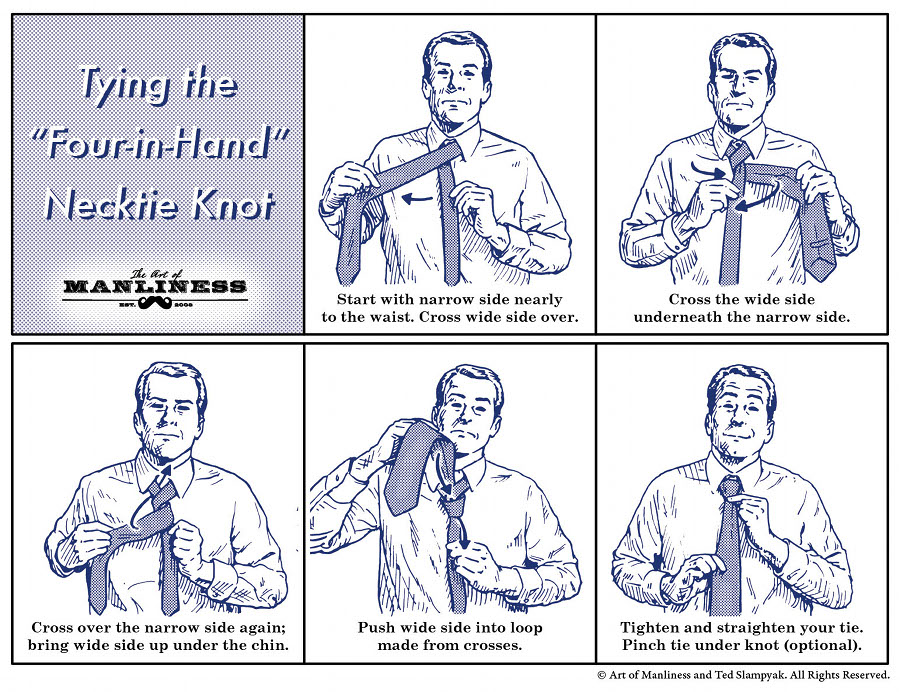
The Four-In-Hand Knot
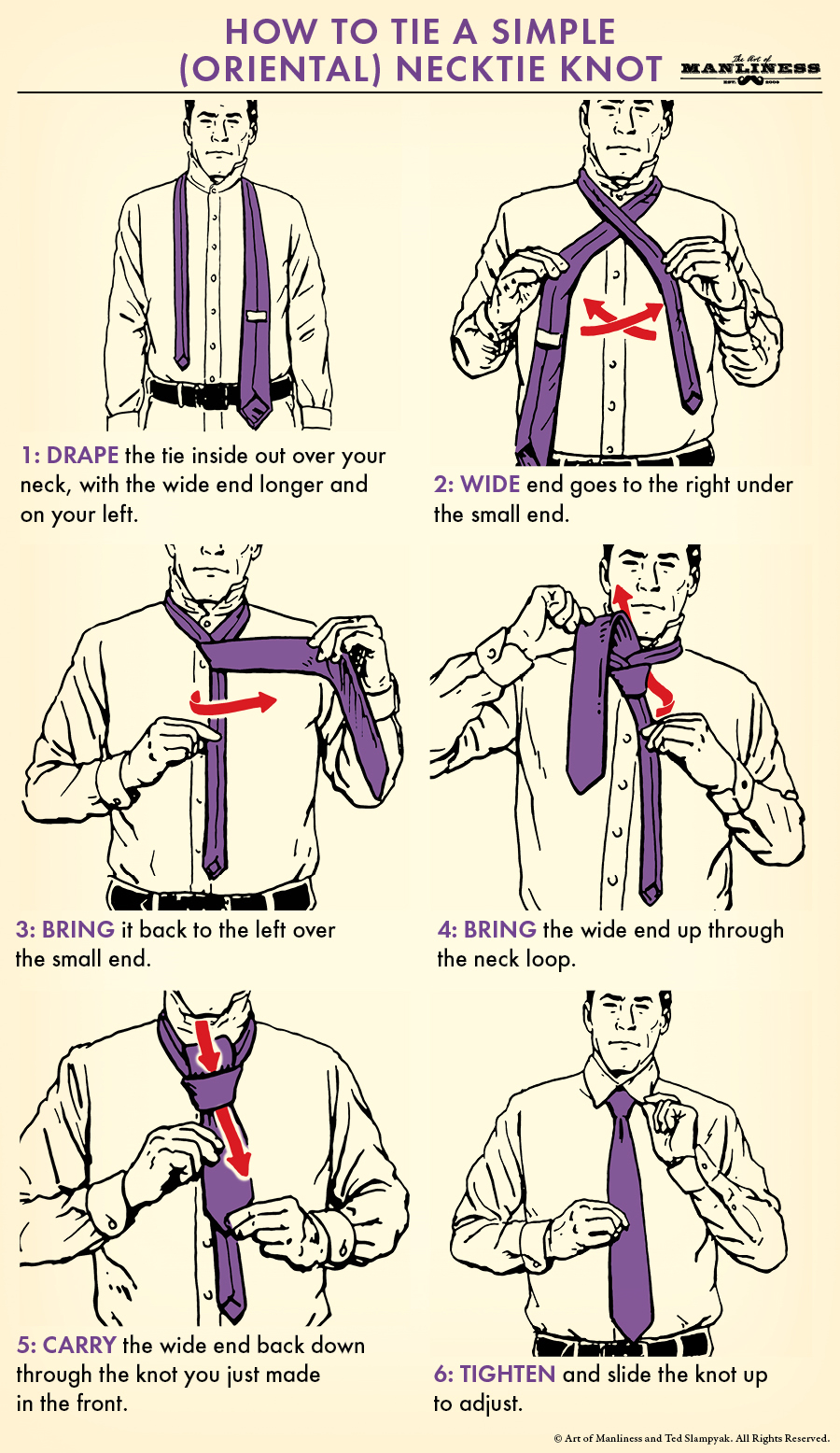
Also known as the “schoolboy,” this is probably the most widely used knot because it’s so easy to tie. It’s a good knot to use if your tie is made of heavier material. It looks best with smaller spread collars.
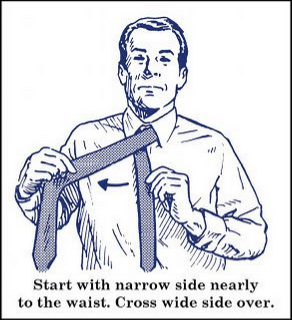
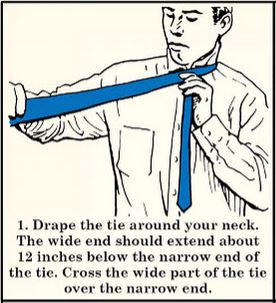
1. Drape the tie around your neck. The wide end should extend about 12 inches below the narrow end of the tie. Cross the wide part of the tie over the narrow end.
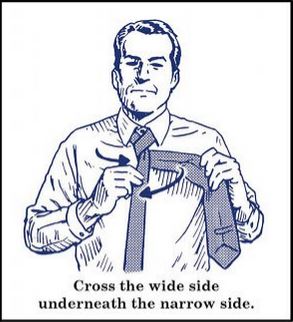
2. Turn the wide end back underneath the narrow end.
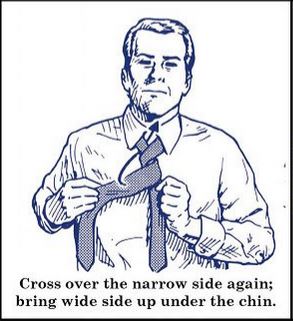
3. Continue wrapping the wide end around the narrow end by bringing it across the front of the narrow end again.
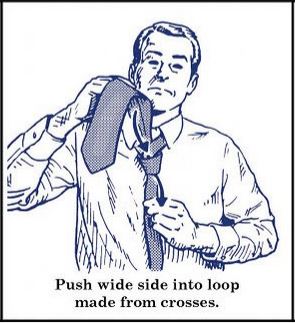
4. Pull the wide end up and through the back of the loop.
5. Hold the front of the knot with your index finger and bring the wide end down through the front knot.
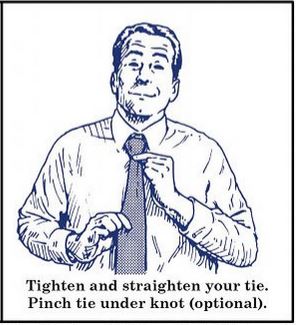
6. Tighten the knot carefully to the gills by holding the narrow end N and sliding the knot up. Center the knot.
The Half Windsor Knot
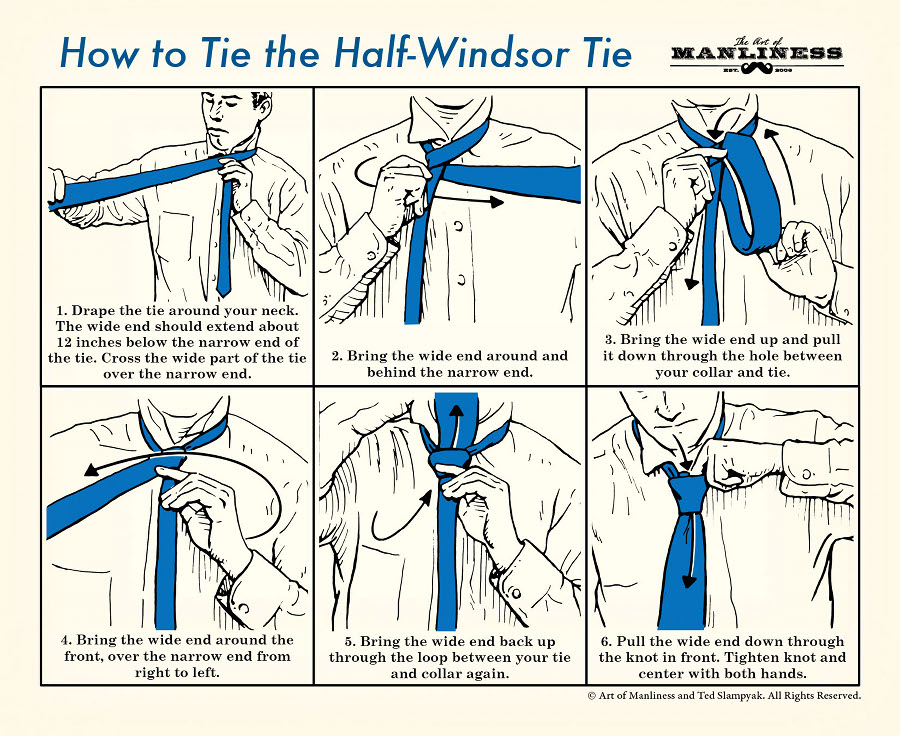
This is the Windsor knot’s little brother. Like the Windsor, you’re left with a symmetrical triangle knot, but the Half Windsor is not as large. This knot is appropriate for lighter fabrics and wider ties. It’s best worn with a standard collar.
1. Drape the tie around your neck. The wide end should extend about 12 inches below the narrow end of the tie. Cross the wide part of the tie over the narrow end.
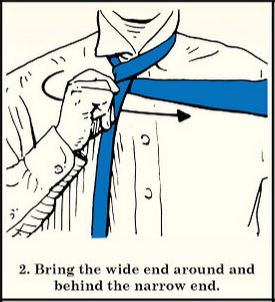
2. Bring the wide end around and behind the narrow end.
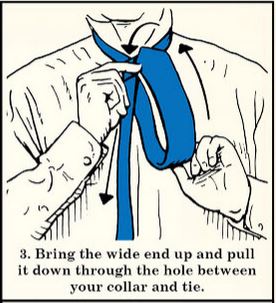
3. Bring the wide end up and pull it down through the hole between your collar and tie.
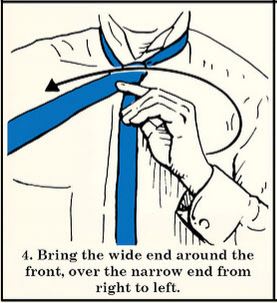
4. Bring the wide end around the front, over the narrow end from right to left.
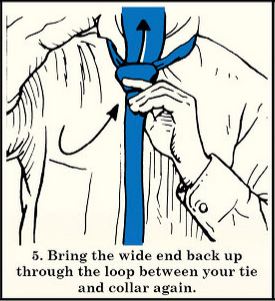
5. Bring the wide end up back through the loop again.
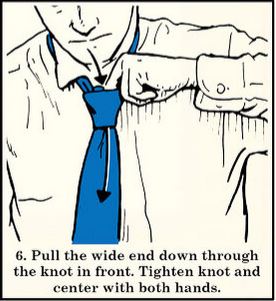
6. Pull the wide end down through the knot in front.
7. Tighten the knot and center it with both hands.
The Windsor Knot
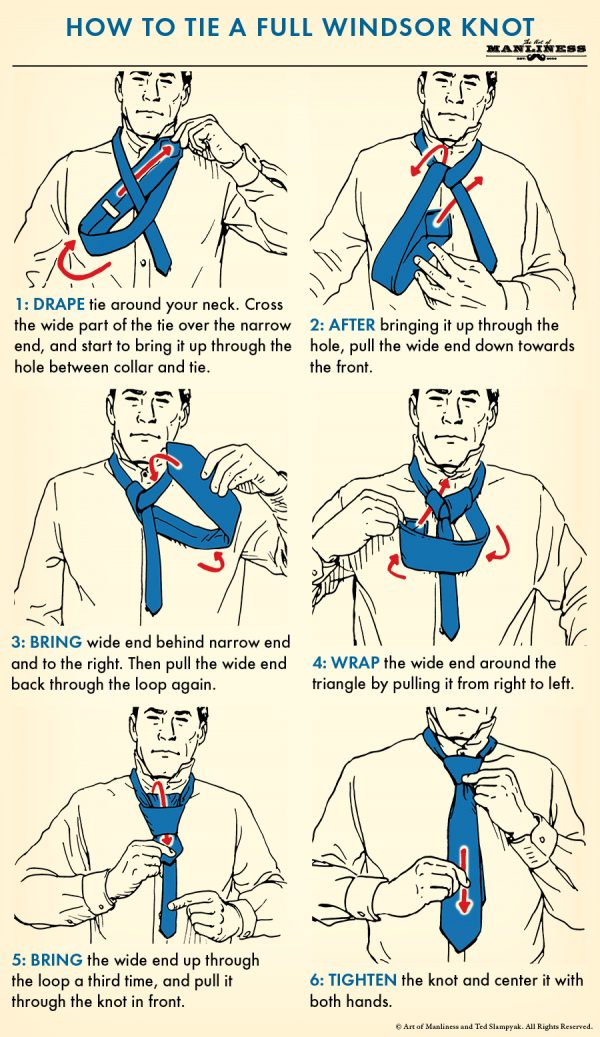
The Windsor knot gives you a wide triangular knot that’s good for more formal settings. This knot is best worn with a wide spread collar.
1. Drape the tie around your neck. The wide end should extend about 12 inches below the narrow end of the tie. Cross the wide part of the tie over the narrow end.
2. Bring the wide end of the tie up through the hole between your collar and the tie. Then pull it down toward the front.
3. Bring the wide end behind the narrow end and to the right.
4. Pull the wide end back through the loop again. You should have a triangle now where the knot will be.
5. Wrap the wide end around the triangle by pulling the wide end from right to left.
6. Bring the wide end up through the loop a third time.
7. Pull the wide end through the knot in front.
8. Tighten the knot and center it with both hands.
The Shelby Knot
The Shelby knot is a more obscure knot and was popularized by anchorman Don Shelby in the 1970’s. It works best with wider ties that are made from heavier material.
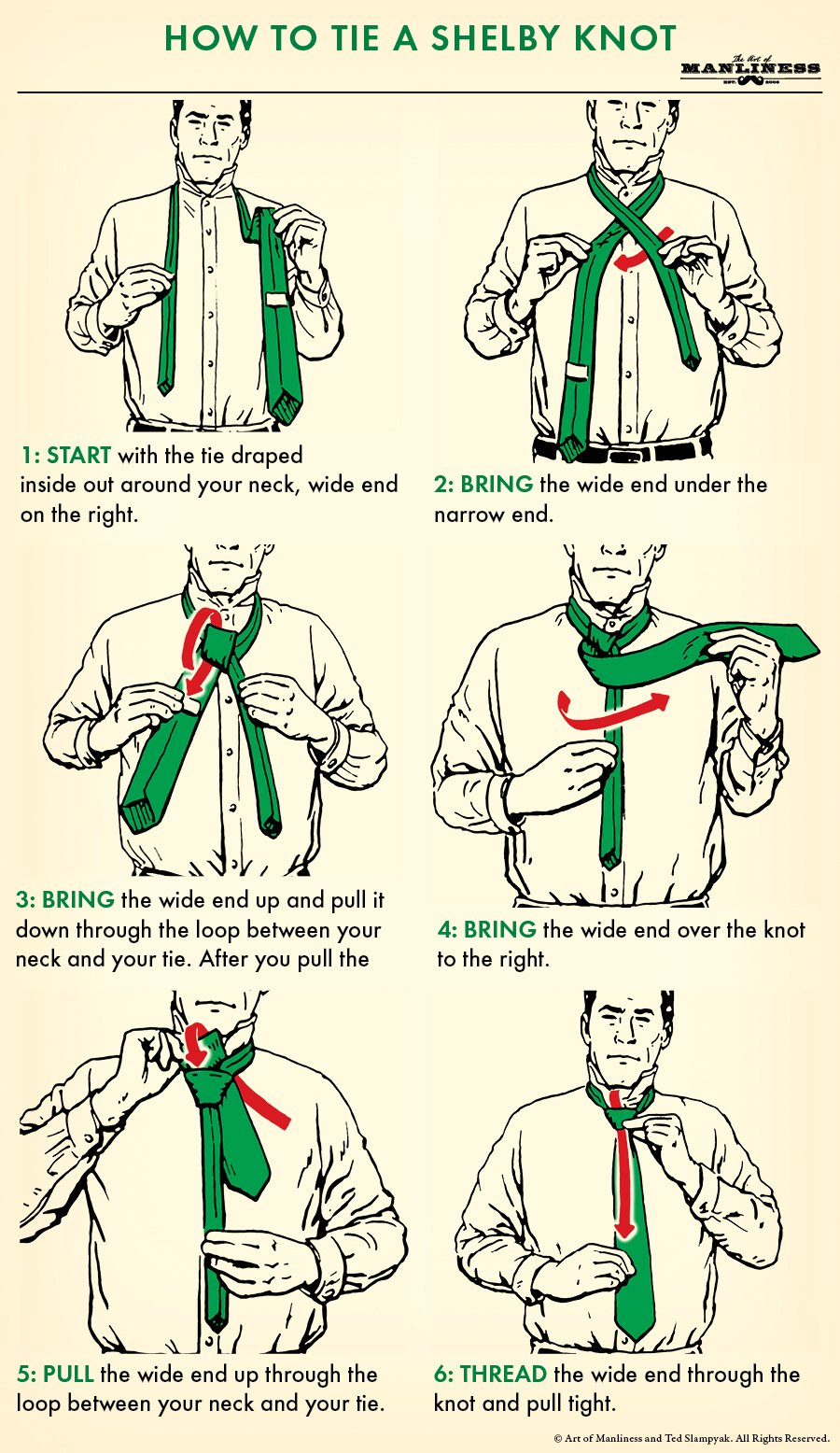
1. Start with the tie draped inside out around your neck, wide end on the right.
2. Bring the wide end under the narrow end.
3. Bring the wide end up and pull it down through the loop between your neck and your tie. After you pull the wide end all the way through, bring it to the left.
4. Bring the wide end over the knot to the right.
5. Pull the wide end up through the loop between your neck and your tie.
6. Thread the wide end through the knot and pull tight. Center as needed.


Facebook


{ 27 trackbacks }
{ 45 comments… read them below or add one }
Great videos! Here’s a question I’ve been trying to solve for some time, maybe you can shed some light!
What sort of tie knot does TV anchor Anderson Cooper wear? It has a smooth, thin conical shape to it, and seems a bit longer than traditional knots.
Example here: http://cache.gawker.com/assets/images/gawker/2008/06/Picture_18-11.png
It sort of looks like a four-in-hand, but not quite.
You forgot to add Bow tie. Very easy and has intimidated people for years. Keep up the good work.
That Shelby knot is interesting, but I can’t see how it is different from a backwards half-windsor. What would make it more suitable for a heavier fabric?
This is helpful! Thank you!
I was watching Appaloosa last week and notice the bandanna/neckerchief that Viggo Mortensen was wearing. Prior to the showdown with the Shelton brothers, he tied it in a unique way. Do any of you know of a special knot for this sort of thing?
Many thanks,
John
PS – If you haven’t seen the movie, y’all might enjoy it. The portrayal of masculine friendship is wonderful!
I always forget how to tie a tie in between the times when I’m looking for work and I have to relearn every damn time. Bookmarked this page for sure, thanks for compiling the videos!.
For those of you who aren’t quite satisfied with the four “classic” knots shown, there were a couple of physicists who calculated the number of possible tie knots.
All 85 are displayed here (http://www.tcm.phy.cam.ac.uk/~tmf20/tieknots.shtml), with detailed instructions on how to do them.
Really enjoyed watching these videos. Very good!!
This is great. I only ever learned to tie a full Windsor, so that has been my go-to knot for everything. Now I can tone it down a little when the occasion calls for it.
I think it’d be great if you’d add a bow tie- One can get by only knowing one of the above knots, but it’s necessary to know at least one regular knot as well as the bow tie.
Great article and videos! The knots I know are the four-in-hand and half-windsor. I’ll have to play around with some of the others and see how I like them.
Glad to see people are enjoying and finding these videos useful!
Doing a video on how to tie a bow tie is a great suggestion and we’ll get started on it.
As a tie aficionado from MN, I learned of the Shelby knot whilst a lad in high school. Mr. Shelby is not quite an anchorman from the 1970s, he merely started then. He still anchors the news for the CBS affiliate and is the most prominent TV anchor in MN today.
One more remark on the Shelby knot: it is, in fact, a real knot, i.e. when you remove the tie and pull the narrow end back through the knot, then tug to undo it, you are left with a knot in your tie. Not a big deal, but if you’re used to just pulling and it all coming unravelled, you could end up putting some unwanted creases in your tie.
Very interesting tip from 85 ways to tie a tie:
“Tie handkerchief
If you can’t make up your mind as to whether to wear a tie, you can keep the option open and put the tie in the breast pocket of your jacket, where it doubles as a handkerchief. This looks best with solid-colored ties, with the tie folded in half three times over, to one-eighth of its original length. ”
What a great idea! Now all of my ties can double as pocket-squares!
Steve
Finally a quality article on how to tie a tie
I’ve been looking for these kind of articles a long time but nowhere you can find the quality of information that you can find here.
Wonderful! … but is it just me, or is the shelby segment not reversed like the other three?
All this time, I thought I had been wearing my tie with a half windsor. Now I realize I had been wearing the full windsor. Who knew?
I also finally realized why I had so much trouble trying to tie my tie the way my dad taught me. He showed me the shelby knot so many years ago, and I was never able to find those instructions online.
@Michael and John-
Those are interesting questions, but I unfortunately do not know the answer. Hopefully, someone will come along who does.
@Jon-
If you use a tie with lighter material for the shelby, the knot can end up looking too small.
@Ryan-
Thanks for the cool link.
@Bob-
Glad you liked it.
@Silus-
I’ll look into that.
About the shelby- you didn’t point out what is really cool about it. Your tie will have a front and a back side, normally you have the fronts facing out and the backs against your chest. WIth the shelby, it ends up back to back. This means that your always showing the “good side” of the tie even if it gets twisted…. Not a huge deal, but neat. My dad actually taught me the shelby, but he called it the “inside out knot”. Good to see the info is out there.
The four-in-hand knot: now there’s a knot that gets the sartorially-advanced into arguments.
On the one hand, some people think that the asymmetrical knot produced by a four-in-hand is unappealing, even ugly. They tend to be the neater dressers, who strive for a smooth, put-together look, and so prefer symmetrical knots. This was the standard American look in the postwar period. While this can result in a very clean, coordinated look, some take this to extremes that are generally considered unstylish, like the matching shirt and tie look once favored by Regis Philbin (amongst others).
On the other hand, you have the dégagé devotees, who think that the symmetry of other knots looks too planned. They prefer the asymmetrical four-in-hand because it follows their fashion dictum of spending 30 minutes planning what to wear so it looks like you just threw on your clothes without giving any thought to them at all. This is a more European, especially Italian, approach. Higher on the dégagé scale are things like leaving a sleeve button unbuttoned on your jacket (you know, the one with working buttonholes), and putting your watch on outside your sleeve.
Ultimately, it’s a matter of personal preference: what look are you striving for? What look do you like?
Great post. The Windsor knots were always favorite knots (depending on the occasion and the tie material), but it was nice to learn the other knots and I still learned new things about the Windsor knots.
I normally wear an ascot rather than a tie, but when wearing a tie I’ve always worn a Full Windsor. I just like the symmetry of it. The other knots available to me in the late 1960’s when I was learning to tie a tie were just too asymmetrical for my tastes. But that list of 85 possible mathematical ties intrigues the Englishman in me. I am probably going to spend a fair amount of the next few days tyeing them and measuring them for symmetry out of some Remains of The Day Ishiguro need for propriety.
Any suggestions for men with large necks? I have a 22-inch neck, and a tie of normal length tied with a Four-in-hand knot tends to leave me with about 3-5 inches of thin end left that I have to tuck inside my shirt. It looks fine as long as the tie does not move, but when it does, it reveals what I’ve done, and looks sloppy, I think.
Classic AoM post. Your awesome man
I’ve always done what I thought was a Windsor… turns out I’ve been doing a Plattsburg…
Outsdr ,
Men with large necks, and tall men, often buy long neckties (about 63″ long, as opposed to the modern standard necktie length of about 57″). I find it strange that you have some of the skinny end of the tie leftover, but maybe that’s because you aren’t paying attention to where the blade (wide end) comes to.
Now that no one wears a vest, the “correct” place for the bottom of the blade to rest is just at the top of your trousers. It may extend a little on to the belt, but should never extend below the belt. If you try tying your ties so that the blade falls somewhere between the top and bottom of your belt, your problem should be solved.
Incidentally, between the knot loosening ever so slightly and my pants waist lowering just a touch, I find that I need to tie my tie a little long in the morning in order for it to look good (i.e., not too short) throughout the day. YMMV.
Great videos. One of the best posts.
My dad taught me the full windsor when teaching me how to tie a necktie. He didn’t even know what it was called. It was just the way he learned from tradition.
I learned the four-in-hand knot on my own a while back, the only difference was that I was taught to place two fingers when wrapping it back it pulling it into the knot. I think I’ll trying without the finger placement.
Thank you, your videos make this so much easier. I’ve been looking at various websites and other tutorials and just couldn’t make head nor tail for it. Thank you!!!
Where are the videos?
I was taught the full Windor by my father on my first day of catholic school and was politely told never to forget it. I’ve been using it ever since (although I don’t wear ties very often). I wore a tie to school everyday for 8 years.
I actually find the flipped videos very confusing.
@Michael
Anderson Cooper’s knot *looks* like a full Windsor on a silk tie, but with no dimple. If tying the Windsor isn’t big enough, you can always do an extra wrap. It could be different though.
I love the Shelby knot because I hate tying ties. I hate wearing them. I tend to avoid situations where ties are called for, but when I have to, I do the Shelby. It is just plain quick and certainly easier to do and undo than any other. I also find it’s not as tight on the neck as other knots. If done properly you can even get away with leaving the top button undone (top button chokes me to death.)
Glad to see people are enjoying and finding these videos useful!
Thank you so much for the videos! I’ve been meaning to practice these knots to show one of my cousins. I do have one anecdote to share:
Many moons ago when it was time for my high school senior prom, there were quite a few young men that were in the marching band with me that had no idea how to tie a tie and niether did thier fathers. Undauted, instead of going and buying a clip-on they asked the gentlemen who taught basic drum skills (an ex-marine I might add) how to tie a tie. I believe I still have pictures from when they held a “Everyday Marine Manliness” band session: for everyone that showed up welearned how to tie a tie, shine our shoes, proper posture and as a suprise he also taught us the basic waltz.
Thank you. I’m starting to love this site. I always have trouble doing my tie, so what I do is ask someone to do it, then keep the knot for the rest of the tie’s existence.
Great article!
My personal three favorite necktie knots are the windsor, half-windsor, and the double knot (popular in the 20s apparently, and totally rocks a striped necktie!). I agree with the other poster who suggested that you add bow tie instructions – it’s great when you go to a wedding or formal and you’re the only man there with a proper bow tie, the others having settled for clip ons…
i don’t know how to tie a tie,that’s why i opened this web site. But it is very confusion.
The videos are of tremendous help, does anyone know of the correct way to create that center dimple directly under the tie knot? I have seen some instructions before, but always continue to have difficulty executing it. I know how to make every other type of knot, but it’s just getting that pronounced center dimple that kills me!
T.Lee
I had only been taught the four-in-hand knot when I was a little boy and today I have found something that works well for me, the full windsor knot. I find it at least as easy to tie and probably easier to learn.
Great article about how to tie different knots with silk ties!
Great Videos! I was a little confused by the comment by Edgar “Now that no one wears a vest”. I wear a 3 piece suit to my office almost everyday. Did i miss a fashion meeting? I still tie my tie the correct length even when wearing a vest.
Just sent this to my husband, a software developer who NEVER wears a tie. Hopefully now he’ll look gooooood at the paaaaarty tonight.
I totally learned how to tie a tie tonight! I recorded my progress on my blog! Check it out! I used a multitude of sites and tried to explain it to the best of my ability! Tell me what you all think!
http://bpennsbasics.blogspot.com/2010/01/what-tangled-messbut-victory.html
Thank you for making this website! I always forget how to tie a tie and next time I’m getting dressed up I’ll definitely check back here for a quick refresher.