




Top

Lessons in Unmanliness: Willy Loman
Print This Post Email This Post To A Friend Email This Post To A Friend
October 2, 2008


If you're new to The Art of Manliness, you may want to sign up for a daily dose of manliness either by email or by RSS. You may also want to check out our free e-book on how to be a gentleman in 2008. Thanks for visiting and don't forget to man up!


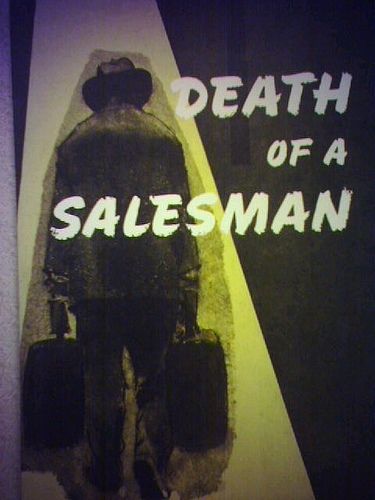
willyloman Lessons in Unmanliness: Willy Loman

Occasionally, the Art of Manliness runs a series called “Lessons in Manliness.” They are an attempt to glean important life lessons from successful and inspiring men. Today, we’re going to do something a little different. We’re going to look at a man who was a paragon of unmanliness. The hope is that we can learn from his mistakes and not repeat them ourselves.

This first profile in unmanliness takes a look at traveling salesman, Willy Loman from Arthur Miller’s play Death of a Salesman. Death of a Salesman explores the world of post-war America and the effect that America’s new found prosperity had on men. During the 1950s, men began to feel pressured to not just provide for their family but to also give them the luxuries that society was coming to believe every household was entitled to. Every family deserved a house with a picket fence, a new car in the garage, and all the newest appliances to make life easier. Advertisers pitched the idea that the American dream was in reach of every man. Yet the reality then, as it is now, is that strenuously reaching to keep up with the Joneses can stretch a family perilously thin. Unfortunately, Willy Loman bought into the idea and he let it destroy him and his family. There’s nothing wrong with wanting to provide nice things for your family; Willy just went about it all wrong. Here are a few lessons we can take from Willy on how not to be man.

Success doesn’t come from just luck, popularity, or personality. All throughout the Death of a Salesman, Loman tells his two sons, Biff and Happy, that the key to success in life is to be “well liked” and that all you need is “a smile and a shoeshine.” According to Willy, if you can become popular and get people to like you, you’ll have it made in life. The other part of Willy’s success equation was dumb luck; he thought men just stumbled into success the way his brother apparently came into his diamond fortune in Africa. But this philosophy simply sets Willy and his sons up for failure. Good luck and being well liked will only get you so far in life. The true lynchpin of success is tireless ambition and hard work. Neither Willy nor his sons ever learn this, and they are consequently failures at the game of life. Don’t be superficial like Willy; put you shoulder to the wheel.

Luxuries aren’t worth taking on debt. Willy wanted to give his family the best in life. He wanted his wife to have a refrigerator, a vacuum cleaner, and a car. There’s nothing wrong with such a desire. The problem is that Willy took on massive amounts of debt to buy these things. His debt load was so crushing that he decided to kill himself so his family could have the insurance policy to pay for it all. Avoid debt like the plague. Sure, some debt is necessary in the form of a mortgage or student loans. But having the latest gizmo is not worth the financial and emotional stress that comes with consumer debt. A man should seek to be independent and self-reliant. Debt will only get in the way of that goal.

Don’t live in the past. As the play progresses, Willy begins to retreat more and more into the past. He daydreams about a happier time when his sons loved him and he was a success at work. As he mulls over the past, Loman tries to figure out how things went wrong. Usually he pegs not being “well liked” as the root of his current troubles. Willy is like that former jock who has done absolutely nothing with his life since his glory days on the high school gridiron. Their best days are always behind them. Living in the past won’t get you anywhere. We should always learn from it, but our focus should be on the present and future.

Stay faithful to your wife. During Willy’s sales trips to Boston, Willy begins to have an affair with a character known only as “The Woman.” His son Biff goes to visit Willy in Boston and catches his father in his adultery. In one of the most powerful scenes, Biff confronts Willy about buying The Woman new stockings instead of buying them for his wife. To Biff, the idea that Willy would treat some stranger better than his poor family back at home is the ultimate betrayal. After Biff’s encounter with his father and his harem, Biff loses all interest in school and fails math, thus setting him up for failure down the road. Adultery is an ugly, ugly thing. It can destroy your family. A manly man is faithful to his wife and devoted to his family. Do all you can to affair proof your marriage.

Running from your problems won’t solve them. Ultimately, it is Willy Loman’s denial of reality that leads to his downfall. He makes his sons lie to him so he doesn’t have to face the truth. And in the end, Willy chooses to escape from reality altogether by killing himself. He figures that the only way he can be of any worth to his family is if he dies, and they get the insurance policy. Instead of facing his problems, he runs from them. Sure, his death allows his wife to pay off the mortgage, and she says that her family is free. Willy does become sort of a sacrificial lamb for his family. But he has forever robbed his wife of a husband and his sons of a father. He could have solved these problems without killing himself if he had confronted them head on.  Don’t shirk the responsibilities of your decisions, no matter how serious the consequences. Be a man of honor and confront your problems directly.

Note: If you haven’t read or seen Death of a Salesman, check it out. Very good. The film adaptation starring Dustin Hoffman and John Malkovich is wonderful.

Share and Enjoy: These icons link to social bookmarking sites where readers can share and discover new web pages.
  • Digg
  • del.icio.us
  • Reddit
  • StumbleUpon
  • Netscape

Comments

23 Responses to “Lessons in Unmanliness: Willy Loman”

  1. W. Mark Whitlock on October 3rd, 2008 6:39 am

    Great observations.

    RE: Living in the Past
    One of my favorite quotes is from author and seminary professor Howard Hendricks. He often says: “When your memories become more vivid than your dreams, you’ve begun to die.”

    I’m at a point in my pursuit of authentic masculinity where I’m having trouble dreaming. Five years of layoffs and financial struggles are catching up with me. I need what Willy desperately needed: hope.

    RE: Stay Faithful to your Wife
    In the past five years of struggle, I’ve learned that remaining faithful isn’t an item on the to-do list. It’s a source of encouragement and freedom. When we as men love and cherish our wives, they help us be what we were intended to be–men.

  2. Mark on October 3rd, 2008 7:20 am

    Don’t forget Willy’s overinflated sense of pride and vanity. Willy’s good friend and neighbor, Charley, not only gives Willy multiple loans(which he never expects to be payed back), but also offers Willy a steady, well paying job, which Willy turns down every time out of pride.

  3. Brett on October 3rd, 2008 7:23 am

    @ Mark- Good call! Willy was a real prideful SOB.

  4. Clare on October 3rd, 2008 9:54 am

    I’m studying Death Of A Salesman as part of an English Literature A-Level course and these are some of the main points I’ve made in my essay, although with a different focus (tragedy). We were told that the film is not a good representation of the text as Arthur Miller didn’t like the way it portrayed his characters and settings.

  5. Gary Slaughter on October 3rd, 2008 1:50 pm

    Very well done, especially the paragraph on luxuries and debt. Our country’s citizens have developed an “entitlement” mentality.

    Part of the problem lies in era in which the play was written. Many parents of that time had experienced the Depression and took the attitude that “I don’t want my children to have to do without the way I had to.” They didn’t realize that those hard times taught them what really matters aren’t possessions.

    I read recently that it’s human nature to want what we want when we want it. It’s also a sign of immaturity.

  6. Kyle Gordon on October 3rd, 2008 2:20 pm

    And for the ultimate irony, in this day and age life insurance is extremely unlikely to pay out when suicide is involved.

    I remember studying this book at school, and it sticks with me to this day.

  7. Barbara Baker on October 3rd, 2008 4:56 pm

    I absolutely loved this movie (still have it BTW).

    My first year of College (in COMP 1) I had to watch the movie and write a report on it. I still enjoy watching it every once in a while (when I want to take a trip in time).

    Great article!
    -Barb :)

  8. David on October 3rd, 2008 5:28 pm

    Good article!
    I remember reading this in high school, and getting into an argument with my teacher. He painted Willy as a victim. A sort of noble, but flawed character.
    I thought he was a tool. Self-centered (I think “The Woman” even calls him that), prideful, and vain.
    Funny though, I think most people who follow the path Willy does see themselves the way my teacher saw Willy, as victims.
    One thing, it’s been years since I’ve read it, but isn’t Biff, his son, the ex-high school jock? No matter. Nice read, thanks.

  9. Laura on October 3rd, 2008 11:37 pm

    “A man should seek to be independent and self-reliant.”
    Careful, this statement has its roots in pride. There is a danger in this statement of sliding into “rugged individualism” which is a place denuded of relationships. A man who is the head of a family, must be in fully formed, transparent relationships with all members of the immediate family, or in the process of getting there. Sure, the family unit ought to be independent and self-reliant from a secular, economic perspective. However, even the family unit should be in relationship with their faith society and with God.
    God bless.
    Laura

  10. Robin on October 4th, 2008 2:59 am

    Take it easy on Willy. Jeez come on. Unmanliness? It’s a tragedy. The guy tried. The guy struggled. The guy failed. The guy died.

    Death of a Salesman is a perfect example of the burden that many men suffer quietly through. And believe you me considering the economy this story is going to become pretty timely.

    Manliness is having a heart and understanding human vulnerabilities.

    See the 1966 version Lee J. Cobb, it will break your heart.

  11. Anna Theodora on October 4th, 2008 4:19 am

    In the Hawaiiabera post, you also posted a photo of yourself with the shirt. At first I thought: “wow, how did he get a young Evandro Mesquita’s photo in that pose?”
    Then I found out it was you. You look a lot like Evandro Mesquita
    http://www.alfredoonline.blogger.com.br/evandro%20mesquit.jpg
    a brazilian rock band leader.
    At least in that photo you look like him ;P

  12. Gary Slaughter on October 4th, 2008 7:01 am

    “A man should seek to be independent and self-reliant.”
    Careful, this statement has its roots in pride. There is a danger in this statement of sliding into “rugged individualism” which is a place denuded of relationships.

    Oh, please! “Rugged Individualism” means to be self-reliant and resourceful. To be able to stand resolutely against what the ’sheeple’ are doing. Denuded of relationships? Spare me.

    “It’s a tragedy. The guy tried. The guy struggled. The guy failed. The guy died.”

    The guy tried, ineffectually. The guy struggled, half-heartedly. The guy failed. The guy took the easy way out. waah.

  13. Brett on October 4th, 2008 7:16 am

    @ Robin- I’ve never had much sympathy for Willy Loman, but I can see how he could be a sympathetic character.

    @ Anna- I think it’s the other way around. The Brazilian rock band leader looks like me. :)

    @ David- Agreed.

  14. William Zanelli on October 4th, 2008 12:00 pm

    This is an amazing article..!! I love it.

    I realised early in life that if I wanted something - I’d have to go out there and make it happen, things dont just fall into your lap!!

    The crux of the article for me is “The true lynchpin of success is tireless ambition and hard work. Neither Willy nor his sons ever learn this” - people are capable of so much, yet because they lack courage they life a life of mediocricy!!

    Life is a daring adevnture or nothing, someone once said :)

  15. Katie M. on October 4th, 2008 2:43 pm

    I disagree with Brett and Robin in having sympathy for Willy’s character. It’s one thing to struggle and fail, but Willy doesn’t even really go down struggling. He keeps daydreaming of success, but never does anything to attain his goals. As someone mentioned above, when another man offers him a job he turns it down because he’s prideful and jealous. Anyone who does all they can and then still fails, has my full sympathy. People who wallow in pity and give-up do not.

  16. Robin Willis on October 5th, 2008 8:41 pm

    OK last thought on this. Willy is the protagonist and probably the antagonist too. Willy is a complex and flawed character. He is not really prideful, he is in denial and trying to protect the concept of who he is and what he has done with his life. He has done many things wrong. He is hiding his shame. Folks, you are not supposed to cheer when Willy offs himself. You are supposed to see it as what it is… a tragedy. Hubris. Failure. Denial. Failure. Realization. Solution. Death. You know it’s not really about sympathy… it’s about empathy. Sorry… as human beings, we all have a Willy Loman in us. It was a bad example of unmanliness. We all can’t be Atticus Fitch all the time.

  17. Brett on October 5th, 2008 8:48 pm

    @Robin-

    Of course every character and every man is a complex being. When we have done the “Lessons in Manliness” articles, the men we have profiled have not been perfect men. But we can learn from the things that they did right. Similarly, Willy Loman was not 100% unmanly, but we can learn from the things he did wrong. It’s a profile of lessons learned, not a complete life analysis. After all, if Willy Loman can’t be presented as an example of unmanliness, who could really? Every man, no matter how debase, has his aspects we can emphasize with. But we’re looking at things as a whole here, a life in summation.

  18. Tony Kibelbek on October 6th, 2008 7:07 am

    I was exposed to this play in High School and again in college. Neither time was the character of Willy Loman discussed as anything other than a hapless victim. Much was made both times that a labor union apparently tried to block the production of the play.
    Now in middle age, I can see the real tragedy of this play is not so much a man being destroyed by economic circumstances beyond his control. Its a man who departed from all reality and lost hope. We don’t sense a lot of obvious despair from Willy and I expect this is because Arthur Miller gave his character a rather unconventional, if not entirely unrealistic, response to the situation.

  19. Jack on October 6th, 2008 10:34 am

    RE: Suicide

    I’ve been wondering, what this blog’s stance on suicide is. Pro or anti suicide, I’ve observed, usually comes from the difference in western and eastern philosophies or belief systems about the subject. I hope to see some posts on it in the future.

    Eastern thinking usually is okay with suicide, while western thinking generally is not.

    Now, in my opinion Mr. Loman’s suicide was avoidable and not exactly necessary. Leaving behind children that need a parent I don’t think was worth his death.

    Now, that I think about it , I should probably search to see if you guy’s have written anything about the subject…

  20. Mr. Jones on October 7th, 2008 10:47 am

    This whole thing is pretty damned depressing.

    To perk up, I’m checking out The Crucible. That should lift my spirits.

  21. Joseph on October 22nd, 2008 9:30 pm

    Ha, good luck with that, Mr. Jones.

    Have you guys seen the play or just read the book? Seeing it on stage changes the perspective a lot. Willy is a broken man by the beginning of the play, he is becoming senile. He imagines and talks to his dead brother. That is proof positive that he is mentally unstable. He was just a victim of the times, and yet he tried to the last. He was misguided but a man nonetheless.

    And he didn’t take the easy way out when he committed suicide. It wasn’t an act of passion but a resolution to help his family. He couldn’t take his neighbor’s offer for help not because of pride. He didn’t know why he couldn’t but he just couldn’t.

Trackbacks

  1. Lessons in Unmanliness: Willy Loman
  2. Barack Obama’s “Willy Loman” Moment: Will the Infomercial Backfire? « The Cache Valley Report

Got something to say?

Please read our comment policy.


<