




Top

How To Debate Politics Like A Gentleman
Print This Post
September 21, 2008


If you're new to The Art of Manliness, you may want to sign up for a daily dose of manliness either by email or by RSS. You may also want to check out our free e-book on how to be a gentleman in 2008. Thanks for visiting and don't forget to man up!


Kate grandpa’s is fond of repeating the mantra he and his fellow sailors repeated while serving aboard the USS Indiana during World War II. “Never discuss politics or religion.” And he always adds, “So what does that leave to talk about? Girls, of course.”

Gramp’s advice is certainly appropriate if you’re going to be trapped on a ship with the same guys for months on end. And it’s a rule of good etiquette for dinner parties and other occasions when polite decorum should prevail.

But otherwise, politics should be debated, vigorously and often. Men in every age debated politics- from the Grecian Assembly to the Roman Forum, from the salons of France to the mutual improvement societies of colonial America. Being able to reasonably discuss the political issues of the day was considered a vital and essential part of being a well-rounded, well-educated, man. Indeed, one of the express purposes of education during this time was to equip men to be able to hold their own in the political forum.

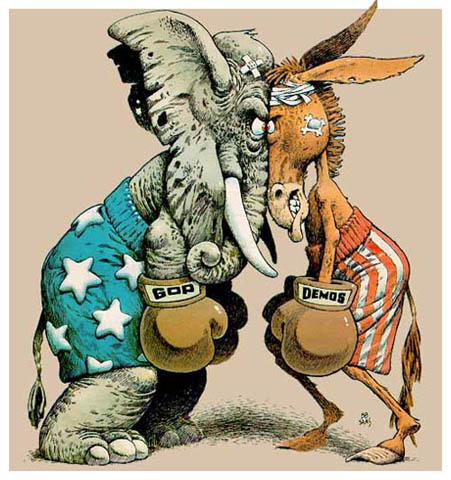
These days rousing, yet respectful political debate is practically non-existent. The new media, far from presenting balanced, in-depth coverage of the important, meaty issues of the day, spend their time constantly regurgitating manufactured scandals and fanning the flames of personality contests. Debates between men in person, and especially on the internet quickly devolve into indignant shouting matches, where personal insults are substituted for rational arguments.

That’s not to say that our manly forebearers were the paragons of respectful debating. They too would often let their passions get away from them and unleash oratorical hell on their opponent. For example, during his days as a young state assemblyman in New York, Teddy Roosevelt would frequently lose his cool during debates on the Assembly floor. He’d call his opponents “cold blooded, narrow-minded, prejudiced, obstinate, timid, old psalm singing Indianapolis politicians” or “oily-Gammon, churchgoing specimens,” or simply “classical ignoramuses.”

Young Roosevelt quickly became the laughing stock of the Assembly and of the state newspapers with his outbursts. After bitterly insulting a senior assemblyman, Roosevelt was rebuked severely, and tearfully apologized for his unbecoming behavior. He soon learned to control his temper and direct his passion towards more constructive debate as opposed to petty insults.

Unlike men from the past, today’s men are unapologetic about their undisciplined, discourteous political rants.  Men need to learn how to bring back vigorous, yet civil political discourse. Here are a few suggestions on how we can.

Disagreement in politics does not a pinhead make.

When it comes to debating politics, men then often create the following faulty syllogism:

  • I’m a very intelligent man and I believe X.
  • This other guy believes Y.
  • Therefore this other guy is a complete moron.

This is what essentially lies at the heart of nasty political discourse. And it’s surely a tempting conclusion to make. But take a step back. Does your “opponent” show other signs of being a feeble-minded moron? Did he graduate from college? Does he have a good job? Does he seem able to function as a normal adult? You know, dress himself, feed himself, and refrain from drooling? Probably so. He’s probably not an imbecile. He just feels differently than you do. He was raised in a home by parents with certain beliefs. He’s had life experiences that are divergent from yours. His faith or lack thereof has shaped him in ways that yours hasn’t. Now, once you have established that your friend is not a pinhead, you can begin to have a polite debate.

Try your darndest to see the other side

When you passionately believe in something, it can seem nearly impossible to even conceive how another person doesn’t see things the same way you do. But since we’ve established that having a divergent political belief does not a pinhead make, you should be duly curious about why your friend feels the way he does.

Dispense with the the how and why questions. Questions like, “How could you possibly believe that?” and  “Why can’t you see how wrong you are?” won’t get you anywhere. Instead, pose “what” questions. “What makes you feel that way?” “What has led you to come to that conclusion?” Be earnestly and sincerely interested in what the person has to say. Do not ask these questions as way to dig up material to pounce on and attack. Take the time to really understand their sides of the issues.

Consume media that presents news from both sides. Why has political debate become so polarized and rancor-filled? Look no father then the current state of the media. Instead of modeling the art of healthy debate, news shows are political theater, filled with talking heads shouting over each other and licking their lips over the chance to cut someone down.

It’s also no secret that various media outlets give the news with their particular political slant. If all you consume is media from one particular source, a source that affirms and flatters your already preconceived beliefs, then you’re never going to be able to see the other side and will end up just another schmo contributing to the untimely death of respectful political debate.

Let’s face it: we all love to see our guy sticking it to the other guy. We love to see the commentators rip into the hypocrisy and inadequacies of the other party. It makes us feel good about ourselves and flatters our world view. But it’s dangerously narrow-minded. Men back in the day didn’t just read tracts and attend speeches of people with whom they agreed. They eagerly consumed what their opponents had to say as well. You must make an effort to read, listen, and watch news that may make your blood pressure soar, but will leave you better informed and ready to make fair assessments. If you’re a devoted Bill Maher fan, tune into Rush every now again. If you usually only read the National Review, spend some quality time with Mother Jones as well.

Concede a point where appropriate

Unless your friend really is an obtuse Neanderthal, he’ll probably say a few things that you actually agree with. A badger of a man will let these things pass by without a word, believing that to concede any point is to show weakness. An intelligent and secure man is able to say, “Yeah, that’s a good point. I hadn’t thought of that.” Even if you don’t agree with something, at least pepper your discourse with the occasional “I understand why you feel that way.” And “I can see that.”

Find common ground

Even if you and your friend are on opposite ends of the spectrum-he sleeps with O’Reilly’s Culture Warrior under his pillow and you have a signed photo of Keith Olbermann on your wall, there will always be a couple of things you can agree on. Even if its banal generalities like “Washington is broken,” you can agree on that and then civilly present your varying perspectives on how it should be fixed.

Don’t use inflammatory language

The man who is insecure with the simple, bare validity of his argument will be tempted to resort to inflammatory language and insults.” “McCain is a philandering, lying, corpse of a man!” “Obama is a pointy-headed, liberal, elitist and a terrorist to boot!” Such language only produces rancor and will quickly steer the debate into a pointless shouting match. Present you points in a calm, well-reasoned manner.

Stick to the facts

Only bring to the table those facts which have been thoroughly vetted as true. Information culled from emails forwarded to you by Aunt Gertie, articles from the National Enquirer, and stories from a pirated radio broadcast you listened to at 4 in the morning do not count. How you and your friend interpret the facts will of course vary, but you must at least be debating accurate information as opposed to  rumors and slander that no one can really prove or argue against.

What are you’re suggestions for engaging rigorous civil debate? Do you even think it’s possible today? Drop a line comment box and let us know.

If you liked this article, please share it on del.icio.us, StumbleUpon or Digg. I’d appreciate it.

Comments

47 Responses to “How To Debate Politics Like A Gentleman”

  1. Vote -1 Vote +1Will on September 21st, 2008 6:58 pm

    Yes, yes, yes!

  2. Vote -1 Vote +1James on September 21st, 2008 7:33 pm

    My friend, this is perfect. Now if only politicians could get their heads on straight, and discuss sensibly instead of “getting in people’s faces” and arguing. Such standards show ignorance and lack of leadership. (Quote was from Obama)

  3. Vote -1 Vote +1Nate on September 21st, 2008 8:11 pm

    Great article Brett. My friends and I all share separate beliefs on political and religious matters, but we have all usually been able to debate them reasonably with each other due to us all being very close and really caring about what each other thinks. Great guidelines!

  4. Vote -1 Vote +1dave on September 21st, 2008 8:19 pm

    Well done, Brett & Kate –
    Truth told, these aren’t the qualities of a politician — at least not in Australia. Gentlemanly debating and oratory is optional; salesmanship, gamesmanship, factionism and a readiness to cut down your fellow man to advance your own cause are standard fare.
    The qualities described here strike me more like those of a statesman — a leader who has transcended petty politics and is actually able to provide a course for their country (or company, or instituion, or whatever) to move forward and become great.
    It’s too bad that our leaders spend so much time taking shots at each other to hide their own weak policies & poor decisions.

    Case in point: One of our major parties elected a new leader last week (Malcolm Turnbull of the Federal Liberal Party), and he hadn’t been in office (as the leader of opposition) for two hours before the ruling ALP party was taking shots at him regarding his personal life. Without taking sides (the Liberal party has run more than its share of smear campaigns in recent years), it simply highlights a culture long on politics and mudslinging and short on statesmanship and leadership.

  5. Vote -1 Vote +1Brett on September 21st, 2008 8:26 pm

    @Dave-

    Thanks for your comment. I had a phenomenal professor in college who often expounded on the virtues of a statesman, a position all men should aspire to and which transcended politics. He said a true statesman had four qualities:

    1. A bedrock of principles
    2. A moral compass
    3. A vision
    4. The ability to build consensus to achieve that vision.

    I think that pretty much sums it up.

  6. Vote -1 Vote +1Ian on September 22nd, 2008 12:17 am

    Great article (my comment may sound trite, but I sometimes offer the opposite sentiment to some aom posts). Sound political argument is the hallmark of a democracy. I was alarmed when I read the first paragraph of this article that I was going to read a recommendation to not discuss politics, glad to say I was wrong with my hasty judgement.

    Both politics and religion are important, therefore they should be discussed, debated and criticised, to uncover their worth. But in a reasonable fashion, as this article points out.

    I agree entirely with dave— I have petty name calling and the inclusion of irrelevant personal actions of politicians. In actuality this behaviour indicates the lack of worth of the party making the attack. As both sides indulge what does that say?

  7. Vote -1 Vote +1Lyndon on September 22nd, 2008 4:36 am

    Great post! I went straight to the National Review and it did, indeed, get my blood boiling.

  8. Vote -1 Vote +1Darren on September 22nd, 2008 4:53 am

    Yet another great post—-In Masonic lodges, it is forbidden to talk about politics and sectarian religion. I couldn’t tell you what party most of my brothers belong to. We are required, as well, to cheerfully obey the laws of whatever country we are in. I think the reason that the political discourse in the United States has taken such a nasty tone lately is because the two main parties have such divergent beliefs about the function of government. Personally, I look to “Common Sense” by Thomas Paine and the “Federalist Papers” by Hamilton, Madison and Jay, for guidance on that issue.

  9. Vote -1 Vote +1tadeusz on September 22nd, 2008 4:59 am

    I would add one suggestion: try to find a constructive way of action.

    People often agree taht the current situation is bad (not-optimal) and generally we could use more freedom, material prosperity, safety, education etc. Encouraging constructive discussion about means to achieve this general improvement is a good idea to cool down, and reach consensus.

    If you read only one politic book in your life – make it Human Action. That helps understanding politics a lot.

  10. Vote -1 Vote +1Ross on September 22nd, 2008 5:34 am

    Very good article. It puts me in mind of an article I read a couple of years ago called “The Mannerly Art of Disagreement.” You can find it here:
    http://members.aol.com/MacedonPg/tmaod.htm

    tadeusz:
    Human Action is a great book, and even better, you can find it online:
    http://www.mises.org/humanaction.asp

  11. Vote -1 Vote +1Peter James on September 22nd, 2008 5:53 am

    Is this actually possible? I hope so, b/c my business partner (mostly left) and I (mostly right), usually wind up in a nuclear war by the time the conversation is over. I don’t even think we care about our side anymore as much as the fact of who is right and why they are! Great post.

    http://yinvsyang.com/

  12. Vote -1 Vote +1Ross on September 22nd, 2008 5:59 am

    Darren:
    I have to disagree with you about the two parties having such divergent views. If anything, they agree on far too much. Both parties seem to vie for more control over our lives, they merely disagree on how much more control in each area.

    Nevertheless, I have to agree with you on the reading of Common Sense (http://publicliterature.org/books/common_sense/xaa.php) and The Federalist Papers (http://federali.st/), but I think to be fair, one should read The Anti-Federalist Papers (http://www.wepin.com/articles/afp/) as well. There were two very passionate sides to that debate, and in hindsight we can see that the Anti-Federalists’ concerns were very well-placed.

  13. Vote -1 Vote +1StevefromMKE on September 22nd, 2008 6:45 am

    I consider myself right of center, but have friends who are probably way over on the left. We can discuss issues without going apoplectic or cursing each other or renouncing each other’s friendship.

    I just find that the coverage seems to be skewed towards the left in the media these days, which is hard to talk about anything because a lot of people only are getting (or only wish to) one side to a story. This is why the internet is critical to getting news and of course, disseminating it so as to get the real story. I don’t get that from my local paper or the nightly news these days.

  14. Vote -1 Vote +1Gabe on September 22nd, 2008 7:24 am

    Thank you for the timely article. The next couple of months would be much pleasanter if folks took this advice. My only qualm is that Brett and Kate keep mentioning “feelings”: pointing out that those who disagree with us, “feel differently than we do,” and inviting us to ask folks, “what makes them feel that way.”

    I know it’s a petty nitpick, but I think there’s a distinction to be made between thoughts and feelings, and it’s important to keep in mind if you’re going to be discussing politics. When you’re discussing and defending political positions, your personal feelings aren’t going to hold much sway. If you’ve arrived at your positions rationally, you will be able to explain to others how you arrived there. Feelings don’t have rational roots, so they aren’t worth a hill of beans in a debate, or of much interest in a political discussion.

    The writers wisely allude to this in their final point, recommending that one sticks to vetted facts. This is sound advice. Don’t ask your pals how they feel about politics, because there’s not much to discuss or debate there. Ask them what they think.

    Great site, great article, thanks again!

  15. Vote -1 Vote +1JS on September 22nd, 2008 7:26 am

    Good article. I have always had aspirations for running for a political office when the time was right and I became slightly older (presently 25). It has always been a priority of my campaign that I would never devolve into petty mud-slinging or slanderous tactics as they cloud the issues that the candidates should truly be debating. As such, it constantly pains me to watch TV and see a continuous onslaught of “he said/she said” ad’s regarding a candidates campaign. Highlight your achievements and your platform without lowering yourself to the level of a grade-school child. Instead, be a true leader and rise above the squabbling and lead the people as they need to be led.

  16. Vote -1 Vote +1Darren on September 22nd, 2008 7:45 am

    @Ross–Perhaps I wasn’t clear, I wrote: “the two main parties have such divergent beliefs about the function of government”. What I mean is why government exists. Paine stated that protection from our enemies and protection from each other are the only true functions of government. Therefore, we sacrifice a portion of our property to help facilitate the protection of the rest, and the government that provides the most protection, at the least expense, is preferable to all others. Others would have the government protect us from ourselves and the “Fates”. This is anathema to the concept of “self ownership” from which Liberty derives. I maintain that this is the same paternalist view used by Jefferson to justify his reluctance to free his slaves. This is also the same premise used by Marx and Lenin to espouse communism. When one cedes personal responsibilty, or has it taken from them, they are rendered under absolute despotism. But I digress; this is, in a nutshell, what I meant. Whether or not any politician puts ideals into practice is another thing. I also submit this as a humble example of what I hope is taken as gentlemanly political discourse. Thank you for your patience.

  17. Vote -1 Vote +1Ross on September 22nd, 2008 8:54 am

    Darren:

    Ahh, I see. I did misunderstand you. You mean to say that the current political landscape has diverged from the initial views the United States were founded upon. I can agree with that, as well as much of what you wrote.

    Judging from Jefferson’s writings, he knew slavery was opposed to his ideals, despite his occasional attempts at justification. I would say it is a simple as this: comfort and power are both very difficult to give up once you have them, despite knowing that you go against your own principles to keep them. Even Washington waited until he and his wife were dead before relinquishing his slaves. It is unfortunate that such intelligent and good-intentioned men could harbor such cowardice, but great men often have great weaknesses. This was a large reason why these men believed government should be limited to specific functions, for even they were not fit to wield such power. And while better presidents than most, they too were willing to manipulate the laws once in office.

  18. Vote -1 Vote +1Peter on September 22nd, 2008 9:07 am

    I find it interesting that nearly everyone believes themselves to be a moderate.

    “I am the man in the middle; for the middle is, by my definition, where I stand. … I am a ‘friendly’ sort of person; anyone more friendly than I is ‘familiar’; anyone less friendly than I is ‘aloof.’ I am an ‘open’ person; anyone more open than I is ‘brutally frank’; anyone less open than I is ‘devious.’ … I am a ‘determined’ person; anyone more determined than I is ‘pig-headed’; anyone less determined than I is ‘indecisive.’ … I am a ‘realistic’ person; anyone more realistic than I is ‘cynical’; anyone less realistic than I is ‘naive.’” (Sidney J. Harris)

    The Left Wing blogs wonder when the media is ever going to go after Sarah Palin, while the Right Wing blogs wonder when the media is ever going to give her a break.

    The Democrats think that Fox News is a right-wing propganda organ, while the Republicans are sure that the Daily Kos has a direct feed to MSNBC’s teleprompters.

    And since we tend to gather around us people with similar socio-economic/religious/social backgrounds, we find ourselves surrounded with people who are just as much in the “middle” as we are, and we can all pat each other on the back for our acceptable views and wonder what is wrong with the rest of the country out there.

    A perfect example is the 2000 eleciton fiasco in Florida. Both the Republicans and the Democrats can say with perfectly straight faces that they believe that the other side was trying to steal the election. Since Republicans tend to discuss politics with Republicans, it’s pretty clear to them that “everybody that they know” voted for Bush, there is no way that Gore could lay a claim to a victory. The Democrats discuss politics with Democrats and don’t know anyone that purposefully voted for George Bush, let alone Pat Buchanon, so it must have been fraud.

    One of the hardest things to do in life is to try to actually see things from anothers point of view.

  19. Vote -1 Vote +1John on September 22nd, 2008 9:22 am

    I liked this article on how to debate. Too bad I hadn’t read this before. It gives me many things to think about for the next time. I do have a question, though. I find myself in debates often but I end up feeling like I am unprepared. Where are some good places to get unbiased facts about debated topics (especially ones important to the current election)?

  20. Vote -1 Vote +1Ross on September 22nd, 2008 9:40 am

    John:
    Unfortunately, I don’t believe there is any one place you can find unbiased facts. Usually, to find unbiased information, you check multiple sources and make sure they’re not sourcing each other. Wikipedia is not a bad place to start though, since people of different opinions have to work together to keep the page from constantly reverting (although you should still check the sources, and be sure to read the discussion page). Otherwise, you can try to tease out unbiased facts by reading many differently biased opinions on the same thing, although that is much more difficult. Unfortunately, information is recorded by humans, and humans tend to be biased in one way or another.

  21. Vote -1 Vote +1Jerry on September 22nd, 2008 11:17 am

    Great rules of engagement! These apply equally as well to debates on religion.

  22. Vote -1 Vote +1TheMightyQuinn on September 22nd, 2008 11:27 am

    Bravo for making it this far in the discussion without it disintegrating into mudslinging re: the upcoming US election. It’s good to be in the company of men. Now if our politicians would behave in a similar fashion…

  23. Vote -1 Vote +1Kimberly on September 22nd, 2008 11:41 am

    Thank you!!!!!!!!!

  24. Vote -1 Vote +1Brett on September 22nd, 2008 5:41 pm

    Great comments everyone. You all have provided some good insights.

    @Ross- Thanks for sharing the link to the Mannerly Art of Disagreement.

    @Gabe- You make a good point on focusing more on facts and less on feelings. I think that’s probably at the heart of most uncivil political debate. People focus too much on how they feel about an issue and less about their thoughts on it. And you’re right. Feelings don’t really sway people in a political debate.

  25. Vote -1 Vote +1Nick on September 22nd, 2008 6:36 pm

    Loved the article. However, political debate has given us some of the most brilliant insults of all time, and I find it sad that our discourse today is so insulting, yet not creatively so. My favorite from British politics:

    “Sir, I don’t know whether you will die first of the pox or on the gallows!”

    The reply: “Well, that would depend on whether I first embrace your mistresses or your principles.”

  26. Vote -1 Vote +1Kevin J Jones on September 22nd, 2008 7:21 pm

    I second Gabe’s concern about using the word “feel” as a synonym for “think.”

    We are at our best when we are reasoning, rather than feeling. Implying someone has thought through to his position is a subtle compliment.

    However, asking someone “Why do you feel this way?” can come off as patronizing. It implies that at root his opinion is emotional or psychological and not rational.

    The “principle of charity” from the rhetorical arts expands on the material presented here. Always consider the strongest part of your interlocutor’s comments, rather than clutter the conversation with straw man arguments.

  27. Vote -1 Vote +1Brett on September 22nd, 2008 7:34 pm

    @Kevin-
    As I commented to Gabe, I definitely would temper the importance of feelings in debate. But I also disagree that “feelings” have no place in political discourse or that asking someone “why they feel that way” is patronizing. A man may be pro-choice because his sister was raped and did not want to have the rapist’s baby. A man may be anti-war because he served in Vietnam and became totally disillusioned with armed conflict and nation building. A man may be against free trade because his father had his factory job outsourced to India. A man might be against gun control because he’s an avid hunter or because someone broke into his house and he had to brandish his gun to scare off the intruder. All of these things are reasons are subjective in nature but show why a man would “feel” a certain way about a policy. Without understanding these “feelings” you would never really understand why you friend felt a certain way.

    Certainly rational facts should be the basis of an argument, but the reality is that we often seek out these facts to confirm and support a pre-conceived position based on our feelings from life experiences. Therefore, if you and a friend have reached an impasse of understanding in your debate, and are having trouble respecting each other’s side, citing another study or historical factoid isn’t going to help. You need to delve deeper and ask why your friend came to that position in the first place.

  28. Vote -1 Vote +1Vynara on September 22nd, 2008 8:22 pm

    Ah, a timely and thought-provoking article; thank you, AOM.

    to fellow AOM reader John:
    Nothing wrong being unprepared, really. What I do is to seek facts from the person I’m discussing with. Stuff like, “I can’t say I know this topic very well. Why don’t you tell me why you agree with position X and not position Y?” Even without the so-called unbiased facts at your fingertips, it is perfectly possible to engage in a frutiful debate via Socratic questioning alone; that is, exploring the internal rationality of your fellow debator’s belif system. So the discussion becomes more of a “You claim that you disagree with position Y because of X, Y, Z, but Y is unrelated to the issue at hand here”. Be warned, though; Greek philosophy Socrates eventually got so many people mad at him that he was sentence to drink hemlock! ;)

    @Rational vs Emotional Debate:
    I very much agree with Brett on this. It seems too “traditionally masculine” an approach to demand pure rationality and cut out of the discussion anything that touches on the emotion. It doesn’t have to be that way; emotions are part of that which makes us who we are, after all. Emotions, I feel, have gotten a bad reptuation from seeing politicians rant and rave at each other – the kind of shout-matches that have so unfortunately taken over so many debates. You can be calm and still speak passionately about what you believe in. Understanding how yourself and your opponent came to ‘feel’ about certain policies would, in my opinion, open new ways to look at any old issue.

    My two cents’ contribution to the article:

    i) Sometimes, at the end, two intelligent and passionate individuals can simply agree to disagree. There’s nothing wrong or odd about two great friends holding differing views on a certain topic. If anything, those two people are even better friends for being able to respect each other’s principles and beliefs.

    ii) Take responsibility for your own beliefs. I avoid saying stuff like, “You’re wrong to think that way”, “Can’t you see why this is irrelevant?”. Instead, I try to use “I think”, “it is my opinion that”, “from where I am standing”, “from what I understand”. That is, instead of making it sound like I’m accusing my opponent of something, I try to phrase my words in such a way that it’s clear *I* am the one presenting *my* side of things. I feel this makes the discussion much less confrontation and therefore much more fruitful.

    Lastly, to Nick: Haha! Thanks for sharing that. The stiff British upper lip never fails to amaze.

  29. Vote -1 Vote +1Chris Cree on September 23rd, 2008 3:38 am

    I get along much better with folks of diverging opinions after a friend of mine told me one day, “Chris, you’ve got to decide: do you want to be right, or do you want to have friends?”

    It never occurred to me that those mostly are mutually exclusive goals.

    So now, instead of working to “prove” to others that I am “right” I simply share my view and allow them to think that I’m “wrong.”

    Sure I still have as much conviction of my own beliefs. But once I let go of my need to be seen as right I quickly found myself getting along a whole lot better with other folks.

  30. Vote -1 Vote +1Charlie on September 23rd, 2008 4:51 am

    Really thought-provoking piece, guys. I myself need to take some of this advice to heart.

    Man, I look around and American politics has gotten so nasty over the years. People are really fed up and a lot angrier than they used to be, or maybe it’s just me. The art of a friendly political debate is lost, it seems. I’m going to take this advice to heart. Certainly, the older you get, the easier it is to see the other side. As the old French saying goes, “If a man is not a socialist before the age of 30, he has no heart. If he is still a socialist after the age of 30, he has no brain.”

  31. Vote -1 Vote +1Peter on September 23rd, 2008 6:16 am

    Great article! It is a shame today that there is no respect given in the world of politics, much less anything else. It seems to me that our current election is more of a Hollywood popularity contest than it is about ideals and beliefs. I am not saying votes are not important, I just see this as a reflection of most Americans inability to think for themselves and their lack of principle. It is a sad day. Very good points and thank you!

  32. Vote -1 Vote +1Meiji_man on September 23rd, 2008 8:34 am

    Very well put.

    Too bad those Morons on the other side can’t read, they could benefit from this!
    (joke, I joke…)

  33. Vote -1 Vote +1Gabe on September 23rd, 2008 9:36 am

    @ Brett and Kevin,

    Interesting discussion, all. I think the emphasis one places on the importance of feelings versus rational arguments is largely a product of one’s personality (Meyers-Briggs’ T vs F types), so different people will respond to different kinds of appeals.

    But more importantly, I think that the approach you take in a conversation should be dictated by what you hope to achieve.

    In my earlier comment, I was thinking along the lines of a semi-formal debate, where you’re trying to convince someone of something, or change someone’s mind (if not your opponent’s, then an audience’s). In these cases, your personal feelings don’t count as arguments.

    But if you’re having a social conversation with friends or acquaintances, you’re probably just trying to state your personal case in a respectable way. You’re trying to help someone understand you. In cases like these, it seems to me that a string of statistics or facts might not be very compelling. They don’t help your audience understand you. Brett provides some clear examples of how our personal experiences can shape our views, and in discussions where understanding is the goal–not scoring points or changing minds–I think discussion of personal anecdotes can be relevant.

    Could it be that in personal discussions, first-hand experience probably holds more sway than a bunch of numbers that may not be immediately verifyable? While in public or professional debates, you need to abstract your arguments beyond yourself, since you’re acting as a spokesman for a position?

    Thanks for the discussion, folks. Again, excellent site here.

  34. Vote -1 Vote +1Thomas Johnson on September 23rd, 2008 7:30 pm

    Good article, a lot of this applies to any conversation on a sensitive topic e.g. relationships, philosophy.

    I don’t think “why” and “how” questions are necessarily more provocative than “what” questions. “What” can form some pretty hurtful statements as well e.g. “what on earth makes you think that!”.

  35. Vote -1 Vote +1Alan on September 26th, 2008 2:02 pm

    Maybe I am slowly becoming a cynical and angry person, but it seems that as time passes, attack ads against politicians have become more prominent than positive ads about themselves, and that the ads have reduced themselves into demonized, twisted, pus-spewing shells of truth. McCain attacked Obama for “Wanting to teach kindergartners about sex”, when he wanted to help them avoid potential predators. Obama made fun of McCain for not being able to use computers, even though he had a war injury that does not allow for enough finger dexterity to use a keyboard. It seems petty, like two children fighting, and whenever the proverbial shit hits the fan, they both point to each other for the problems that arise from it. I would love for one to have an ad of them just sitting in a chair, and talking about what they believe in, without throwing a single “My opponent|the liberals/conservatives|the right/left|etc.” anywhere. I would quite literally jump out of my seat and applaud for one of them finally doing something relevant.

    I am withholding my political views from this post, because I don’t want it clouding my own judgment. All I will say is this: I think there are too many attack ads, and they just degrade the ones who release them.

  36. Vote -1 Vote +1Ed on September 29th, 2008 10:02 am

    Vynara on September 22nd, 2008 8:22 pm

    I think that in a formal debate, such as a political debate, your methodology is absolutely perfect. It would allow you to actually understand how the person came to his/her belief and also if they really did believe it deeply it would come through. Also it would give you time to question your own position, especially if you respect the other party. This keeps you everyone from having to come up with some sort of long winded song and dance that the audience knows is a not correct. There is never anyone who knows everything about everything and your knowledge base is created by your life experiences.

  37. Vote -1 Vote +1Marv on October 13th, 2008 11:04 am

    Could McCain and Obama debate as gentlemen on the issue of the arts in America? Check this out: http://www.artsology.com/obama_mccain.php

  38. Vote -1 Vote +1Jim M on December 1st, 2008 3:08 am

    I would like to add, in our house it is the rule to not talk politics after four beers.

  39. Vote -1 Vote +1Chris on January 24th, 2009 8:14 am

    I think some of the best advice is finding common ground, though you give it the least attention here. I think it’s incredibly important to let the other side know that you share their same concerns–it’s just that you disagree with the way they are proposing to fix it.

Trackbacks

  1. Vote -1 Vote +1Debating Politics Like a Gentlemen | Heretical Ideas Blog
  2. Vote -1 Vote +1The Boar’s Head Tavern
  3. Vote -1 Vote +1Links for September 22nd » the metafictional blues
  4. Vote -1 Vote +1Reading List (Not Totally Republican This Time!) « Unterekless Thoughts
  5. Vote -1 Vote +1Brian Gallimore’s Website » Blog Archive » The Art of Manliness
  6. Vote -1 Vote +1Pointillist: In Praise of Political Gentlemen... and Ladies
  7. Vote -1 Vote +1How to Have a Respectful, Political Debate — CivilPolitical
  8. Vote -1 Vote +1Canadian Gun Control: Survey - Page 8 - Ford Powerstroke Diesel Forum

Got something to say?

Please read our comment policy.


Mens Blogs - BlogCatalog Blog Directory <