
Manvotional #1: “If” by Rudyard Kipling
Email This Post To A Friend
Welcome back! Enjoy your stay, and don't forget to man up!

Editor’s Note: Great men before us have penned poems, letters, and essays on what it means to be a man. We want to share with you some of these writings each Sunday in a series called Manvotionals. Each Sunday, we’ll post a short poem, essay, or letter that inspires men to be better men. We’ll look at writings from great men like Shakespeare, Aristotle, and Churchill to see what they said about being men of virtue, honor, and valor. So each week we invite you to grab a mug of coffee, pull up a chair, and immerse yourself in the lost art of manliness.
How do you know when you become a man? Is it when you win your first fight? When you get married? Have kids? “If,” written by manly writer Rudyard Kipling, is an amazingly insightful poem on the attributes of what makes a man a man. Becoming a man isn’t just one event, but rather a series of attributes developed over a lifetime. If only more men desired to obtain these characteristics, the world would be a much better place.
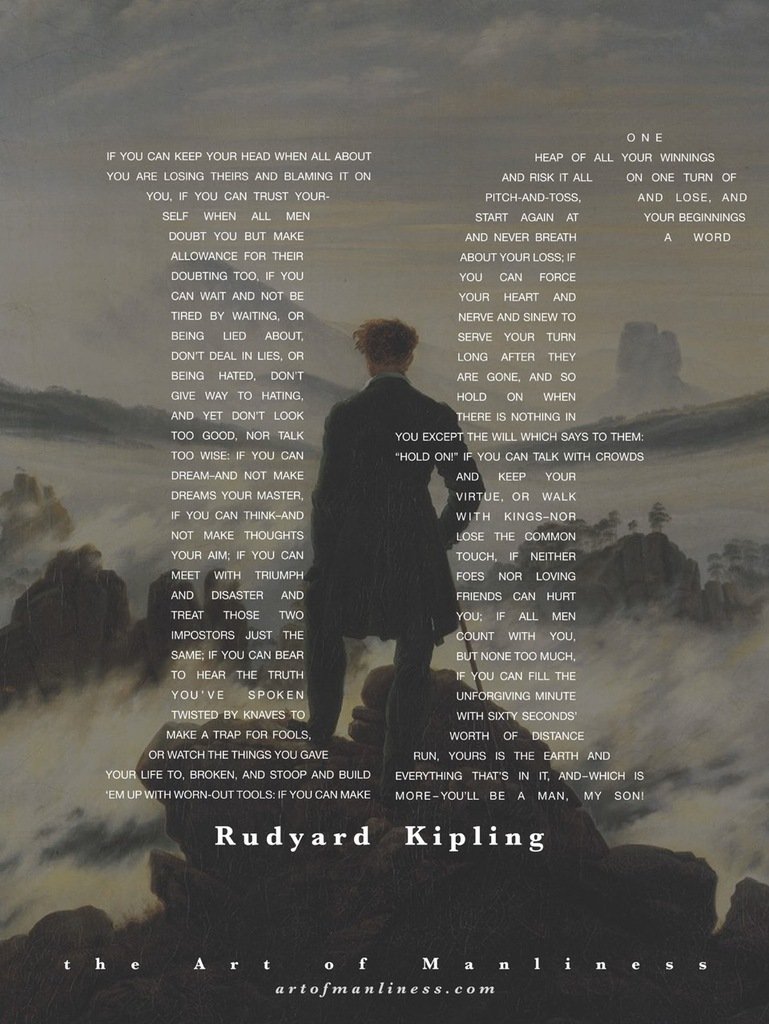
“If”
By: Rudyard Kipling
If you can keep your head when all about you
Are losing theirs and blaming it on you,
If you can trust yourself when all men doubt you
But make allowance for their doubting too,
If you can wait and not be tired by waiting,
Or being lied about, don’t deal in lies,
Or being hated, don’t give way to hating,
And yet don’t look too good, nor talk too wise:If you can dream–and not make dreams your master,
If you can think–and not make thoughts your aim;
If you can meet with Triumph and Disaster
And treat those two impostors just the same;
If you can bear to hear the truth you’ve spoken
Twisted by knaves to make a trap for fools,
Or watch the things you gave your life to, broken,
And stoop and build ‘em up with worn-out tools:If you can make one heap of all your winnings
And risk it all on one turn of pitch-and-toss,
And lose, and start again at your beginnings
And never breath a word about your loss;
If you can force your heart and nerve and sinew
To serve your turn long after they are gone,
And so hold on when there is nothing in you
Except the Will which says to them: “Hold on!”If you can talk with crowds and keep your virtue,
Or walk with kings–nor lose the common touch,
If neither foes nor loving friends can hurt you;
If all men count with you, but none too much,
If you can fill the unforgiving minute
With sixty seconds’ worth of distance run,
Yours is the Earth and everything that’s in it,
And–which is more–you’ll be a Man, my son!


.jpg)


Brett,
Excellent post. This poem really says it all about what it means to be a man. Love the blog, keep up the great work!
That’s one of the most inspiring poems out there. Both it and Desiderata make the perfect guide to become a better person, no matter age, sex, or nationality of the reader.
Kipling’s “If” holds a special deep meaning to me, because it really describes a lot of the qualities that make my dad a great man.
Hope everyone else likes it as well.
…
Wow.
Great post and great idea indeed.
This is great idea.
I love the site.
That is definitely getting printed out and hung up. Awesome poem. Man, I love this site!
fantastic idea and a superb opening article for it. Kipling has eloquently summed up what it means to be a true man, a very difficult ideal which we should all strive for.
Another inspiring article, keep up the great work
@ damien
I ckecked out ‘desiderata’ based on your comment. Another brilliant poem and guide to becoming a better person. It reminded me, along with ‘if’, of the really important things in life which are all too easy to lose sight of. Thanks
“Rudyard Kipling was a 4:30 miler.”
-Quentin Cassidy
I was at a company event back in late 2006 and the guy who heads up my division had just taken up the post. He used this as part of his introductory “pitch”. I hadn’t heard it before, later asked him what it was, immediately got a copy and posted it on my pin board. My son’s 9, a bit early to see the value in that but it’ll be there for him.
I too, enjoy the blog, keep it up.
great post and concept. i suggest people take a look at this article penned by henry rollins for details magazine a few years back
http://www.gittlen.com/rollins.htm
Awesome in so many ways. Keep up the great posts.
This poem was a major source of comfort and encouragement to me when I was in my 20’s (20 years ago).
Reading it again today was like coming across a long lost friend.
Thanks for posting!
Alec
Nice post, I’m printing this and hanging it on my board at work Monday morning.
And awesome article from Rollins there, Josh. Gotta admit, Henry is pretty freakin’ manly there, eh?
Wow. Both the poem and that Rollins piece linked to above were intense.
My favorite poem ever - in fact, it’s the only one for me really.
A brilliant piece that inspired me was ‘Abraham Lincoln’s letter to his son’s teacher’ which everyone should read.
I am looking forward to more Manvotional posts.
My father has this poem engraved on a wooden plaque, I remember reading it so many times as a kid, and I remember how as I grew older I began to understand it more and more. If more boys were taught these lessons growing up the world would be a much better place.
This has long been one of my favorite poems. As an Assistant Scoutmaster, I give framed copies to all of my new Eagle Scouts. It helps them to live up to their oaths of service.
Don’t skip the blog, practical skills are great. But if want a constant guide inside your very own head, memorise this poem. You may think that’s hard (so man up already!) but if you are really interested in it and feel the impact of it, you will. I memorised it when I was 17 or 18 after just a few readings, and I’ve not forgotten a line since. You won’t really understand much of it until you’ve actually applied the verses in a situation where they are called for, but at least you will be prepared; you will know what the right course to take is.