






I look around at young people these days, and I honestly fear for the future of my country. People are becoming less and less resilient and more and more clueless on how to survive in the real world. We live in a society of namby pamby men and women who whine when they don’t get what they want and think they are entitled to all the comforts the world has to offer. What do I blame it on? Bad parenting.
Baby Boomer parents developed a parenting philosophy that was soft on discipline and heavy on spoiling their children. Because many Boomer couples were both working, they wanted to make sure their children liked them to make up for the lack of time they were spending with their children. Generation X parents are even worse about coddling their kids. To many many Gen X parents, children are just an accessory you get to dress up with ironic t-shirts and fauxhawks.
In an effort to stop the wussification of yet another generation of children, here are six ways young fathers can raise strong, resilient, and independent children.
1. Give them some independence
Several weeks ago there was a large brouhaha over a NY journalist having allowed her 9 year old son to ride the subway home all by himself. Some people chastised the mother for putting her son in danger, while others wrote in to applaud her decision and to share their own stories of taking solo adventures as a child. I, of course, side with the latter. Kids can’t venture a half a mile from their homes these days without parents worrying for their safety. I live in a quiet suburban neighborhood adjacent to a middle school. Every day, SUVs line up down the street to pick up their kids because heaven forbid they would walk the mile home by themselves. They could be snatched!
This culture of obsessive over-protectiveness is bred by the media. As the 24 hour news networks and Satan’s minion, Nancy Grace, regurgitate stories of abduction over and over and over again, it begins to seem like the world outside your suburban castle is a very dangerous place indeed. Yet the reality is very different from how the media spins it. According to Newsweek:
Nationwide, stranger abductions are extremely rare; there’s a one-in-a-million chance a child will be taken by a stranger, according to the Justice Department. And 90 percent of sexual abuse cases are committed by someone the child knows. Mortality rates from all causes, including disease and accidents, for American children are lower now than they were 25 years ago. According to Child Trends, a nonprofit, nonpartisan research group, between 1980 and 2003 death rates dropped by 44 percent for children ages five to 14 and 32 percent for teens aged 15 to 19.
Don’t coddle your kids by keeping them under lock and key and only letting them out if you can keep a constant eye on them. You’re squelching their development and sense of independence. Teach your kids how to stay out of trouble and away from strangers, and then turn them loose to ride their bikes, roam the neighborhoods, run errands, and walk to school by themselves.
2. Let them do unsafe things
“Helicopter parents” not only worry about their child being abducted, they wring their hands over letting their children do anything mildly unsafe. Everything today is childproof and fun proof. Have you been to a playground lately? Did you notice what was missing? Teeter-totters, merry-go-rounds, and sometimes even swings are going extinct, replaced by plastic coated, low to the ground, snooze inducing apparatuses. Some playgrounds even have signs that say “no running.” I kid you not. While these changes are often pushed by city managers worried about liability, parents are equally at fault in trying to clear any dangers from the path of their children. They fail to understand that while sticking kids in a protective bubble may keep them in safe in the short-term, it leaves them more vulnerable in the long run. Some lessons in safety must be learned from trial and error. If children don’t learn to deal with dangerous tools and situations growing up, when they finally leave the nest, they will be lacking in the skills necessary to negotiate the real world.
For more on this check out Gever Tulley’s lecture on “5 Dangerous Things You Should Let Your Kid Do:”
3. Don’t be their best friend
I recently read an interview with Billy Ray Cyrus in which he was asked how he keeps his daughter Miley from turning into another Hollywood train wreck (this was before the topless pictures in Vanity Fair episode). He responded by saying, “I always try to be her best friend.” While many parents applaud such a philosophy, it is fundamentally the wrong way to raise a child. Parents want to believe they can be their child’s best friend because they enjoy such a healthy, close relationship. The reality is that parents want to be their child’s best friend because they’re afraid of their kid not liking them. But parenting is not a popularity contest. Being a true parent means that sometimes you have to lay down the rules, and oftentimes your kid is not going to like it. While “tough love” may be painful for both child and parent in the short term, it greatly benefits both in the long term. Kids don’t need a best friend, they need an authority figure. Deep down, they do want someone to lay down the rules and give them some structure. They want guidance. Best friends are equals, parents and children are not. If you insist on being your kid’s best friend, a situation will inevitably arise where you do finally try to reign them in and make them respect you. But it will be too late; they’ll feel free to toss your advice aside like they would for any friend.
4. Don’t automatically take their side
My mom works at an elementary school. One day, one of the students was causing all manner of trouble: disrespecting the teachers, throwing tantrums, and antagonizing the other children. It got to the point where the girl’s parents actually had to be called to come take the child home. When the mom arrived, she gave the teachers the stink eye, turned to her kid and said, “Awww, you’ve been having a tough day, haven’t you Sweetie? Let’s go buy you a toy.”
While it’s natural to think the best of your children, don’t be overly defensive when others criticize them. Teachers and friends typically do not have ulterior motives when sharing a story of your child’s misbehavior. As outside observers, they may have valuable insight into something about your kid that you have overlooked and need to address. Your child needs to earn your trust, just as anyone else does. Don’t give it to them automatically.
5. Make them work for what they get

Many young people today are swimming in debt up to their ears. They feel entitled to the things it took their parents 30 years to acquire. Such a problem exists because many young people have never had to earn the things they’ve enjoyed. They expect the good things in life to naturally flow into their lives.
If children are not given responsibilities and work as a young age, it’s harder to instill the ethic when they’re older. You’re doing your child a great disservice if you buy every stinking thing they want. Sure, it’s easier to just buy them the $10.00 toy just to shut their tantrum up. But all you’re doing is conditioning them to the idea that if you whine enough, you’ll get what you want.
By encouraging your children to work for what they get, you’ll be teaching them valuable skills that they will carry with them the rest of their life. Not only will they develop an appreciation for work, they’ll learn valuable money management skills, responsibility, and initiative.
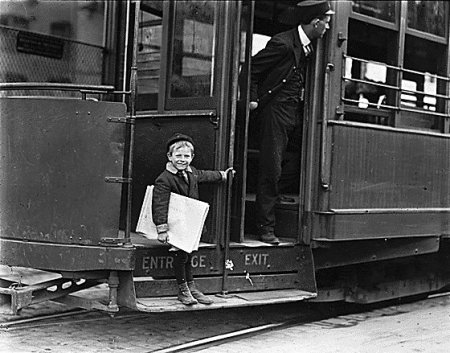
During the early 1900’s kids were working 60 hours a week in factories and coal mines. While it was a deplorable situation, it shows that kids are capable of taking on far greater tasks than parents today are willing to give them. They may no longer have to break slate, but they can at least clean the bathroom and mow the lawn.
6. Don’t praise them indiscriminately
“If everyone is special, then no one is” -The Incredibles
One year, I volunteered at an after-school program at an elementary school. At the end of the summer we had an awards ceremony for the kids. The very PC director (no Pilgrim or Indian crafts on Thanksgiving!) insisted that every kid, whether they deserved one or not, had to receive an award, lest anyone should feel left out. So we were forced to think of awards even for the kids who had consistently misbehaved and caused trouble. Upon such students we ended up bestowing the “High Energy Award.” What a crock.
What’s the point of an award if everyone gets one? What’s the point in striving to be your best, if everyone is equally rewarded? Praise then loses all of its meaning, even for those who really deserve it.Every parent believes their kid is special; that’s natural. But if you heap enormous and unwarranted praise on your kids, it’s going to end up debilitating them. Praising your child indiscriminately sends the message that praise is not earned, it is something one is naturally entitled too. It will end up dissolving their competitive drive. These children grow up believing they can do anything and everything well. Thus, they become restless at every job, quit, go to culinary school, then getting a masters in philosophy, and then think they’d like to try to enter the space program.
The reality is that there are certain things we are good at, and certain things we are not. If you praise your kids for everything, they’ll have a harder time honing in on their true talents and abilities. Instead of praising them indiscriminately, center your praise on specific achievements. For example, say, “You did a great job on your math test.” Not, “You are so smart and wonderful!”


Facebook 


{ 119 comments… read them below or add one }
Love it. Preach on brother.
Amazing article. This should be required reading for any pregnant couple. I agree 100 percent with everything you said. Well done.
I could not have said it better myself. This entire article is so right on it blows my mind. It is as if the author took exactly what I was thinking and put it to the web. Bravo! I am a father of a two year-old daughter and a 9 week old son. I am printing this off and sharing it with my wife so we can both be on the same page when it comes to raising our kids.
I feel that I was coddled to much as a kid. I never even got in a fight.
My sister-in-law is something of a hobo and I tell my wife that my son and I are going to go ride the trains with her when he’s big enough to actually be able to get on one.
Also, I used to break thermometers to play with the mercury and used to melt lead into shapes. I want to afford the same learning opportunities to my kids.
And when I say fell, I of course mean feel. But you people obviously knew that.
In fact, I think I should get beat by the bamboo stick on the backside for that typo. It should help me to be more attentive to my spelling.
Point #6 reminds me a lot of an article you may have seen in New York Magazine: “The Power (and Peril) of Raising Your Kids”–definitely a worthwhile read http://nymag.com/news/features/27840/
I don’t have kids yet, but I anticipate having a hard time with #1, #2 and #3. I was given a ton of leeway and independence as a kid, played with sharp things and fire at my leisure, blew stuff up and had the run of the neighborhood. But man, I predict a tendency to “helicopter”. My wife? Not so much. So I think we’ll balance out.
Great article.
Great article and a fantastic remidnr for us all. Thanks for sharing…I ahve shared this with my readers who I am sure will love it.
Sarah
#2 doesn’t just apply to your kids, does it? Or, can anyone explain to me why the lid on paper coffee cups has the words: “Caution, contents may be hot” on them? How about the words “What doesn’t kill us makes us stronger” instead?
Great article by the way, but as long as there are lawyers in this world your words will fall on hard ground.
I’m really glad you didn’t quote Billy Ray Cyrus as being a model parent. I was almost scared for a minute there
When my wife & I were preparing for adopting our son, the agency required a number of hours of educational credits per parent. There was a reading list of books that could apply to some of this, but we also opted to take a parenting course offered by a local non-profit agency called Love & Logic (http://www.loveandlogic.com/).
This was an excellent intro course that led us to also purchase accompanying books and a video. The focal point of Love & Logic is to teach children to be responsible and prepare them for the real world by allowing them to experience its choices – and the consequences of those choices. They emphasize that experience is a far more effective means for children to learn than lectures. Love & Logic’s philosophy is to let your child suffer the consequences of less-than-optimal choices while the price tag is still very low.
For example, be if your child is a picky eater, you should simply make available the foods you want your child to have and then leave it at that – if he chooses not to eat what’s been given, then he can wait it out until the next meal to see if it seems more palatible. That little rumbling gut will be a much more constructive and educational opportunity than an hours worth of coaxing at the dinner table. Likewise, if your child learn that his toys will not automatically or magically be replaced if he loses of damages them then perhaps he’ll truly value the bigger-ticket stuff later in life.
The only drawback I see to this plan – and it’s a minor one – is that you do kinda have to wait until your child is old enough to communicate well with before you can really start implementing most of the Love & Logic ideals – not quite so effective on an 18 month-old. So, I’m biding my time and trying to introduce some of the concepts in small steps.
What’s really amazing is that many of the Love & Logic concepts work on adults as well. It has made a difference for both my wife & me at work where we no longer accept ownership of problems that aren’t our own. We push the responsibility – and/or the price of failing to be responsible – back on the appropriate parties. This works wonders for dealing with those self-entitled Gen Y slackers who’ve wormed their way into the job market in recent years.
This is a great article. I’m certain that every part of this can be put to use just about anywhere in the world. I live as far away as Denmark and i can relate to all of it.
I still don’t have any kids but this is going to be the way I raise them.
Thanks for the read.
The video’s great. Boys will love it.
I think we could improve the advice in the article in some ways, though. (Its point is obviously to help the kids; I think these changes will help.)
*Praise them outrageously* when they’re small — let them build up enough of those internal messages that when they fail at something, they know it doesn’t mean *they* suck, and they should keep going! Let them know they *are* wonderful to you. I never heard of a kid who *actually* thought, when he failed, “I’m so great I don’t care” — but I *have* heard of those who thought, “I suck so much I might as well give up. I’ll never succeed.”
*Never make them work for your love* or kind regard — give it freely! (Expensive toys, that’s another matter.)
*Always* be on their side — always. They need you in their corner. Telling the teacher they couldn’t possibly be to blame for any problems at school, or letting them hit the little sister, is *not* being on their side.
Wordsmithing matters. If my principles lead me to not give, not love, not support, unless there’s some special reason, I will be less loving than if my principles lead me to give, love, and support unless there’s a special reason not to.
You can find anything on the Internet, but in the real world, I never meet people who say, “I wish my parents hadn’t praised me so much, or been so generous. They always took my side — it was awful!” But I regularly meet those who say with regret, “My mom/dad never had a good word for me. ” Or those that say, if pressed, “Sure, my parents have always been supportive of me” — like, “Yeah, that’s not an issue, it’s cool.” Having it not be an issue, to me, means the parents did a fine job.
Let me add: #1 and #2 are great. Kids will love whoever wrote this!
They really need to bring dodgeball back into public schools.
Don’t spoons feed your kids once they are able to hold the spoon. Let them eat or drink on their own under your supervision. I’ve made a mistake of spoon feed my son up to 6 years old. We as parents always worry about our kids’ health of not getting enough food, and start spoon feed them come meal time. By doing so, it will lead them to be selective of food once they grow up. They also don’t seem to really enjoy variety of food. The reason why it is so is because when you spoon feed them, they really don’t know what food they are taking since you’ve mixed the food up in the bowl. This is what happens to my son who is now 14 years old. This is my experience which I would like to share with you all.
You know what I have noticed? Less and less children get broken bones. Not that I am saying that broken bones are ‘good’, but it’s just a sign that a child is playing, exploring, and testing their limits. Getting a cast used to be a badge of honor, the playground ‘war injury’. Now I meet people that have never broken any bones…ever.
Great article!
@Will-
“Let them know they *are* wonderful to you. I never heard of a kid who *actually* thought, when he failed, “I’m so great I don’t care�? — but I *have* heard of those who thought, “I suck so much I might as well give up. I’ll never succeed.�?”
I don’t think spoiled kids say “I’m so great, I don’t care” when they fail but what they do do is blame someone else for failing. They have been praised so much that they cannot conceive that the failure is their fault. They say that their boss didn’t like them, or their teacher was out to get them, or their coach was biased toward other people. They never locate the problem within themselves.
“You can find anything on the Internet, but in the real world, I never meet people who say, “I wish my parents hadn’t praised me so much, or been so generous. They always took my side — it was awful!�?”
Again, it is true that spoiled people will seldom say this…but that is because most people like being spoiled, and it’s the only reality they know. But you can bet that people who work with them and attempt relationships with them, will have these kind of thoughts.
Trust me, I’m an Esquire subscriber. If there were topless pictures of ANY sort in that magazine, much less of Miley Cyrus, I’d know about it. The incident to which you refer is almost certainly to do with pictures of her that appeared in Vanity Fair; personally, I think to refer to them as “topless pictures” is a drastic oversimplification, but YMMV.
@Brian-You’re right, it was Vanity Fair. And yes, “topless” is quite the simplification-the incident was rather ancillary to the point I was making, so I was simply being economical with my words. I just wanted to clarify the time line of the interview, as some people became less enamored with Billy Ray’s parenting style after the Vanity Fair dust-up.
Absolutely!! Kids need to be set free at some point, and they need to skills to be able to be free. When we coddle them and protect them from everything, they will not be ready to handle the demands of life – and that’s a pity.
Our boys are now 10 years old and they are the most independent I know – because I’ve taught them independence since day 1. There is NO question in my mind that they will be just fine when they grow up.
We are actually taking off in three days to ride our bikes from Alaska to Argentina – yes, 10-year-old twin boys will be pedaling 20,000 miles. Can they do it? No question.
I think we, as a society, have set the bar way too low – kids don’t need to do anything these days. And that’s crippling our society.
You can read about our journey at http://www.familyonbikes.org
Wow, this is great. I need to start making some adjustments on my parenting philosophy. An additional idea that I would like to throw in is that we should not allow our kids to follow what all the rest of the kids are doing, just because it is popular. For example, due to my Christian beliefs, Harry Potter and anything to do with those books and movies is not allowed in our household. Lots of my kids classmates are very into Harry Potter, but our kids have understood the reasons behind our prohibitions.
Now, what about grandparents…aren´t they the greatest coddlers of all? But I guess is ok, since their interaction with the kids is not daily, unless you have a live-in grandparent.
Many blessings,
Art Gonzalez
Check my Squidoo Lens at: Quantum Knights
been saying this crap for years.
preach on brother.
Great post. I think it really hit a nerve. Just last week I posted about the same thing except from my perspective as a kid who wasn’t coddled but was fully loved. I’m so thankful that my parents let me play in the desert with BB guns and snakes.
I agree on your points regarding character building. We can all agree that kids shouldn’t be spoiled brats. However, the turn of the century child labor pics need to go. Those children may be smiling, but they probably have lesions growing on their little bodies from the toxic materials they’re handling. Chimney sweeps were always young boys, and most of them developed painful cancerous lesions on their genitals from exposure to soot.
Keep things in perspective. Children are children and they grow up fast. Don’t rush them off to be adults, and make sure that once they get there they have fond childhood memories to look back on. Just love them.
@Geoff-
As I said in the post, child labor at the turn of the century was a despicable thing. The pictures are simply being used to show a point: that kids are far more capable of hard work and responsibility than we give them credit for. Early Americans saw children as little adults and expected them to shoulder the responsibility of helping the family as soon as they were able. Childhood as we know it is a modern invention. Which is not to say that I think kids need to be shipped off to the coal mines. They should be allowed to enjoy their childhood and have fun. But they should also be given some freedom and some responsibility.
Agree and disagree.
The very same facts you use to back up how “Safe” the world is, would suggest that when parents did the things you suggest (25-30 years ago) the mortality rates for those kids was much higher! Didn’t think about that, did you?
“Nationwide, stranger abductions are extremely rare; there’s a one-in-a-million chance a child will be taken by a stranger, according to the Justice Department. And 90 percent of sexual abuse cases are committed by someone the child knows. Mortality rates from all causes, including disease and accidents, for American children are lower now than they were 25 years ago. According to Child Trends, a nonprofit, nonpartisan research group, between 1980 and 2003 death rates dropped by 44 percent for children ages five to 14 and 32 percent for teens aged 15 to 19.”
I couldn’t agree more.
I love it! I am a mother of four and have been wondering if anyone else out there thinks children are being coddled to death. Most of my friends and aquantences look at me strange because I don’t coddle my children. I have the rep of being the “mean” mom because of it. Yet my children sit in a resturant, keep quite at the movies, and can handle things like losing our home to a fire and the death of their grandmother without needing professional help. They wake up everyday with a smile and ready to take on the day. I’m not saying they’re perfect, they are just happy well adjusted children. When asked how do I get my children to behave I respond because it’s expected of them and if they don’t behave in public then we don’t go out, it’s as simple as that for us.
I really hope that you open some parents eyes with this one and if not it’s always nice to know your not the only “mean” person out there.
Do you want me to get off your lawn, sir?
Brett-
Amen!
The very best gift we can give our kids is self-sufficiency. Teaching them stuff like how to save up for a car and how to interview for and hold down a job. Not giving them everything we could afford to give is also so critical to their developing toughness and independence. Especially when they see their friends being given those things that rightfully should be earned through hard work and thrift.
Tough love is allowing them to get a few scrapes and bruises along the way, and then helping them to see that their life lessons learned young will save them from the misery of learning them as adults.
Great Post, man!
Words of wisdom for sure. This is advise that should be standard issue when you go to register your child. Too bad too many people listen to all the softy crap spewing from the grossly inflated market of parenting advisors that’s the norm is most western countries nowadays. In Holland, my home country, things are just the same.
When faced with something as asinine as a demand that every child must win an award, it’s rather important to push back, and to do so loudly.
Trying to child-proof the world makes us neglect the much more important task of world-proofing the child.
-jcr
“Harry Potter and anything to do with those books and movies is not allowed in our household.”
Ok, this is hilarious. You’re proud of depriving your children of some very fine childrenss literature, and doing so because of your superstition. Sorry to break it to you, but you’re following the crowd yourself. It’s just that your crowd is smaller and culturally impoverished.
The Harry Potter books are excellent moral teaching for children: they show that what matters most are the moral choices we make, and they show that authority can be wrong. It’s surprising that a British author did such a fine job of promoting traditional American values.
-jcr
You’re a dumba$s. Men don’t let their children roam the streets unattended. Lazy parents do that. You know something bub? When I lived in Guatemala they had this mentality with their kids and guess what? Lots of child funeral marches.
I watch my kids like a hawk. I carry hardware about my person to ensure my family’s got a fighting chance on the streets. I am their bodyguard and my job…AS IS ANY FATHER’S is to protect and give my life if necessary.
I’m out there with my kids. I let them play but I keep the danger away. My presence ensures they can concentrate on playtime rather than the shadows in the woods.
I will utterly destroy anything that even thinks about harming my children. If someone should harm my child I will destroy that person wholly and completely…even if it means my own demise.
THAT is being a parent. You, Mr. Manliness, know nothing of what you speak and it is only by God’s grace any of your children lived under your watch.
BTW, if you haven’t already guessed, I’m unsubscribing to your blog. This advice is foolish and dangerous.
oh my…i get dirty looks in the store when i let my children suffer the consequences. but at 3 and 5, they are worlds ahead of the same-aged kids i know.
by the way, i’ve done (Teaching with) Love and Logic, and now Parenting with Love and Logic. IT WORKS!!!
when kids ask what they “get” for helping you around the house or in class, i say, “earning respect and honor feels great, doesn’t it?”
preach it!
I have always told my wife, and other parents, that broken bones heal quite easily, much, MUCH better than broken psyches.
Growing up our friends were impressed with how much freedom we had during elementary school ages, and dismayed at the fact that in High School (and beyond!) we were supposed to let our parents know where we were and who we were with. We could go pretty much anywhere, they just had to know. My wife and I have done much the same thing with our 3.
Another good parenting tip, passed to me 23 years ago upon the birth of our first:
Every minute you spend with them before they are 5 is and hour you don’t have to worry about them when they are 15.
It seems to have held true so far. . .
Tandemman
brett, fabulous post; as articulate and amusing as it was accurate. as a child of overprotective/semi-spoiling parents, i cant attest to the truth of what you’ve said. i believe it is the selfish motives of parents that prompt them to be the hero (ahem, scott. sorry to call you out, but WHOA THERE BUDDY), and/or the best friend. truly loving parents will consider what is in the best interest of the child, recognizing and putting aside any inclination to focus on themselves, and make decisions accordingly–decisions that might even make them feel uncomfortable from time to time.
john c randolph, i liked the platitude you contributed about world-proofing your child being more important than child-proofing your world. i hope i remember that one if any hypotheticals ever come along
Amen, amen, amen.
I must have my sons read this.
Thanks.
Scott-
Your comparison between Guatemala and American suburbia is like comparing apples to oranges, my man. I lived in Tijuana, which I’m sure is pretty much like Guatemala. Probably worse. If I had kids in Tijuana, I wouldn’t let them roam the streets either. High crime+corrupt police force= not a safe place for anyone. But I don’t live in a third world country, so I’m not strung out like you. Jimminy Christmas, quit watching Nancy Grace. America is a safe country. What are you going to do when your kids leave home? Sleep underneath their bed in the dorm room with an AK47?
I couldn’t agree more. I am in a situation with my ex where I have to travel 2000 miles everytime I pick up my son. I get him 25% of the year. This last trip she refused to let me bring him back at his bedtime because it would mean that he got to bed two hours later. The attorney representing my son said that she agreed it might be too much for my son to arrive in the Midwest at 8:30pm, so I had to buy non-stop tickets around the fourth of July to accommodate their ridiculous request. The tickets ended up costing $300 more to get my son in town at 4:30pm. Are you freaking kidding me? My son has been traveling now for five years, and probably has more airline mileage than most thirty year olds. He loves flying and loves the experience in general. When I was a kid our parents and uncles/aunts would drive us kids on 15 hour trips to save money. There were many of trips that we slept in a car through the night and never thought the worse of it. Sure our parents got a lot of “are we there yet” comments, but that’s just life. Sometimes schedules get upset a little bit. It is really upsetting to me that my ex-wife coddles my son and worries about schedules to such a degree that she makes things so difficult. I was raised by a single father, and we did what we needed to make it. It is unnerving to me that my son’s life is so regimented that he is not being taught the lessons of doing what you need to do to solve a problem. Instead the problems are solving him.
THis article hits very close to home…good job.
Great article, and it’s the second time this week that I have read about the dangers of coddling children, so time for me to pay attention I think!
I especially like point # 3 “Don’t be their best friend” , this has been a tough one for me because I have a tendency to avoid discord….. But anyway, lately I have been implementing some rules into our household about helping out and contributing energetically. Currently this has taken the form of my son taking his turn in cleaning the kitchen. At first there was minor rebellion, but I do believe after a couple of days there was some satisfaction in him that he was helping me out in a meaningful way. Plus now he knows that dishes and floors don’t clean themselves!
@Jeff-
Wow. That is completely ridiculous. Thanks for sharing such a pithy example.
This is a great post and should be required reading for every new parent. I have been saying something similar to #3 for quite some time – that I will not be my daughter’s best friend, but I AM going to be her father.
This was also sobering to read things like “bring back dodgeball in schools”. I was not aware that it had left, but since kids can no longer create Pilgrim or Native American crafts for Thanksgiving, well, what do we expect? While we’re at it, let’s remove spanking in schools, and whittle away all forms of discipline… oh wait, we already did that. This PC bullshit needs to stop. Schools are so sterile now that they are setting kids up for failure in the real world. Ironically, you don’t get a job just for participating, you have to be the best. Lawyers fight all the time, and there is only one winning side. Ever seen two political candidates get elected for the same position at the same time? If kids do not understand winning, losing, and competition from the start, then they will fail by the time they graduate college (if they make it that far).
I have a friend who’s wife is a 1st grade teacher. She can tell off the bat if a student will be a good student once she meets the parents. She (probably like many others) can tell if a parent will be the one to violate #4.
Although I may not be a parent, and be 21 years of age, I do feel lucky to have ole’ fashioned soviet parents who somehow seemed to follow your article word for word in raising me. It may have been tough at times, but these days I feel greatful for my parents. Especially the part about not being their best-friend. I was a little freaked out by you basically quoting my father when you talk about parents not being the best friend to their child. Im happy with my subscription!
Excellent post! I suggest the book, “No: Why Kids — of all Ages — Need it and Ways Parents Can Say It” by David Walsh to any reader for further reading.
another thing to think about:
http://nymag.com/news/features/27840/
From reading your comments it is very easy to deduce that the large majority of you are:
a) not parents
b) were not treated well as children
c) don’t realize that there are many more threats- and not just mortal- out there today than there were when our parents were reaising us
d) and finally just becasue some of us love our kids and treat them with kindness, we are not all spoling them with material things and not breaking their independent spirit
and btw I do not believe that physical discipline gets anyone anywhere
Excellent points! Thanks.
There are “real sciencey” reasons why these are all good parenting guidelines:
1. The human brain primarily perceives changes only/most and when input is static the brain starts to automatically nullify the sensation to zero (Shannon’s Law of Information states there is technically no information present when there is complete predictability. The brain’s neurons detect this and begin to block sending it up the chain of command to the consciousness – why waste the energy if we know what’s going to happen next?). This is why you need contrasts to perceive things at their richest: sadness makes happiness sweeter but striving for continuous happiness is never a successful or rewarding experience. Fragrant flowers smell even better after a waft of sewage. Etc. etc. Preventing a child to experience anything surprising (another definition of “information”) or allowing only “pleasant” experiences is such a nullification. This also relates to the next point.
2. Learning comes from feedback which only works against a set reference to generate error information – it’s the error information that causes learning to occur so you can not possible learn about the outside world without interacting with it and without also having a fixed (or mostly fixed) standard, aka parental inflexible authority, social peer feedback or even just the laws of physics as you fall out of the tree, to generate that error signal.
This is also the central flaw in *all* zero-tolerance strategies: they are, by definition, striving for zero error which means that a) no learning is happening any more, b) no information is received so the brain (and society) in its glorious urge to efficiency will filter this non-information and start to dismantle all the mechanisms that once were induced by that error signal.
Even worse, actually achieving zero error is precisely equivalent to eliminating corrective feedback altogether!! Striving for zero tolerance with any success only weakens feedback and control of the situation or system! There is a strict mathematical point of cross-over for this where “improving” is actually “worsening”. You can’t always determine that point in real life but generally striving for zero tolerance is a recipe for crossing very quickly – it always a bad strategy.
See movie “Demolition Man” for an accurate and funny societal example of what happens without that error signals (from the legal error signal called “crime” in the movie).
Also think about what happens when you stop exercising, thus eliminating the feedback error signal called muscle microtears, which trigger the body to build and maintain muscle in response to input stimuli (aka resistance against the muscle movement that causes the microtears).
3. Anything that is “News” is by definition an exceptional event. News is information. Information is surprise. That which is common place or expected is not surprising. It is not information. It is not “News”. “Man goes to work, works all day, comes home and then goes to sleep” is not “News”. “Child abducted” is “News” precisely because it is a *profoundly* rare event. Terrorism is “News” because it is a *profoundly* rare event. This is one of the biggest reasons to stop consuming the main-stream media as a sole source of information as it reinforces beliefs that are the exactly opposite of truth.
Anything that you see on the “News” which isn’t truly exceptional is either entertainment or propaganda. No exceptions. Treat all three appropriately.
4. Humans in general are horrible as estimating any numeric value for things and then particularly when estimating risks, which includes both the probability that an event may take place combined with the value or impact of that event. Neither risk probabilities nor risk impact are not “central” so you can’t take the past and automatically extrapolate it accurately into the future with much accuracy. These dubious values of probability and impact get multiplied to give “risk” – multiplication has no naturally intuitive mapping (unlike addition) so the errors are further compounded.
The complexity of our constructed world compared to the flat, easy-to-survey African Savanna to which our brains are optimized assures our befuddlement. Our only defense for our ape-brains is the rigor of statistics and rational analysis but that is too often a shunned discipline.
5. Basic biology. Let’s be blunt – parents: YOU WILL DIE! And it’s even the best case scenario if you die before your children do! When you are dead you will not be there to take care of your precious offspring and they had been better be able to survive without you. You’re job is to work yourself out of being a parent by training and raising your children to be independent adults who can take over and handle anything required once you are gone. Doing anything else is unconscionably cruel and selfish.
6. The quick-and-dirty-yet-accurate assessment of risk, errors and mistakes for our children actually centers on two things: risk as described above (probability and impact) combined with reversibility of the impact. This is what seems to be lost on helicopter parents.
Most things, events or situations that are risky but reversible are good risks that should be allowed as soon as the child can reasonably be expected to be able to learn from mistakes that occur. Generally children reversibly heal from cuts and bruises so these are good risks. Generally children aren’t hurt by losing money because they can reverse a debt or zero balance in the piggy bank and earn more so letting them completely make their own purchase decisions with money they make is a good risk.
Other mistakes/errors/risks are mostly or completely irreversible and need some degree parental protection at least until they are old enough to take responsibility to make their own decisions about irreversible events. Irreversible events include unplanned pregnancy by making poor sexual decision or getting into fights with motorcycle gangs or not wearing a seatbelt while driven or drunk driving.
Even allowing them to make decisions on irreversible things is something that must eventually be fully ceded by every adult to their children. See #5 for the worst-case. Hopefully a parent has been progressively allowing and explicitly or implicitly training their child to handle bigger, less reversible mistakes continually over time. Small changes in error experiences are trivial to handle but large changes in error experience due to sheltering are either overwhelming or the cause to truly dangerous due to unfamiliarity with self-assessment of risks – big risks and little risks look the same when you’ve never experienced either.
But when so many people have the inability to keep cause-and-effect and simple time sequences straight it’s hardly a wonder they can’t assess reversibility of risks.
Of course, I see numerous typos only after I hit “Submit”. Apologies in advance…
I ENJOYED EVERY BIT OF MY READING. I CAN SAFELY SAY ONE THING THAT NOW PARENTS ARE REARING THE BEST CITIZENS OF THE FUTURE WORLD . THE ARGUMENTS ARE SO STRONG EVERY TIME I FELT LIKE TO ON THE WRITERS SIDE. I PICK UP THE BEST OF THE IDEAS AS A PARENT OF TWO KIDS. THANKS
THANKS .A READING WILL GIVE A FAIR IDEA AS TO HOW WE SHOULD RAISE OUR CHILDREN.
Provocative post with terrific content, Brett! I’m a Gen X parent myself and can be something of a helicopter. There’s a balance. One of the reasons I helicopter my kid a little is to keep him from annoying others – I don’t let him run wild in stores, restaurants, etc.
I agree with what you’re saying for the most part, but we moved to this sleepy little seaside town 4 years ago (the kind of place where nothing ever happens) and within a couple of months there really was a “stranger” trying to abduct children. Thankfully after several unsuccessful attempts he disappeared. A couple of years later, a family in town was in a roll-over accident. Only their 11 year old son was killed because he was the only one not wearing a seatbelt.
So while I agree that there is much over-coddling out there, there are also real risks and dangers that we as parents are responsible for protecting our children from. It is fine to say I did this or that when I was a kid and I’m still here, but the children who died doing this or that aren’t here to say I did this or that and died doing it so don’t let your kid do it.
I try to find the “happy medium.” I let my kids play with toy guns (much to the chagrin of family and some friends), they play unsupervised down at the bogs, they wittle with knives, shoot their bow and arrows, and climb every tree with branches close enough to the ground for them to reach, but I also have a few things that I just don’t let them do.
Thanks for your post – and let’s let the kids be kids!
It’s easy to use statistics like that to say that it’s really not that dangerous out there in the burbs. But, what do you tell someone like myself who’s children have been kidnapped? I agree with this article for the most part but it’s hard to have that attitude when something like that has happened to my children. Now, if anybody looks at them funny I’ve got a knife to their throat. But who knows, maybe I’ve just paranoid. And rightfully so.
Dear Sir,
This might possibly be the the most rediculous article I have ever read on parenting. I have never seen a writer string together so many generalizations and stereotypes in my life. I’m truely surprised that you did not end with,” And you kids better stay off of my lawn!”
I am a baby boomer and I will continue to coddle my kids. If God grants me the years, I will coddle my grandchildren as well. I have three daughters that will know every day how much I love them. That’s what children need. I grew up with a father and mother that only knew how to scream orders and pile on chores. My parents didn’t believe in spoiling their kids, they believed in beating them. Corporal punishment never helped me respect them – it made me hate them and want to leave. I never once heard “I love you” from either of them. And while some may find that “namby pamby”, I find it is essential to raising children. In short – the good old days weren’t so good.
I don’t believe previous generations have done a better job of parenting. I believe that most people do the best they can AND THERE IS NO MANUAL! (With the possible exception of the bible). A good place to start is just loving them. Many people struggle with that, so sometimes it gets exhibited in a material way. I am blessed with the gift of poverty – so that’s not an option. Yet, I find ways to coddle them even as a poor man.
I am disappointed in this article. I, by and large, enjoy much of what comes out of this website, but you genuinely missed the mark here. Why not an article on how we can do more for kids in our communities? Perhaps an article on mentoring. Perhaps even an article in defense of our children, for I am often brought to tears by the crimes I see committed against children every evening on the news. The world is ugly – children are innocent. You really need to change your paradigm. I will leave you with something my grandfather told me when I was a young man. “A man never stands so tall, as when he stoops to help a child.”
Respectfully,
Geoff Sager
Griffith IN
@ John C. Randolph: Thank you for your comment but I respectfully disagree. Sorry, but I cannot accept that. Obviously, once my children become adults they can proceed as they wish, but I would have remained loyal to my principles and not let them get in touch with unclean ideas, suggestions, etc. Harry Potter is all about sorcery and witchcraft, in other words Satanism with some cool special effects and attractive story to attract kids.
Below are some verses on which I base this:
Proverbs 4:13-15 “Hold firmly to my teaching and never let go. It will mean life for you. Don’t follow the bad example of cruel and evil people. Turn aside and keep going. Stay away from them.”
Proverbs 22:6 “Teach your children right from wrong, and when they are grown they will still do right.”
Also check Deuteronomy 18:10-12 “There shall not be found in you one who passes his son or his daughter through the fire, one that uses divination, an observer of clouds, or one divining, or a whisperer of spells, or a magic charmer, or one consulting mediums, or a spirit-knower, or one inquiring of the dead. For all doing these things are an abomination to Jehovah. And because of these filthy acts Jehovah your God is dispossessing these nations before you.”
The Lord is clear that any practice of sorcery or witchcraft (as Harry Potter practices and proposes) is a curse. So, if my principles are Christian based, I wouldn’t be a good man to my family if I allowed things like this.
Many blessings to all,
Art Gonzalez
Check my Squidoo Lens at: Quantum Knights
Anyone gonna delete Tito Toronto’s quote? Beating your kids? Spanking, yes, but a punch or a slap? It’s offensive and presented in a style inconsistent with this blog, including the use of the f word. And referring to women as bitches is NOT manly.
well said, brett.
i think some people have misread the article. i don’t think the author is advocating being mean or depriving your children. no one ever said anything about not telling your kids you love them or being negligent and stupid about caring for your kids.
of course you need to tell your kids you love them and praise them when they excel, but instilling a sense of entitlement and arrogance puts them at a disadvantage rather than making them a better individual.
@Geoff, I agree that grandparents should spoil their grandkids, that’s what grandparents do. i also agree that it is wrong for parents to never praise their children or express love. i don’t think the author was encouraging parents to be heartless jerks. you can still show love to your kids while being an authority figure in their lives.
and yes, the dude that said punching your kids is a good idea is pretty much a moron. i hope that was a joke or something.
@Art Gonzalez
I’m a Christian and enjoy the Harry Potter books. I like G.K. Chesterton’s take on “magic” and “fairy tales,” saying they point a child to the supernatural in a way that is healthy. J.R.R. Tolkein and C.S. Lewis created magical characters in a Christian world view, and I’ve found the Harry Potter books contain many of the same elements of those great works of Christian fantasy.
Science fiction creates a tale around science by suspending some of it’s fundamental laws: like you can’t eat soup on a spaceship because of the absence of gravity in space. They do this in order to point out other important points of science and its consequences.
In the same way, fantasy suspends some fundamental spiritual laws. If you can transform someone into a cheese sandwich in real life, then you shouldn’t be walking around in the open. But in a book – the characters aren’t damned for sorcery, because there are different laws created to show other, more relevant spiritual lessons, like those of charity, loyalty, kindness, and bravery.
Sorry for being so wordy…
@Art,
While I see where you’re coming from, have you considered some other books? Harry Potter is not the first nor the last series to feature “magic.” Example: The Chronicles of Narnia. The Chronicles of Narnia were written by C.S. Lewis, one of the leading theologians of our time, and the books have very clear symbolism which illustrate principles laid out by Jesus in the Bible. Yet they also include “magic” very much along the lines of the “magic” in Harry Potter.
One of the keys I think is teaching your kids to discern between reality and fantasy. While I am a Christian who believes dabbling in occult-related practices is a definite no-no, I also realize that the magic within Harry Potter is not real: it is fiction. They are merely stories, and are not magic themselves. There is nothing wrong with reading them.
To prohibit Harry Potter on the basis of “witchcraft” is a little like saying you could never tell ANY stories because telling them is like lying (since you’re saying something that presumably never happened). Jesus also told some figurative stories (parables) to illustrate points, but they are not considered lying because of their *intended purpose*.
The intended purpose of Harry Potter is not to teach sorcery to kids, but rather to entertain with wonderful stories. If you were buying your kids a “guide to black magic” I would be concerned, but Harry Potter is far from being “sorcery and witchcraft.”
I think if you gave the books a chance and read them you would see what I mean.
I LOVED this post. I am not a father yet but I have the same concerns children as you mention here. Not being your childs best freind does not mean you have to be a jerk or short with them. Growing up in my house I always knew who was in charge and who had the last word in any situation, and I have a wonderful relationships with both of my parents now because of it. One day I look forward to using some of your advise to raise my own.
Here’s a little f-er that should have been beat as a kid:
http://www.youtube.com/watch?v=3vQASUdUoHA
You know, Artie, when you try to argue ad veracundiam, it’s rather ridiculous to cite your own favorite work of fiction as an authority.
Now, you may enjoy your imaginary friend (and I’m sure you do), but face the fact that you’re making your children pay for it. In other words, be a man.
-jcr
I was not coddled when I was a kid (although I didn’t have to work), and I thanks my father for that. It’s very easy to spoil a child by doing so. Great article!
I agree giving responsibility to children helps them grow up to be mature and capable individuals however, PRACTICING responsibility is just as important, not only to set an example to children but to keep them safe.
I hope the author of this article and those applauding him/her unconditionally are not parents, this would explain why you would see nothing wrong with sending a child out alone on a subway. If you do have children then I think you are lacking natural affection for then in not considering what could (and does, you idiots) happen to (a small number of) children who are left unattended like this. Their parents are destroyed internally and are a shadow of their former selves, for the rest of their lives, in not knowing the fate of their children who were snatched away from them.
Would you leave a small child who cannot swim unattended while they play next to a pool? Granted, this hazard in plain view but do you know the people riding on the subway? What you call “teaching independence” I call irresponsibility (or more likely immaturity). You have no business being responsible for the life of another human being.
“Teachers and friends typically do not have ulterior motives when sharing a story of your child’s misbehavior.”
Maybe not friends, but teachers “typically” do have ulterior motives. Their reports are always based on their personal feelings; they overlook seriously bad behavior from the kids they like and make false accusations to those they don’t. Their un-favorites are also punished if they complain about being physically assaulted by the favorites. Teachers are not trustworthy people, and a sensible parent will automatically be suspicious of anything they say.
I have witnessed some incredibly disruptive behavior in the schools I went to, far worse than the alleged incident you’re talking about, carried out by the teachers’ favorites. They certainly never called the parents to take those rampaging little monsters home. The girl in the story you told probably just cried for a minute or accidentally knocked something over, or maybe cried out in pain when a favorite hit her – last year I saw a woman tear her son’s hair out because he cried out when his brother hit him. Thank goodness that girl’s mother had the sense to realize it.
I agree with giving kids independence. While growing up my best friend and I ran around exploring the neighborhood and the woods near by. We climbed stuff, got lost and found our own way back, and (gasp) played with bb guns, pocket knives and fireworks; and this wasn’t more than 15 years ago. The new solution seems to be not letting kids have pocket knives and bb guns instead of teaching them don’t shoot yourself in the foot. And even then some lessons have to be learned the hard way. Everyone of my scars has been a lesson in some form, plus chicks dig them.
You forgot the most important one, reach back and bitch slap them upside the damn head when they act up or pull something stupid…
i am in an awkward position. my youngest is a special needs kid, and as such, in the school system we’re in, i have to battle for any help for him at all. however, if he’s not behaving well, i have to back the teachers up as well (they’re trying very hard to mainstream him). the hard part is finding that fine line in between, where i’m doing all i can to help him, and yet let him get his knocks when and where needed.
that being said, he and his older brother have to earn any money i give them. in the s ummer, it’s mowing the lawn(s). in the winter, it’s scooping the walks. and when we do go out to bookstores, etc, they are only allowed to take a limited amount of cash with them, so they have to work within their “budget.” i hope it’s working.
@ hayden
about the ‘no broken bones’ thing.
I’m in my 20’s, I’ve never broken anything, not that I didn’t have the oppurtunity. I used to skateboard ALOT, jumped into or off of things, etc. etc.
just lucky. which is all it tends to be sometimes how you land if you fall or whatever.
but parents are too lacking in responsibility (as in what they’re teaching their kids today), and WAY too overprotective then even 15 years ago when I was growing up.
Astoria mom
I am a mother of two
I had a great childhood and love my parents to this day
know that there are different threats today than yesterday
know that there are many ways to parent
but also
my kids have played with fire- their dad is a firefighter. They know how to be safe
they have driven in big open parking lots
they throw stuff
We have unscrewed everything in my minivan
they are happy and curious.
different strokes……
I couldn’t disagree with you more. I’m the parent of a gifted seven year old. I coddle her by your standards and will continue to do so. I wish I’d been more coddled as a child. I was set free after school every day and lots of bad things happened to me. Things that haunt me to this day. I’m lucky I wasn’t raped or worse. I almost was.
You and everyone who agrees with you should be ashamed of yourselves.
You’ve generalized and simplified the issues. For example, being your child’s best friend while still being an effective disciplinarian is very possible. Why do you feel that it’s either/or? That makes no sense at all.
Have you ever looked up the number and location of sex offenders near your home? It’s shocking! They’re everywhere!
My daughter has a friend whose parents raise her according to the ideas set forth in this article, which is to say that they barely raise her at all. She wanders the neighborhood daily getting into all sorts of trouble. Not only is she dirty looking, but at eight years old she has a hard edge to her that I find really sad. You only get one childhood. It’s so sad when it’s taken away at an early age.
Mostly, I feel sorry for your children.
Times have changed I suggest u guys change with it. Personally I wouldn’t let my 9 year old kid take the subway in toronto (where i live close by). In my eyes years of suffocation beats a few minutes of rape and maybe murder. I am in my 1 year of child psychology and so far I dont really have a complaint about how parents are raising their children. they do waht they think is best for there kids. sometimes it works sometimes it doesnt. Which brings me to another thing. I would rather have my kid under suppervision then having to beat them and call them little fuckers (Tito Toronto). Tito You may think you are doing the best thing for your kids but calling them little fuckers and giving them a “beat down” is in my eyes abuse. If you read some books and have enough time and trial and error u could teach your kid how to act thus eliminating the need for name calling and beatings. BTW take some parenting classes. I think you need them.
Fantastic stuff. Well written and insightful.
“Get off my lawn!” indeed.
Yawn. Trashing people for being ‘PC’ is about the laziest, most over-used cliche out there. And ‘we’re being too soft on the kids!’ is a hysterical refrain that’s been used by EVERY generation. What a boring, boring piece. I thought manliness could include originality and nuance. This website borders on parody. Get over it, lads, and get on with things. Hand-wringing isn’t manly. Whining about how the world’s going down the toilet isn’t manly.
Thank you for writing that. I am about a generation younger than the parents of my children’s friends and have noticed a lot of the ‘helicopter parent’ problems. My daughter is angry with me because we aren’t best friends. I don’t think it’s a healthy way to parent by being your child’s friend – they need guidance, not a buddy.
Kudos!
As a 12-year-old daughter I COMPLETELY agree with you.
I wish my parents could follow this.
Earning something is a key lesson that you can start early. Whether a kid or an adult, you appreciate something more that you’ve had to work for. I invented a gift giving game for my three nieces that involved them doing reading and problem solving to “earn” their gifts rather. They had so much fun, I created a service out of it on my web site. Kids need to be challenged just like adults.
Super post. I’ll be sharing a link here from my blog! Thank you.
I agree with most of this article, except that you left out one important thing. It is against the law to be a kid, and to raise a child using the method on which we were raised! While I was raising my kids I held fast to the values you speak of, but I meet with resistance from outside forces. I wanted my children to be held responsible for mistakes they made, such as break someone else’s window the child is to pay for it to be repaired. However when my child broke someone else’s window and tried to tell the people he was sorry and would pay for it, the law was called and criminal mischief charges were filed. His father and I ended up helping him pay about 3 times the amount of the actual window. They cannot defend themselves from bullies either; the children that do defend themselves can have charges press against him or her. I truly believe in the method you write about, but in order to do it the local, state, and national governments must leave the parents too it. We have to have the right to use our own judgment in the punishment of our children. We do not need a village to raise a child; we need parents to raise a child.
Very well put. I hate that all the teams get trophies now even if they’re in 99th place. The kids throw them in the back of the closet. The ones they earned– they treasure. This overprotective PC-ness is bringing down (some would say has brought down) our country.
I read a related article in GLAMOUR, in which an executive said that she’s had people CRY in her office because it’s the first time someone has told them they did something wrong! We need to help our kids grow tougher skin to grow as people.
…and the truth shall set you free!!! As others have said, I couldn’t have said it better myself. You didn’t say a single word that I disagree with.
I partially don’t agree with you. I do believe that kids should have their independence but I don’t believe that children should be able to wonder the streets alone. My son was in our driveway playing when an idiot driver backed into our driveway and ran over him. He died as a result. After that day, I changed my entire way of thinking.
An incredible post filled with truth and I hope thousands of parents get to read this. I definitely agree giving kids more independence is a must. Reading this reminded me of the extremely needy and spoiled teenagers I’ve seen in the “Sweet 16″ MTV series. Parents, do you really want your children to turn into that?
What a great post. Another problem with parents is that they have no goal in mind as they raise their kids. You should want to have kids who become independent and competent adults who can function on their own.
I not only followed your 6 guidelines, but here are a few of my own:
1. As soon as the kids were old enough to take to a McDonald’s or whatever, they had to learn to behave. They had to learn to sit and finish their meal, – then they could play on the playground. Once they mastered that concept, I would take them to a low key restaurant (little Chinese place in a strip mall or something). Now, they learned about being served, how the food comes, everyone pays to have a nice “lunch” and they don’t want to be bothered with screaming kids. This made them feel really grown up and special…because they were practicing grown up skills like patience and self control. They learned the world doesn’t revolve around you. And You can’t always have your way.
You build up to these things over time. Life is so much more enjoyable when you don’t have to threaten or bribe your kids to behave.
2. Never make a consequence you are not prepared to back up. Once I was in line at a McDonalds and the kids started acting up and we left. You should have heard the commotion!! It was great. They had the mistaken notion that if you were in line, you could never leave – no matter how badly you were behaving. I also left a Target store while we were looking for beach towels (because they were acting up). It didn’t matter if it was 1 kid or both – the same penalty was levied. After those 2 instances, they were converted and I rarely had to deal with their nonsense.
Plus, they began to see the dividends of all the cool and neat things we could do as a family…because their controlled behavior made it possible. They knew beyond a shadow of a doubt that the “fun” ended the minute they started acting up. Reward the good behavior by doing the fun thing you set out to do, and punish by not doing it.
3. Behavior rewarded is behavior repeated. Do not scream and yell at your kids – constantly repeating yourself. They already heard you. They know what you said. They are just choosing to disobey or blow you off -or both. You are just conditioning them to ONLY “respond to you, when you are losing it – by screaming and threatening them”.
When they act up. Just calmly enact the punishment/consequence. That way they learn to pay attention to your normal tone of voice and even become aware of body language.
Disrespect breeds abuse. Nobody should ever disrespect anyone in the house. Husband to wife, wife to husband, or parents to kids, or kids to kids. I always talked to my children respectfully, I never cursed or swore or insulted or called them names, or in any way diminished their value or worth. By the same token, I expected the same in return. Praise in public -punish in private.
5. By the time they were in high school, I was encouraging them to make their own Dr. appointments or deal with the auto repair guy. The technique is: The first time they WATCH Me do it, the second time They do it and I will assist if necessary and the third time – they do it on their own.
When they smarted off about me not doing laundry enough – I said fine, “you can do it from now on.” And since 5th grade – they have been doing their own laundry. If they were lazy and didn’t do their laundry, wasn’t my problem. It wasn’t until they had to do it…they could even begin to appreciate the luxury of having someone else do it for you.
It was pretty much after the laundry thing, that they stopped complaining about anything else…for obvious reasons.
6. Don’t always be giving them stuff or money. You are just conditioning them to see you as an “ATM”. When you come back from a business trip – they should be missing You..and not just eagerly awaiting the junky toy you picked up at the airport gift shop.
Nancy Grace IS indeed Satan’s minion!
Perfect!!! I totally aggree with your post and yet, having two sons ages 3 and 5 of my own I recognize some areas I have been “coddling” my kids too! Thanks for the swift kick in the rear…I needed it!
Sheila
Your Incredibles quote is incorrect.
http://en.wikiquote.org/wiki/The_Incredibles
“I’ll give them heroics. I’ll give them the most spectacular heroics they’ve ever seen! And when I’m old and I’ve had my fun, I’ll sell my inventions so everyone can be superheroes! Everyone can be super! And when everyone’s super, [laughs maniacally] no one will be.”
Actually Mr. Nitpick, we’re both wrong. The quote I was referencing is different from the quote you have referenced. It says:
Helen: Everyone’s special, Dash.
Dash: [muttering] Which is another way of saying no one is.
Brett, Sorry about that! I had always thought that was a fantastic quote about the dangers of “rewarding mediocrity”. Thank you again for the great article!
Well, this article is find and dandy and unfortunately a little late for most (at least in California – home base to the single/disfunctional parent families)
While most people reading this would be fine saying “this is soooo true” or “I totally agree”. Truth is: only those already raising their children this way are going to be the only ones who keep doing it. What’s more is that in these cases it won’t even matter what state their family is in; single parent, both parents etc. It’s because they were raised properly so it is built into their psychology.
In reality it would be impossible for parents to actually change their ways just as much as it would be impossible (nearly) for these guidelines to stay in effect with the children for whom they are intended.
The best parenting can be viewed in the animal kingdom, hands down. For example; what happens to a lion cub that disrespects the lion? Or what about the gorilla – do you think a gorilla baby is going to act up without getting a chuck norris style beat down or even worse? no. Do these babies grow up to be dysfunctional or any different from what they are supposed to be? no. Put it together.
They say that there is no rule book for parenting. They are right. You’ve given great examples of what should already be apparent to any parent worth their weight. It’s too bad that it won’t even matter to half the population.
That’s what I always teasingly tell my kids:
“You’re unique and special!!……….just like everyone else in the world”.
This always gets a good eye-ball roll from them.
Excellent post all round, Brett. I thank my parents regularly that they followed a similar strategy in raising me. I feel it should be mentioned though, that the major motivating factor in the degradation of playgrounds to foam-padded, brightly-colored lumps of plastic is not directly to ‘protect the children’. Many playgrounds, particularly school playgrounds, are trying to protect themselves from lawsuits from the aforementioned ‘helicopter parents’ after Jimmy Snowflake comes home with a skinned knee. When someone non-parental is responsible for the children on the playground, even the threat of a lawsuit is enough to keep playgrounds from including anything dangerous (read: fun).
I absolutely agree with all of this, but #5 particularly rings true for me. I am swimming in debt up to my ears and it’s precisely because of the sense of entitlement that you speak of. Love the site in general- keep it up!
learning to use tools and build things by using sharp objects or fire were some of the best times when I was 10. I sure did learn a lot.
I think that #1 on the list is a bit misleading though because those statistics are taken on a national level. Of course more rural areas are going to be significantly lower than urban areas and section 8 areas. You get lower percentages with those umbrella stats. In my opinion, you need to have good idea of the area you live in and the know crime rates because those are the real statistics.
I am so glad my mother did not coddle me. I was raised to be independent from a very young age.
It turned me into an independent 25-year-old. I guess part of the reason why I was never smothered at any age, is that we’re not a middle-class family. Never have been. Lower-income families think , and raise their children differently.
And finally…not matter how you raise your kids, they will have issues. So you might as well raise them to be self sufficient. My children are young but they wash the dishes, and their clothes, and I let them work out their own problems.
I provide the means for them to do what they need to and they know that I am always there to catch them when they fall. I will not however carry them because they are afraid to walk!!
KUDOS to this post!
Every child should own a bike. They should be taught to ride and fix it by their fathers at an early age.
I agree .. let the kids play and ride their bikes around . sleep out in the yard in their blanket tents they worked on the whole day before and have popcorn and koolaid stands even though their customer might be someone they dont know BUT ALSO LET THE PARENTS leave the windows open for some fresh air and take to the front porch or the city parks for cooking out and their time in the great outdoors instead of barricaded behind 6 foot block walls in their backyard and LET THE PARENTS begin to stop fearing striking up some conversation with some one they dont know and those with no home …. because every time we ve changed the way we live ( locked our doors put bars on our windows stopped hanging out after dark ) for fear of some crime some unacceptable behavior thats gone on out there we ve without meaning to “accepting” the crime and behavior and it becomes our way of life .. before we ll let our kids out we ll have to ourselves stop being afraid of whats out there at least thats what i think .. but maybe im wrong …
I agree 100% with all of you. Every child should own a bike and learn to ride it at an early age. Remove those training wheels mom and dad, your kids will love you forever for it.
I am wondering if the guy that wrote this even has children!! Some people can’t let their children wonder around their neighborhood for the fact of how bad it is. I believe that all children should be cuddled!! Not overly cuddled to where they dont do anything for theirselves but to know that their parents love them and want them to succeed. Not all parents are what the article says. I cuddle my child but also discipline him and i teach and encourage him to be independent….as long as he knows that when he needs me i am there. Never take sides stay nuetral and get both stories. How does a child learn how to ride a bike without having first training wheels to learn balance? So why take away the training wheels? I agee with some parts of this article but i mostly disagree its all who the parent is and how THEY want to raise their child!!!!
I’m sorry for being about 3 months late in commenting – but I really have to say something about this article.
I find the article very Western-centric – it suscribes to the Western style of bringing children up. It makes an assumption that all parents are indulgently so when there are many cultures which are completely opposite, such as Eastern and Asian cultures. Perhaps the article should clarify that this article only applies to the indulgent (Western?) parents, and perhaps, to the parents who scarcely indulge (Eastern?) – they should learn to indulge their children a little as well.
The article should emphasize on a balance between discipline and coddling, not merely or simply to ’stop coddling’, because some parents really don’t coddle.
I am only seventeen, and my siblings and cousins (aged 7-12) are brought up in this same manner. Our parents from the Babyboomer era are admittedly work-centric, but their fresh memories of the harsh childhood they had imparted a lot of frugal values to their us. Being Asian also meant a lot of community-based values such as humility, discipline, obedience, with the use of corporal punishment (and what perhaps may constitute as “child abuse” in US). I walked to my own preschool and cooked my own meals before I went to grade school. My parents never bought me anything as a gift and never celebrated birthdays; even with being a top student my parents never praised me, they focused on all the ‘areas for improvement’ aka shortcomings; they were figures of authority and left me independent to fight my own fights. My parents never defended me before my teachers (in China, many teachers possess so much power and authority they can humiliate parents unjustly.) Despite the fact that it may have contributed to my resilience today, I still wish my parents coddled me more.
Anyhow, I think the article should emphasize more upon how the right balance of discipline and coddling should be achieved, instead of making the assumption that coddling is pervasive or sending the impression that coddling is necessarily bad.
What exactly is riding a subway alone at 9 years old going to teach a child? And by god, I do hope that by “5 Dangerous Things You Should Let Your Kid Do†you mean “5 Dangerous Things You Should TEACH your kid to do.†Keeping them under supervision isn’t coddling them or unnecessarily shielding them. It’s taking a proper precaution against very real dangers. Give them freedom, give them responsibility, but BE THERE in case it was a really fucking dumb idea.
I love the abduction statistics. /sarcasm, in case you lot were coddled too much to get the insinuation. Try citing them to someone who’s kid has (or has almost) disappeared. Telling your audience (which is obviously impressionable parents who don’t have their own set morals, guidelines and regulations) the equivalent of “It won’t happen to your kids, so it’s okay to be a lazy fuck and let them roam,” is complete bullshit.
Don’t just let them play with bbguns. Take them to a Gun Safety course. Teach them the morals of not randomly shooting wildlife (versus hunting) just because they hold the tool in their hands.
They’re kids. You don’t have to unleash them out in the world to learn what needs to be done when facing it. They need your examples and instruction and opportunities to take it on with you back in their corner.
And for all of you “Well, I don’t have kids yet, but I agree! OH and here is what I think parents should do,” shut the fuck up. You lost credibility the INSTANT you admitted NO experience. “I babysat” or “I raised my younger siblings” can also take a seat. There is NOTHING that will compare to your own flesh and blood, and EVERYTHING changes once it is reality and not mere hypothesis. I know it sounds like I’m saying you don’t have an opinion, but that’s not my point. My point is, you don’t know what the hell you’re talking about.
its so true, its like an immunity. the adults that were raised with challenges seem to have so much more character and independence, they seem so much more prepared then the ones that were spoiled rotten and cottled. when i say immunity i mean the best way to learn is trial and error, doing things on your own, not being a puppet, they have to learn to think for themselves. i think kids are ten times smarter and capable then what we give them credit for, i think todays mentality is very limiting to what they could be achieving. ps. i have three kids.
I think some of the critics fail the reading comprehension tests. “give your kids independence” does not equal “let them aimlessly roam the streets” The example Brett uses is specifically related to transportation, getting from one place to another.
When I was little, I used to walk to school. Lots of other kids were walking or driving at the same time, there were people about, it was SAFE. Same with the subway, its packed full of people, if the kid is smart and has been taught not to go with strangers, he will be fine. Why? Because there are people around. People tend not to stand by and watch some guy grab a kid off a train platform.
I was not allowed to ‘roam the streets;. I could walk places with a friend, or do something productive (often improving my mind).
The key is discipline and structure. Your kid should know better than to roam the streets aimlessly looking for trouble. They should only be on the streets with purpose. That is what my mother taught me and it is what I will teach my children.
Humans learn by mistakes. If you do not let your child do anything where they may be hurt in some way, thenthey will not be equipped to deal with the real world. Consequence HAS to attach to actions, and children need to be raised to realise this.
The key with all these things is discipline and common sense, things that need to be instilled in your child from an early age.
I love this article. I actually employ a lot of the things on here already with my 10 yr old. My problem is #2. I have a hard time with this one. My kid one day wanted to ride his scooter without his helmet (he was about 5 at the time. I made him put on his helmet. I’m glad I did, he was turning into our driveway and the back flew out. He fell right on his head. My main thing is around the house. He has a habit of running up and down the stairs with socks on (stairs are hardwood and slippery). Here is where I can’t let him do an unsafe thing. He could really injure himself should he fall. I tell him to slow down. But I don’t baby him. He rides his bike to school and comes home alone for a couple of hours. He goes to the park, over friends house to play football, etc. We even take him and his friend to a local pizza, game place and leave them. I told him last year, no more allowance. It is now called “commission”. He does what he’s supposed to do, he gets his full commission. He’s only done that once or twice.
It is hard as a parent to do these things stated in the article. You always want your childrent to have better than you did as a kid. But the do have to learn. My kid wanted to stay inside on a nice day. I made he and his buddy get up and go outside and called his friends parents to make them stay out of their house as well.
Anyway, great article. Old school values are still relevant today.
My daughter asked for a pocket knife at 10. My immediate reaction was “No way! She’ll cut her finger off!” I waited until 11, and gave in. She has yet to cut herself.
Thanks~ Love this article. I totally agree with all of your points and as a mother of five, I strive to parent this way almost exactly. Of course I don’t do everything right, but I know what it takes, and with God’s guidance, I really try. It’s easier to let them be, and give them what they want, but in the long run like you said, they aren’t learning anything. I make it very clear to my kids that I am not their friend, I am their mother and I’m so glad you point that out because so many parents today are caught up in wanting their kids to like them.. thinking that’s going to get their kids somewhere in life. Kids need a parent, I could care less if my kids like me, they will LOVE me for it later.
Thanks again for this article. I wish all parents, grandparents, soon to be parents, and all people who have an influence on children should read this apply it to their lives. It will make a difference.
Great blog, I will be adding it to my own blogroll. It is great to see such a ground swell of support for getting back to basic parenting and putting a stop to soft touch parenting.
Good on you!
this is a great article….but i feel there should be a balance between being a parent and being a best friend to ur child…this is the only topic which me and my husband always debate about.
from my childhood experience,(i used to be very scared of my parents,bcas even when i told them the truth, i used to be punished rather than appreciated for being truthful) i felt that my daughter should not be subjected to the same treatment.
so i balance my roles both as a best friend and as a parent. when my daughter needs someone to confide her secrets and apprehensions, i play the role of a best friend and listen to her and share a lot of secrets….
when she needs to be guided in the right way, i become a parent…
Believe me, this works…..
Hear Hear!
Whatever happened to good old fashioned beatings?! If you screw up you pay the piper. It worked for thousands of years. This 12 second animation is what I’m talking about! lol! Timeout indeed!
http://www.youtube.com/watch?v=niC6HILyzgs
I totally agree! Kids these days feel like they are entitled to everything without having to work for it…. It’s a shame!
I totally agree with ever thing Brett has put forth in this article. As a 20 year old raised in and around this parenting style (ie. coddling… not how I was raised) I can actually remember being around kids who were spoiled, I honestly couldn’t stand them or believe the way they would talk to their parents!
I currently enjoy a very healthy relationship with my parents based on mutual respect. I think that my parents did a bang up job in raising me, they seem to have struck a good balance between, keeping me in line and safe while allowing me enough space to learn on my own. I here people I grow up with saying all the time how much they hate their parents and I could never really understand it, but it’s the modern parenting style… let everything go and keep them safe on a tight leash, instead of discipline and freedom to experience life.
As far as disciplining your children goes IMO hitting is only a last resort. Period. You can discipline effectively with out ever striking you child. I’ve been through my whole life only having been hit once. As I said before its only in very extreme cases where a sharp slap is not only permisable but is nessessary, and thats safety.
The only time I was ever hit, and I fully commend my father for doing, it was as a last resort. When I was very young, 3 or 4 I would try to run into the street, my father try several time to get me to stop but I wouldn’t listen, one sharp slap on the behind later and little me stayed out of the road. Once again the only time violence is acceptable is if it will prevent something more harmful from occuring.
The other thing parents these days don’t seem to realize is that if you yell at your kids all the time they are doing to tune you out, plain and simple. Pick your battles and yell only when the situation needs it, if you use it sparingly you can really scare the crap out of your kids, because it’s unexpected. It’s always more effective to go with the more dramatic aproach. Quiet intensity, think about any movie you’ve seen with a really effective villain. All you do instead of yelling is pause and stare at your kids… then in a lowered voice with a lot of intensity tell them the consequences they’ll face if they don’t stop the behavior. I used to use this all the time as a camp leader, it’s much more effective than yelling, try it out… it’ll save your voice and is much more subtle particulary in public than yelling.
The modern parent just doesn’t know how to stike a balance, they either praise there children for everything they do, or flip out at them over everything they do wrong… it just isn’t healthy.
Also I feel it’s extreemly important that kids learn the value of a hard earned dollar at a young age. Had my first job at the tender age of 10 (I time kept hockey), It’ll grow hair on their chast and make them feel like a real man. 10 might be a bit extreme but I wanted to make some money, so my parents helped me get one. But a child over the age of 14 with out a job IMO is a bumb.. ok maybe thats a bit extreme but it’s not going to kill them to work 1 or 2 shifts a week at the local super market. Plus they’ll apreciate being able to spend their own money, far more rewarding than spending dad’s. The other thing that is good for learning about money is getting your kids to pay for stuff they really want but don’t need once they start working or if they don’t have the money ethier agree to pay half or loan it to them (this method taught me to stay out of debt right quick.) My experience with this method is as follows, when I was 12 or 13 one of my friends at school wanted to start a band so my dad rented me a bass and amp and got me some lessons. I practiced and liked it so I wanted to get my own bass, so my dad took me down to the local music store and I tried some out and picked one I liked (if you don’t know instruments are expensive) so I didn’t have the funs to by it. So we worked out an agreement that he would pay half and loan me the rest. This worked well, through this experience I got the money thing.
All this is just my opinion and yes I’m only 20 but I thought I’d give the perspective of someone who has grown up resently with this problem. So take it for what it is. YMMV.
Great article!I see how much more I need to do to become the parent I want to be.I also see some things that I’m doing right (but thought were wrong) like setting limits and not always being their best friend.Maybe there is hope for me yet as a dad.
Although I like your general attitude of toughening up the kids and letting them face real life from a young age, I do have some reservations:
1. Consider that perhaps the reduction in crimes against children might be a result of parents being more protective today. I agree kids today live a restrictive life, but it may actually be safer.
2. There’s a limit to the level of danger kids can be exposed to, because sometimes, you can’t just say “Oops, let’s try that again”. I agree kids today are being told not to run or jump, which is too much, but the main point about allowing our kids to do things should be to make them sensible about danger and then let them loose.
3. I totally agree with this point. I always tell my kids “A family is NOT a democracy. There’s parents and there’s kids. It’s not fair, but that’s the way it is”
4. Again, I agree (buying a toy to appease? God forbid!), but in your example, maybe the system could listen to what the girl was trying to communicate, not just see her as a disturbance.
5. Talking about 60-hour workweeks is a bit much, but the point is valid. However, implementation can be complicated. We gave our kids 5-cent coins for emotional stretches (doing things that are hard for them) and for helping others, which seemed to work for a while.
6. Praise must be genuine and relative. If a child has difficulty sitting down, reward him for sitting down longer than usual. Then, it’s relative to what he can do and it’s real, so both giver and receiver believe it.
Thank you for writing this. It’s great!
Pretty good article, and it might apply to alot of people.
The problem, of course, is when this stuff DOESN’T apply and parents get caught up in it and can’t see the forest for the trees. When I was younger, my parents used to do this alot. They got wrapped up in “teaching me a lesson” when I had already learned the lesson and I now needed help.
Most of these points I agree with. Just keep in mind that they are means to an end. You do these things so your kid can grow up a healthy and happy adult. Parenting rules, regardless of what they are, should never be an end in of themselves.
I can’t say I fully agree with everything you said (mostly the thing about the 9 year old on the subway) because the world today is so different than it was years ago. Living in a safe neighborhood, it is good to let your kid ride bikes with his friends around the neighborhood because it gives freedom and stuff. I was coddled a bit too much by my mother, but she had good reason (her brother died tradgically when they were kids) and I understood that. I know the public school system coddled me and had a more negative impact on my than my parents (giving awards for everything, for example). My parents were my parents, NOT my best friend and that is the way it should me. Every other kid I knew who had the best-friend parent was severely screwed up, and didn’t know how to function in life at all.
I see a generation of emerging “adults” who are still children in every sense of the word. They can’t care for themselves and they can’t think for themselves. It’s sickening.
GREAT article!
I have to say I LOVE this article. It is the truth that children are being coddled way to much. My son had a graduation ceremony from the 5th Grade…. Did you get that? The 5th Grade! I have always felt that ceremonies like that cheapen the real ones like high school and college graduations. I went to a competition because my girls are on the color guard. Their squad frankly sucked and some other schools did a lot better so needless to say my girls squad got a trophy for some stupid crap that equated to just for showing up. I told them both, they were not deserving of any trophy because they LOST! They tried to do well but in the end, they were no contest for the other teams. I used that as a tool to explain the idea that if everyone gets a prize then why try to win. Parents please, stop trying to treat your children as little porcelain dolls and teach them how to be CONSTRUCTIVE members of society. Let them fail, praise their successes but above all, be honest.
From reading the article, and the comments, I question the child raising qualities of many of them. Coddling is never allowing a child to experience failure (i.e.reality), not making sure they know they are loved. The original author has a strange definition of “Friendship,” as evidenced by the article. Friends do not “coddle” friends, they let them make mistakes, and help repair the damage later, if the person is determined to make them.
Much of the criticism of Miley Cyrus is just plain stupid. She and her father *trusted* the photographer, who turned out to have the wrong kind of values. She (the photog) had East coast (New York) values, not MidWwestern ones. NY values say teens in suggestive poses are okay, MW values do not. As far as the female idiot who saw a suggestive “pole dance,” in someone trying to keep her balance on a moving cart, deserves just as much respect as her complaint. One of the purposes of Teenage is to make carefully allowed mistakes, *and learn from them.* Such as wearing clothes that are a little too “adult,” or daring. Generally, teenagers aren’t as aware as they could be, of how they actually look. How you think you look and how you actually appear, are often different. It isn’t until you see it in a picture that you can see the difference, in how you think you look and the reality. Teenagers rarely choose to look like streetwalkers, because they can’t see how it looks. The exceptions are the ones who want to be “adult.” Rarely do teenagers know how they want to dress in life.
I was one, of the rare few. Until my back injury, I preferred comfortable, clean casual. Meaning a T-shirt or Polo Shirt and clean jeans. Some prefer “dressing up,” which is fine. So did I, for the right occasions, but unlike some, I don’t demand total conformance.
I’ve helped raise two young women and an adopted granddaughter, with openly expressed affection, and good values. Like many of the teenagers I meet, they are some of the real, best and brightest. They’ve experienced what it is to be genuinely loved, so they are less likely to fall for the, “If you loved me. . .,” line. They’ve been allowed to make mistakes and learn from them, just as they’ve had good guidance.