




Lessons in Manliness from Gladiator

by Brett and Kate McKay on January 26, 2008 · 19 comments

in A Man's Life, Lessons In Manliness

gladiator-crowe.png

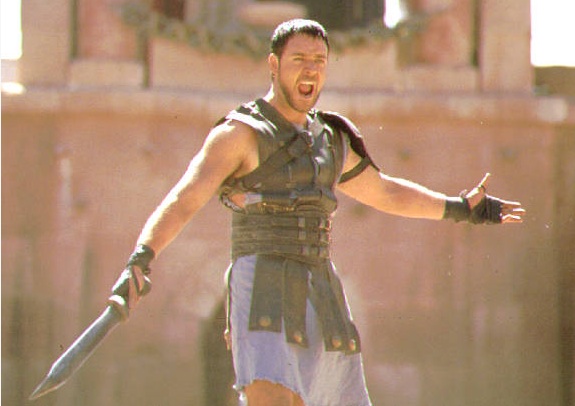
There’s a reason men (and women) loved “Gladiator.” The main character Maximus Decimus Meridius is the epitome of manliness. Here are four lessons on manliness that we can learn from him.

He loved his family and was loyal to them

Maximus was a family man. He turned down the glory of being Emperor of Rome in order to embrace the warmth of familial love.

Marcus Aurelius: When was the last time you were home?
Maximus Decimus Meridius: Two years, two hundred and sixty-four days and this morning.

Although Maximus’ wife was brutally murdered, this did not dampen his devotion to her. Throughout the film a romantic tension exists between Maximus and the Emperor’s daughter. Yet Maximus stayed loyal to his dead wife and family and turned down her advances.

[Maximus looks at images of his wife and son]
Juba: Can they hear you?
Maximus Decimus Meridius: Who?
Juba: Your family. In the afterlife.
Maximus Decimus Meridius: Oh yes.
Juba:What do you say to them?
Maximus Decimus Meridius: To my son — I tell him I will see him again soon. To keep his heels down while riding his horse. To my wife… that is not your business.

He loved his country

Before Maximus became a gladiator, he was a loyal general in the Roman army. His men respected and honored him greatly.

When Rome falls into corrupted hands, he did not give up on his country. Loyally striving to fulfill the dying emperor’s wish for Roman rule to be restored to the people and the Senate, Maximus toils and sacrifices until the Republic is restored.

He could kick anyone’s ass, yet remained honorable.

“Gladiator” is known for its amazing fight scenes. In every battle, whether in war or in the arena, Maximus always defeated his opponent with a combination of brute force and strategy. He was able to ignore pain to get the job done. He never gave in to fear. Instead, he exuded an a quiet confidence that unnerved his opponents. He never doubted his ability to win.

Maximus: At my signal, unleash hell.

While Maximus excelled at the martial arts, he did not revel in bloodshed. He only fought when he needed to and in the service of a worthy cause.

He was in tune with spirituality

Maximus Decimus Meridius: What we do in life, echoes in eternity.

Maximus devoted time to his spiritual life. He prayed to his gods. He had no doubt that his wife and son were waiting for him in the afterlife. Before each battle, Maximus would reach down and run dirt through his hands. It was as if he was asking the gods to be with him during the battle.

Maximus Decimus Meridius: Ancestors, I ask you for your guidance. Blessed mother, come to me with the Gods’ desire for my future. Blessed father, watch over my wife and son with a ready sword. Whisper to them that I live only to hold them again, for all else is dust and air. Ancestors, I honor you and will try to live with the dignity that you have taught me.


{ 19 comments… read them below or add one }

1 Jason February 13, 2008 at 2:40 pm

I agree… I loved Maximus. I also like Leonidas from 300… not quite the same story, but both had honor woven into the very core of their beings.

2 James Chartrand - Men with Pens February 14, 2008 at 8:37 am

First time on the site and I clicked on this one with a silent chuckle running through my mind.

However, what I find isn’t something that makes me chuckle. This portrayal of values taken from the movie’s example has made me think rather deeply and suddenly about my own values. Perhaps it’s foolish to strive to be so strongly loyal or so deeply firm in devotion, but after reading this, I suddenly find myself wishing I was like Maximus.

Thank you. When content makes me think, it is worthy of my time and that of others.

3 Milo Warby February 16, 2008 at 6:04 am

A good lesson in manliness!

but isn’t maximus spanish not roman??

4 Mercer February 17, 2008 at 4:16 am

Maximus isnt Spanish, someone just dubbs him Spaniard and he never bothers to corrects them as he is past caring

5 Greg February 21, 2008 at 12:11 pm

Definitely agree with this post, Maximus was an awesome character.

@Jason: Leonidas vs. Maximus in a fight. Who would win? Discuss……

6 John Buchan March 15, 2008 at 7:57 am

mercer, he is spanish!!! imbd: Was born in the province of Baetica in Hispania in AD 152. He was the son of Meridius, the governor of the province, and of Lucretia, the daughter of the Roman Senator Bodaus.

hispanic? ring any bells – he’s spanish-roman

7 Kyle Lassiter March 19, 2008 at 9:36 pm

He may have been invoking the gods by running dirt through his hands, but I would suggest he was also offsetting the effects of sweat and body oils to keep his weapon from slipping in his hands.

Minor point of thought though, good article and good insight. Kyle

8 Mark May 4, 2008 at 8:50 pm

@ James

“Perhaps it’s foolish to strive to be so strongly loyal or so deeply firm in devotion, but after reading this, I suddenly find myself wishing I was like Maximus.”

This made me think. My gut instinct tells me we all would want to pull off upholding these values. However, some may start saying that restricting oneself through these values is just foolish. I propose that it’s mere weakness due to our fear of failure that has anyone denounce these values as foolish. I know the only reason I’d not want to work to uphold these values is because I am afraid of my imperfect humanity, my incomplete manliness, showing itself by letting me down through occasional failure.

9 chum July 14, 2008 at 12:56 am

Maximus was Spanish. He even says his home was in the hills above Trujillo, which is in Spain.

Even Marcus Aurelius was half-Spanish

10 Matthew Holzapfel October 3, 2008 at 7:54 pm

Maximus rubbed dirt on his hands and smelled the dirt because he was a farmer. Farmers are always evaluating the soil, you can be talking to them and they subconsciencely will pick up a handful of dirt, rub it and smell it. Farmers know the smell and feel of rich, fertile soil.

Maximus’ dreams were dreams of running his hands through the harvest of wheat at his wonderful farm.

Maximus was a warrior – but first he was a farmer. He loved the soil and what it could produce. Watch the movie with this in mind. You will see it pop up in all sorts of places.

11 Feli October 5, 2008 at 12:11 am

1. At the time “Spain” refers to the geographic area of the Spanish peninsula, a part of the Roman empire. The territory was probably first called that by Fenician sailors who discovered it (Fenician language was very similar to the ancient Arameic/Hebrew – “Eee Shfaniya”(The island of the rabbits – which were most probably Hyraxes and not rabbits) turned into “E-Spania”, Spain.

2.@Greg: “Leonidas vs. Maximus in a fight. Who would win?”.
Maximus as an individual was turned into what he was by education, decission and circumstances. Leonidas was turned into what it was not only as an individual – his whole people was educated into the same codes. As a fine exemplar and king, Leonidas excelled in the qualities for which he was bred. I personally disliked the sparkle of madness in his eyes, but most probably all heros disregarding their own physical pain and life were at least a little bit mad. By Hollywood’s craft Maximus’s sparkle was dilluted so we could have a more sane and honorable character on screen.

12 Eric October 21, 2008 at 8:24 am

After watching the movie for the first time on a very large screen, I was amazed at how Crowe personified the pinnacle of the male persona. My very first thought was that there are very few men like that in these times we live in and therein lies a huge problem. If men of today were to ascribe to these moralistic standards the world would be a MUCH different place.

I strive every day to love my children and be faithful to them. My ex-wife was not to me ( that is a different story ) but I at least show my wonderful kids that I am their father and will never give up on them.

The only thing I have is an insecurity of myself in a fight. I need to train myself to never ever doubt myself and not to give in to the fear of just “running away to fight another day” ( thank you Jack Sparrow ).

Great article and I will have this posted on my wall for review every day.

13 sebendebi November 13, 2008 at 5:57 am

the best movie…
that all i can say..
=D

14 Shannon January 6, 2009 at 8:40 am

Wonderful article. And a great analysis of the charachter. This same theme of true virtuous manly behavior has been used in all of my favorite movies. Men struggling against unbelievable odds, with pain and suffering tempering their actions, and honor and belief guiding them daily. Several of the best westerns, as well as movies like The Patriot, and to an extent, Braveheart, hold up the same ideals.
I think that several have touched on the point of Maximus grabbing a handful of dirt before battle. I think everyone was correct, and I had never looked at it from the agricultural perspective before. It was a ritualistic motion, with practical overlays, as well as spiritual. All warriors have these rituals, and given the time and opportunity, will consistently use them. Paratroopers before a jump, soldiers and swat officers before a raid, fighters before they enter the ring, even jockeys before a race. This is a human response to a challenge, and when that challenge is repetitive, eventually the preparation will be also.
The ideals are difficult to reach, but that just makes them so much more worthy of our effort to try.

15 Alex April 20, 2009 at 2:53 pm

Maximus was probably from the Roman province of Spain. From what I remember that was showcased through his armour somehow. He never lived in the city of Rome, but belonged to the Roman Empire. The Romans pretty much owned everything in present Europe.

16 Christoph Dollis July 13, 2009 at 1:28 pm

So in other words, he was a Stoic, as was Marcus Aurelius and Aurelius’ mentors, such as Epictetus, Musonius Rufus, and Lucius Annaeus Seneca.

17 Frank Perri August 9, 2009 at 7:15 am

>>he did not revel in bloodshed. He only fought when he needed to

As personified by that great line, when Quintas mocks Maximus finishing his service and returning home to farm,

“Dirt washes off easier then blood, Quintas.”

Great line, it puts everything in perspective.

18 Bela November 23, 2009 at 2:18 am

In regards to his devotion to Rome, there is a line that stands out to me.

Maximus: Five thousand of my men are out there in the freezing mud. Three thousand of them are bloodied and cleaved. Two thousand will never leave this place. I will not believe that they fought and died for nothing.
Marcus Aurelius: And what would you believe?
Maximus: They fought for you and for Rome.
Marcus Aurelius: And what is Rome, Maximus?
Maximus: I’ve seen much of the rest of the world. It is brutal and cruel and dark, Rome is the light.
Marcus Aurelius: Yet you have never been there.

Having never been to the capital, yet he speaks of his country as though it were everything.

19 SGT William Ferguson March 12, 2010 at 4:00 pm

Great article. This remains my favorite movie because of its moral and spiritual message as well as “ass kickery.” While I liked the fighting and battle scenes, Maximus’ refusal to give up and his resolve to continue to fight for a higher cause still stirs me every time I watch it. Of course movie critics sneered at the message but that’s their loss; when have they ever been right about a movie?

“300″ is a close second but the ending of “Gladiator” where Maximus finally reunites with his family and his buddy optimistically says he will see him again (…”but not yet, not yet.”) made all the difference. This reinforces the hope that I and my fellow warriors have that no matter how we may fall in this world, we will see things turn out right on the other side.

Leave a Comment

Previous post:

Next post: